How the news media can keep
p. 14 · Read in the full issue
their noses clean in PNG
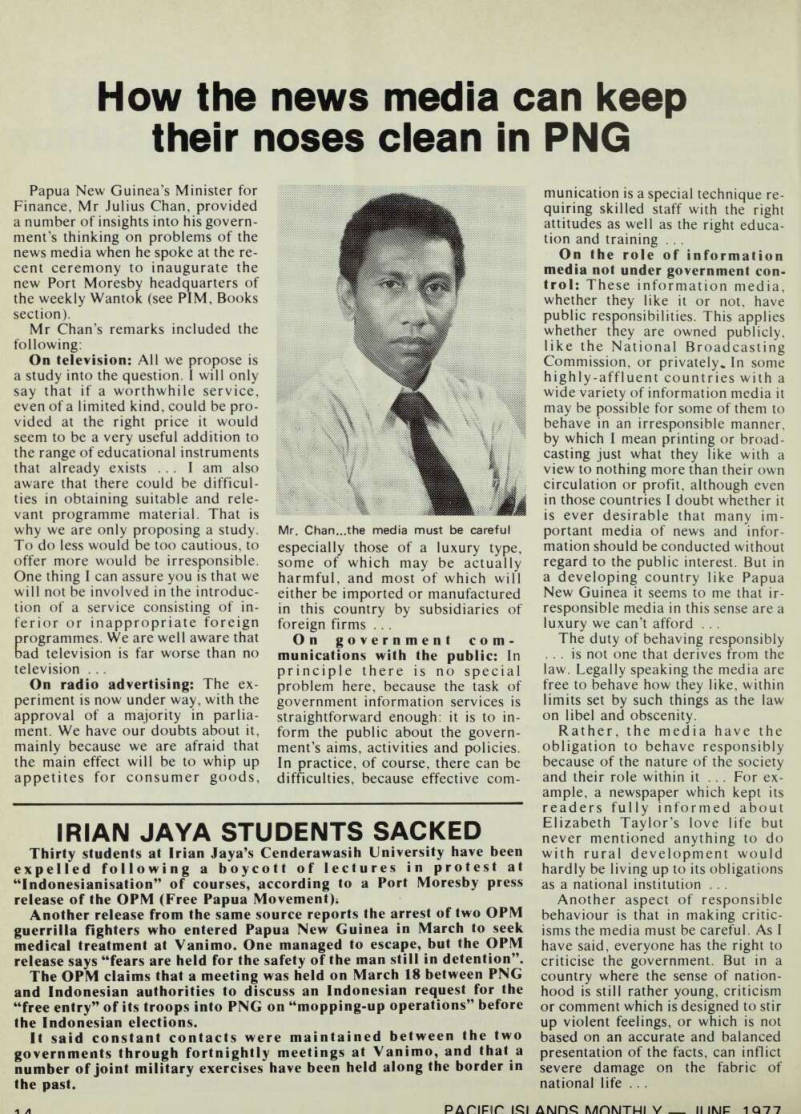
Papua New Guinea’s Minister for Finance, Mr Julius Chan, provided a number of insights into his govern ment’s thinking on problems of the news media when he spoke at the re cent ceremony to inaugurate the new Port Moresby headquarters of the weekly Wantok (see PIM, Books section).
Mr Chan’s remarks included the following; On television: All we propose is a study into the question. I will only say that if a worthwhile service, even of a limited kind, could be pro vided at the right price it would seem to be a very useful addition to the range of educational instruments that already exists ... I am also aware that there could be difficul ties in obtaining suitable and rele vant programme material. That is why we are only proposing a study.
To do less would be too cautious, to offer more would be irresponsible.
One thing I can assure you is that we will not be involved in the introduc tion of a service consisting of in ferior or inappropriate foreign programmes. We are well aware that oad television is far worse than no television . . .
On radio advertising: The ex periment is now under way, with the approval of a majority in parlia ment. We have our doubts about it, mainly because we are afraid that the main effect will be to whip up appetites for consumer goods,
especially those of a luxury type, some of which may be actually harmful, and most of which will either be imported or manufactured in this country by subsidiaries of foreign firms . . .
On government com munications with the public: In principle there is no special problem here, because the task of government information services is straightforward enough: it is to in form the public about the govern ment’s aims, activities and policies.
In practice, of course, there can be difficulties, because effective com
munication is a special technique re quiring skilled staff with the right attitudes as well as the right educa tion and training ...
On the role of information media not under government con trol: These information media, whether they like it or not, have public responsibilities. This applies whether they are owned publicly, like the National Broadcasting Commission, or privately,. In some highly-affluent countries with a wide variety of information media it may be possible for some of them to behave in an irresponsible manner, by which I mean printing or broad casting just what they like with a view to nothing more than their own circulation or profit, although even in those countries I doubt whether it is ever desirable that many im portant media of news and infor mation should be conducted without regard to the public interest. But in a developing country like Papua New Guinea it seems to me that ir responsible media in this sense are a luxury we can’t afford ...
The duty of behaving responsibly ... is not one that derives from the law. Legally speaking the media are free to behave how they like, within limits set by such things as the law on libel and obscenity.
Rather, the media have the obligation to behave responsibly because of the nature of the society and their role within it .. . For ex ample, a newspaper which kept its readers fully informed about Elizabeth Taylor’s love life but never mentioned anything to do with rural development would hardly be living up to its obligations as a national institution . . .
Another aspect of responsible behaviour is that in making critic isms the media must be careful. As I have said, everyone has the right to criticise the government. But in a country where the sense of nation hood is still rather young, criticism or comment which is designed to stir up violent feelings, or which is not based on an accurate and balanced presentation of the facts, can inflict severe damage on the fabric of national life ...
Mr. Chan...the media must be careful