with independence in sight?
How’re things in the Solomons with independence in sight?
Independence simply meant
transferring power and re sponsibility from the British Government to Solomon Islanders it did not mean that individuals would immediately get personal benefits.
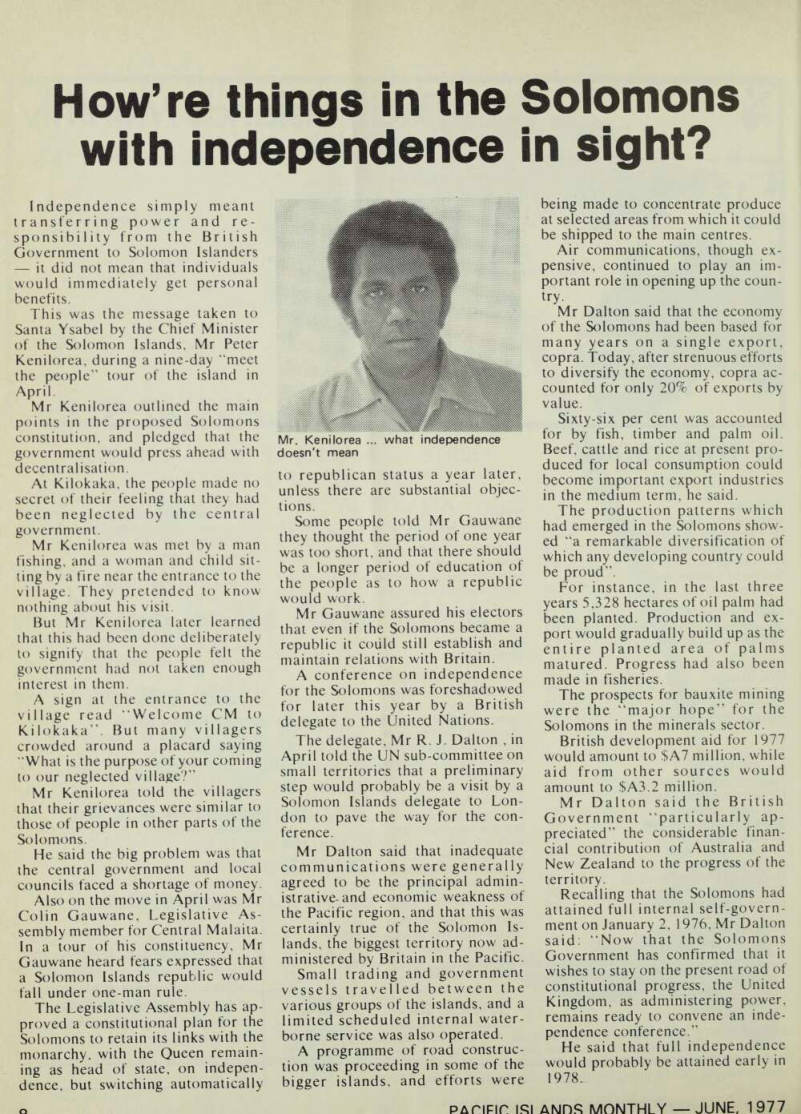
This was the message taken to Santa Ysabel by the Chief Minister of the Solomon Islands, Mr Peter Kenilorea, during a nine-day “meet the people” tour of the island in
April.
Mr Kenilorea outlined the main points in the proposed Solomons constitution, and pledged that the government would press ahead with decentralisation.
At Kilokaka, the people made no secret of their feeling that they had been neglected by the central government.
Mr Kenilorea was met by a man fishing, and a woman and child sit ting by a fire near the entrance to the village. They pretended to know nothing about his visit.
But Mr Kenilorea later learned that this had been done deliberately to signify that the people felt the government had not taken enough interest in them.
A sign at the entrance to the village read “Welcome CM to Kilokaka". But many villagers crowded around a placard saying “What is the purpose of your coming to our neglected village?”
Mr Kenilorea told the villagers that their grievances were similar to those of people in other parts of the Solomons.
He said the big problem was that the central government and local councils faced a shortage of money.
Also on the move in April was Mr Colin Gauwane, Legislative As sembly member for Central Malaita.
In a tour of his constituency, Mr Gauwane heard fears expressed that a Solomon Islands republic would fall under one-man rule.
The Legislative Assembly has ap proved a constitutional plan for the Solomons to retain its links with the monarchy, with the Queen remain ing as head of state, on indepen dence, but switching automatically
to republican status a year later, unless there are substantial objec tions.
Some people told Mr Gauwane they thought the period of one year was too short, and that there should be a longer period of education of the people as to how a republic would work.
Mr Gauwane assured his electors that even if the Solomons became a republic it could still establish and maintain relations with Britain.
A conference on independence for the Solomons was foreshadowed for later this year by a British delegate to the United Nations.
The delegate, Mr R. J. Dalton , in April told the UN sub-committee on small territories that a preliminary step would probably be a visit by a Solomon Islands delegate to Lon don to pave the way for the con ference.
Mr Dalton said that inadequate communications were generally agreed to be the principal admin istrative-and economic weakness of the Pacific region, and that this was certainly true of the Solomon Is lands, the biggest territory now ad ministered by Britain in the Pacific.
Small trading and government vessels travelled between the various groups of the islands, and a limited scheduled internal water borne service was also operated.
A programme of road construc tion was proceeding in some of the bigger islands, and efforts were
being made to concentrate produce at selected areas from which it could be shipped to the main centres.
Air communications, though ex pensive, continued to play an im portant role in opening up the coun try.
Mr Dalton said that the economy of the Solomons had been based for many years on a single export, copra. Today, after strenuous efforts to diversify the economy, copra ac counted for only 20% of exports by value.
Sixty-six per cent was accounted for by fish, timber and palm oil.
Beef, cattle and rice at present pro duced for local consumption could become important export industries in the medium term, he said.
The production patterns which had emerged in the Solomons show ed “a remarkable diversification of which any developing country could be proud”.
For instance, in the last three years 5,328 hectares of oil palm had been planted. Production and ex port would gradually build up as the entire planted area of palms matured. Progress had also been made in fisheries.
The prospects for bauxite mining were the “major hope” for the Solomons in the minerals sector.
British development aid for 1977 would amount to SA7 million, while aid from other sources would amount to $A3.2 million.
Mr Dalton said the British Government “particularly ap preciated” the considerable finan cial contribution of Australia and New Zealand to the progress of the territory.
Recalling that the Solomons had attained full internal self-govern ment on January 2, 1976, Mr Dalton said; “Now that the Solomons Government has confirmed that it wishes to stay on the present road of constitutional progress, the United Kingdom, as administering power, remains ready to convene an inde pendence conference.”
He said that full independence would probably be attained early in 1978.
Mr. Kenilorea... what independence doesn't mean