Up Front
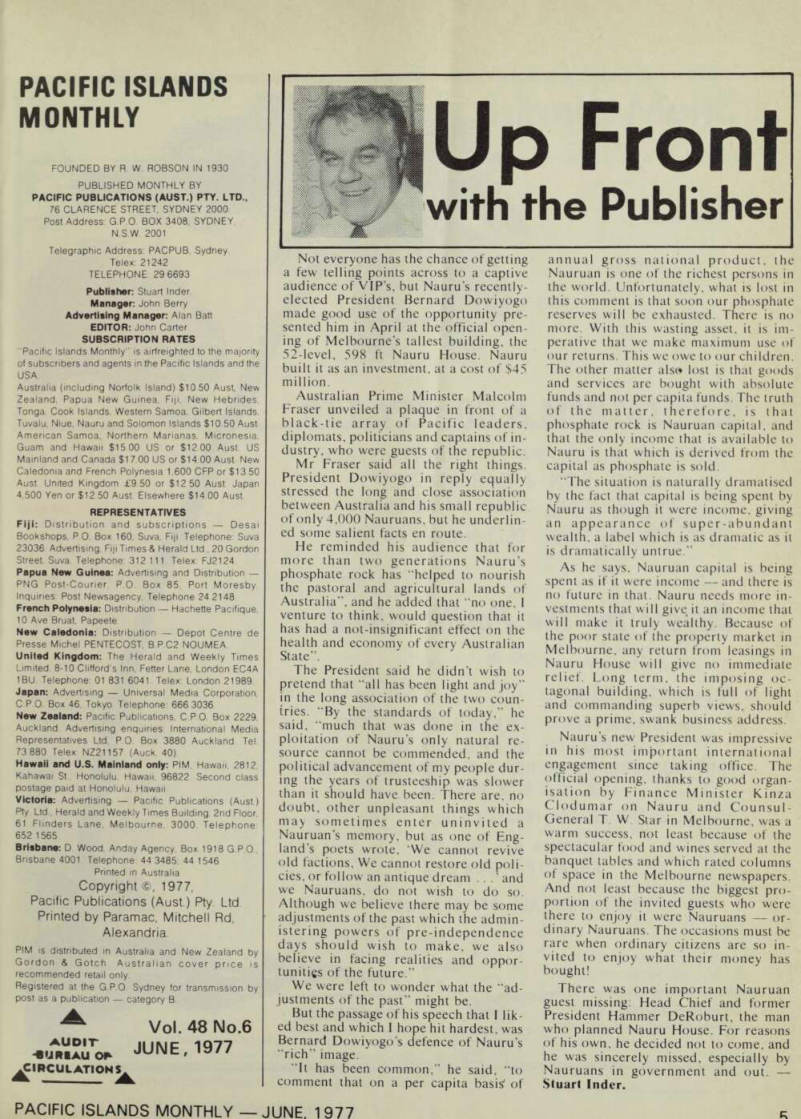
with the Publisher
Not everyone has the chance of getting a few telling points across to a captive audience of VlP's, but Nauru’s recently elected President Bernard Dowiyogo made good use of the opportunity pre sented him in April at the official open ing of Melbourne’s tallest building, the 52-level, 598 ft Nauru House. Nauru built it as an investment, at a cost of $45 million.
Australian Prime Minister Malcolm Fraser unveiled a plaque in front of a black-tie array of Pacific leaders, diplomats, politicians and captains of in dustry, who were guests of the republic.
Mr Fraser said all the right things.
President Dowiyogo in reply equally
stressed the long and close association between Australia and his small republic of only 4,000 Nauruans, but he underlin ed some salient facts en route.
He reminded his audience that for more than two generations Nauru’s phosphate rock has “helped to nourish the pastoral and agricultural lands of Australia”, and he added that “no one, I venture to think, would question that it has had a not-insignificant effect on the health and economy of every Australian State”.
The President said he didn’t wish to pretend that “all has been light and joy” in the long association of the two coun tries. "By the standards of today,” he said, “much that was done in the ex ploitation of Nauru’s only natural re source cannot be commended, and the political advancement of my people dur ing the years of trusteeship was slower than it should have been. There are. no doubt, other unpleasant things which may sometimes enter uninvited a Nauruan’s memory, but as one of Eng land’s poets wrote, 'We cannot revive old factions. We cannot restore old poli cies, or follow an antique dream . . . ’ and we Nauruans, do not wish to do so.
Although we believe there may be some adjustments of the past which the admin
istering powers of pre-independence
days should wish to make, we also believe in facing realities and oppor tunities of the future.”
We were left to wonder what the “ad justments of the past” might be.
But the passage of his speech that I lik ed best and which I hope hit hardest, was Bernard Dowiyogo’s defence of Nauru’s
“rich” image.
“It has been common,” he said, “to comment that on a per capita basis 1 of
annual gross national product, the Nauruan is one of the richest persons in the world. Unfortunately, what is lost in this comment is that soon our phosphate reserves will be exhausted. There is no more. With this wasting asset, it is im perative that we make maximum use of our returns. This we owe to our children.
The other matter also lost is that goods and services are bought with absolute funds and not per capita funds. The truth of the matter, therefore, is that phosphate rock is Nauruan capital, and that the only income that is available to Nauru is that which is derived from the capital as phosphate is sold.
"The situation is naturally dramatised by the fact that capital is being spent by Nauru as though it were income, giving an appearance of super-abundant wealth, a label which is as dramatic as it is dramatically untrue.”
As he says, Nauruan capital is being spent as if it were income and there is no future in that. Nauru needs more in vestments that will give it an income that will make it truly wealthy. Because of the poor state of the property market in Melbourne, any return from leasings in Nauru House will give no immediate relief. Long term, the imposing oc tagonal building, which is full of light and commanding superb views, should prove a prime, swank business address.
Nauru's new President was impressive in his most important international engagement since taking office. The official opening, thanks to good organ isation by Finance Minister Kinza Clodumar on Nauru and Counsul- General T, W Star in Melbourne, was a warm success, not least because of the spectacular food and wines served at the banquet tables and which rated columns of space in the Melbourne newspapers.
And not least because the biggest pro portion of the invited guests who were there to enjoy it were Nauruans or dinary Nauruans. The occasions must be rare when ordinary citizens are so in vited to enjoy what their money has
bought!
There was one important Nauruan guest missing; Head Chief and former President Hammer Deßoburt, the man who planned Nauru House. For reasons of his own, he decided not to come, and
he was sincerely missed, especially by
Nauruans in government and out.
Stuart Inder.