Pacific Transport
pp. 81-85 · Read in the full issue
Australian dollars for the Pacific Forum Line
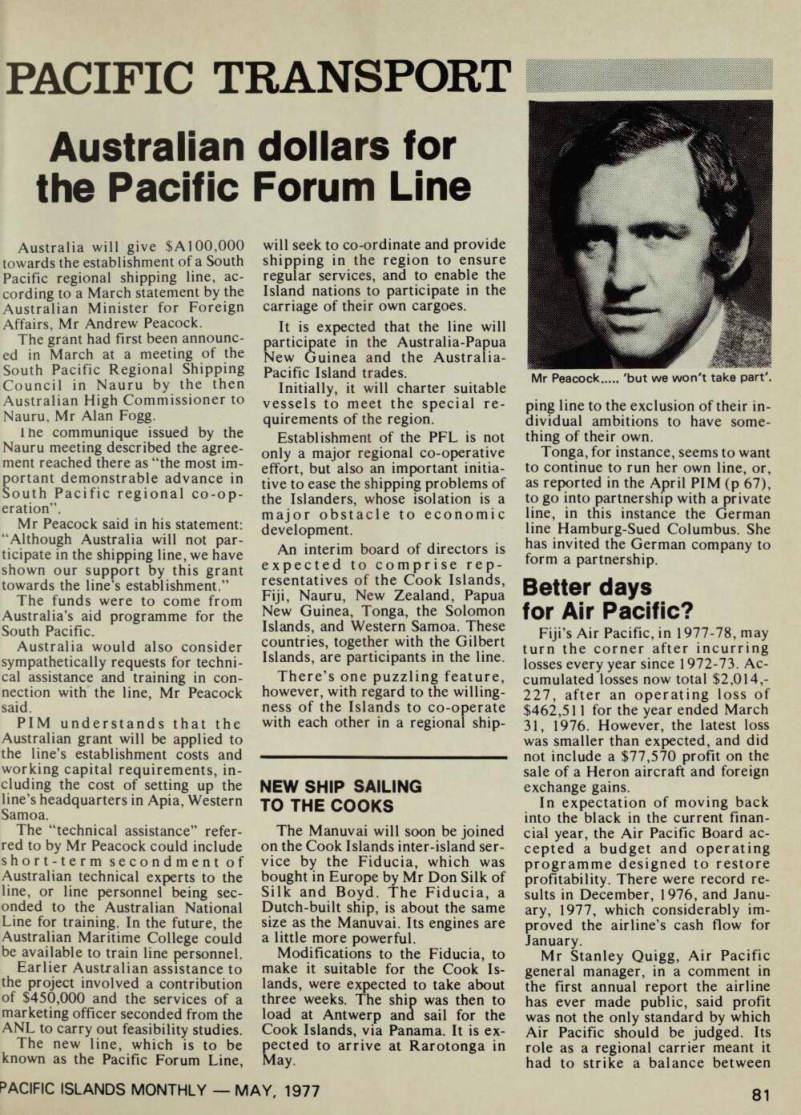
Australia will give SAIOO,OOO towards the establishment of a South Pacific regional shipping line, ac cording to a March statement by the Australian Minister for Foreign Affairs, Mr Andrew Peacock.
The grant had first been announc ed in March at a meeting of the South Pacific Regional Shipping Council in Nauru by the then Australian High Commissioner to Nauru, Mr Alan Fogg. me communique issued by the Nauru meeting described the agree ment reached there as “the most im portant demonstrable advance in South Pacific regional co-op eration”.
Mr Peacock said in his statement: “Although Australia will not par ticipate in the shipping line, we have shown our support by this grant towards the line’s establishment.”
The funds were to come from Australia’s aid programme for the South Pacific, Australia would also consider sympathetically requests for techni cal assistance and training in con nection with the line, Mr Peacock said.
PIM understands that the Australian grant will be applied to the line’s establishment costs and working capital requirements, in cluding the cost of setting up the line’s headquarters in Apia, Western Samoa.
The “technical assistance” refer red to by Mr Peacock could include short-term secondment of Australian technical experts to the line, or line personnel being sec onded to the Australian National Line for training. In the future, the Australian Maritime College could be available to train line personnel.
Earlier Australian assistance to the project involved a contribution of $450,000 and the services of a marketing officer seconded from the ANL to carry out feasibility studies.
The new line, which is to be known as the Pacific Forum Line,
will seek to co-ordinate and provide shipping in the region to ensure regular services, and to enable the Island nations to participate in the carriage of their own cargoes.
It is expected that the line will participate in the Australia-Papua New Guinea and the Australia- Pacific Island trades.
Initially, it will charter suitable vessels to meet the special re quirements of the region.
Establishment of the PFL is not only a major regional co-operative effort, but also an important initia tive to ease the shipping problems of the Islanders, whose isolation is a major obstacle to economic development.
An interim board of directors is expected to comprise rep resentatives of the Cook Islands, Fiji, Nauru, New Zealand, Papua New Guinea, Tonga, the Solomon Islands, and Western Samoa. These countries, together with the Gilbert Islands, are participants in the line.
There’s one puzzling feature, however, with regard to the willing ness of the Islands to co-operate with each other in a regional ship-
New Ship Sailing
To The Cooks
The Manuvai will soon be joined on the Cook Islands inter-island ser vice by the Fiducia, which was bought in Europe by Mr Don Silk of Silk and Boyd. The Fiducia, a Dutch-built ship, is about the same size as the Manuvai. Its engines are a little more powerful.
Modifications to the Fiducia, to make it suitable for the Cook Is lands, were expected to take about three weeks. The ship was then to load at Antwerp and sail for the Cook Islands, via Panama. It is ex pected to arrive at Rarotonga in May.
ping line to the exclusion of their in dividual ambitions to have some thing of their own.
Tonga, for instance, seems to want to continue to run her own line, or, as reported in the April PIM (p 67), to go into partnership with a private line, in this instance the German line Hamburg-Sued Columbus. She has invited the German company to form a partnership.
Better days
for Air Pacific?
Fiji’s Air Pacific, in 1977-78, may turn the corner after incurring losses every year since 1972-73. Ac cumulated losses now total $2,014,- 227, after an operating loss of $462,511 for the year ended March 31, 1976. However, the latest loss was smaller than expected, and did not include a $77,570 profit on the sale of a Heron aircraft and foreign exchange gains.
In expectation of moving back into the black in the current finan cial year, the Air Pacific Board ac cepted a budget and operating programme designed to restore profitability. There were record re sults in December, 1976, and Janu ary, 1977, which considerably im proved the airline’s cash flow for January.
Mr Stanley Quigg, Air Pacific general manager, in a comment in the first annual report the airline has ever made public, said profit was not the only standard by which Air Pacific should be judged. Its role as a regional carrier meant it had to strike a balance between
Mr Peacock 'but we won't take part'.
being run as a business and being run as a service to Pacific Islands travellers.
Within those guidelines the com pany had operated efficiently and had become an important con tributor to the region’s economy.
Air Pacific’s revenue for the year ended March 31, 1976, was $ll,- 063,655, 22% higher than the pre vious year, while costs at $11,526,- 116 were 18.7% higher. The num ber of passengers carried was 259,- 676, compared with 264,658 the previous year. Traffic on internal services fell from 204,000 to 192,- 000, mainly because of a drop in the number of tourists.
The airline is now running more services to Australia and New Zea land. In an effort to create a purely Air Pacific marketing identity in Queensland, and to preserve its identity in Fiji, Pacific Island Air Services is taking over ticket sales, promotions and other work in Brisbane, and Air Pacific is taking over its own reservations facilities from Qantas at Nadi Airport.
Air Pacific is now the only op erator on the Nadi-Brisbane route.
Late in March it took over the Qan tas share of the route and is now fly ing to Brisbane six times a week.
Previously there were five flights.
On southbound flights, which do not include Vila and Honiara, the aircraft will make technical stops in New Caledonia to take on extra fuel because of prevailing headwinds.
Boats Name
Is A Date
A new boat for the members of the Free Wesleyan Church of Tatakamotonga village in Tonga has been named 1797. But the name is significant as King Taufa’ahau Tupou explained when he com missioned the boat. In 1797 Chris tianity was introduced to Tonga by the first missionaries, Walter Lawry and John Thomas, from the London Missionary Society, who landed at Tatakamotonga.
The people raised the money, $A16,428 to buy 1797. The Free Wesleyan Church minister at Tatakamotonga, Mr Sione Alo Fakahua, said the idea was to raise funds on a charter basis. That had been suggested to them by the king.
Money raised from charter work
ing. One of the first requests for a charter was from the Dateline Hotel.
Nauru Opens
Its Shop In Suva
Nauru has opened an air and ship ping agency in Suva to handle the business of Air Nauru and Nauru Pacific Line. The agency will employ a staff of six and will cost $70,000 a year to run.
The former President of Nauru, Mr Hammer Deßoburt, headed the Nauru delegation which went to Suva for the official opening of the agency, which is in Ratu Sukuna House. He said the agency would promote economic development and closer ties between Nauru and Fiji.
Ratu Julian Toganivalu, execu tive officer of the Nauru Local Government, said the agency would take over work previously handled by Rabi Holdings and Air Pacific.
He said Air Nauru planned a new service and fare structure designed to attract international travellers from Hong Kong to Fiji. In ex panding its network in the Central Pacific it offered prospects of a direct route from Hong Kong, Manila, Kagoshima and Okinawa to Fiji.
The proposed fare structure could save people travelling to Europe from Fiji, via Nauru and Hong Kong, about $4OO. Air Nauru hoped to increase the frequency of its flights to Fiji from the current one a
week but that depended on whether Nauru was granted further rights. • Nauru Pacific Line, which op erates a regular cargo service cover ing the US west coast, Hawaii and Micronesia, intends to increase the westbound freight rate on May 24.
The increase is 10% , except for rice, flour and poultry foods. Those rates will remain unchanged. The rates for lumber to Majuro. Ponape, Truk and Saipan will rise by 20% . The rates for plywood to all ports will be increased by 15%, for liquor and spirits the rise will be 25%, unless otherwise specified.
Down To Earth
On An Airstrip
Sir Albert Henry, Premier of the Cook Islands, made political pro paganda out of an interim airstrip on the island of Atiu. Announcing that he intended to fly to the island to officially open the airstrip, he said his action was fulfilment of the first stage of an economic program me his government planned about 10 years ago.
He said there were certain people always quick to criticise an idea, especially if they belonged to the Opposition Party. It had been said many times in reference to the airstrip programme it was “another of Albert Henry’s wild dreams”.
Well, the first airstrip had been laid and what was important it was laid at the right time.
There was wild excitement on
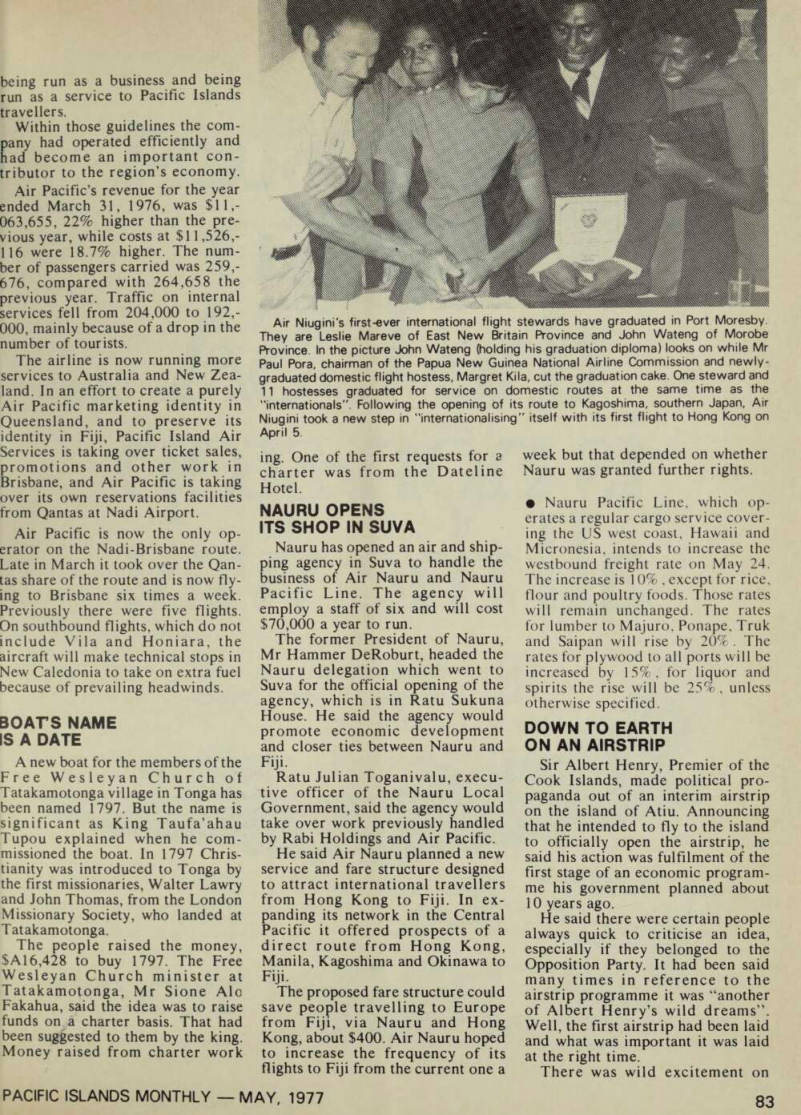
Air Niugini's first-ever international flight stewards have graduated in Port Moresby.
They are Leslie Mareve of East New Britain Province and John Wateng of Morobe Province. In the picture John Wateng (holding his graduation diploma) looks on while Mr Paul Pora, chairman of the Papua New Guinea National Airline Commission and newly graduated domestic flight hostess, Margret Kila, cut the graduation cake. One steward and 11 hostesses graduated for service on domestic routes at the same time as the "internationals”. Following the opening of its route to Kagoshima, southern Japan, Air Niugini took a new step in "internationalising” itself with its first flight to Hong Kong on April 5.
Atiu for the occasion, and Sir Albert declared a public holiday for all government workers and schools.
There will be Rarotonga-Atiu return services on Tuesdays and Fridays.
To show it meant business, the Cl Government sent a development and planning committee to Mauke and Mitiaro soon after the opening of Atiu to survey airstrip sites, assess construction costs and complete for malities for taking over the required land.
Sir Albert expected to become directly involved in the next stage of the programme by heading a development and planning team in vestigating the possibility of laying an airstrip on Mangaia.
Daiwa Ro-Ro
Ship For Fiji
The South Pacific will get another container service in June when the Daiwa Line, of Japan, sends a new roll on/roll off (ro-ro) ship, the Fiji Maru, 15,240 tonnes, to Suva on its maiden voyage. The Fiji Maru is a multi-purpose carrier, designed and built to carry motor vehicles, con tainers, general cargo, heavy cargo and bulk cargo.
She has two side ramps for the ve hicles to be driven to the car decks.
A pair of 51 tonne and 41 tonne electrohydraulic twin deck cranes are on the upper deck to handle con tainers and heavy cargo. There is other sophisticated equipment to help speed up handling of cargo.
The Fiji Maru will have a maxi mum speed of 18.7 knots, and a cruising range of about 22,000 kilometres. She will run a monthly service from Japan to Papeete, Pago Pago, Apia, Fiji, Noumea, Sydney and Honiara.
Daiwa Line operates a similar ship, the Ponape Maru, from Japan to Guam and Taiwan.
Ustt Cold Shoulder
For Freezer Shippers
Bureaucracy in the US Trust Ter ritory has foiled a plan by Refrige rated Express Lines to open a ship ping service from Australia to TT ports with the Lae Express. As a re sult, about 1,500 tonnes of cargo is waiting in Australia for 50 to 60 days till it can be shipped by a Daiwa Line service.
REL several weeks ago applied to the TT Director of Transportation
for a regular or continuing entry permit. After much prodding from REL, the director finally replied, refusing the permit.
“We were told we would not re ceive an entry permit and that we should look elsewhere for an area other than Micronesia,” Mr S. Mc- Callum, managing director of REL, said to PIM.
REL then asked for a single entry permit because of pressure from shippers to get cargo away. On March 31, the shipping line re ceived a telex message from the Director of Transportation refusing such a permit.
The TT decision will have a serious affect on Australia’s export trade with Micronesia. Australia was starting to regain, through the 1976 devaluation, trade it had been losing steadily to other countries • The British Government has given $114,000 in aid to the Solomons to construct airfields on Lord Howe (Ontong Java), Lol Lorn in the Reef Islands and Santa Anna, off San Cristoval. The Legislative Council, in January, 1976, gave ap proval to lay the airfields. • Mr C. B. Grey, general manager of Air Niugini, has been appointed a member of the National Airline Commission, along with Mr A. J.
Yates. They replace Mr R. J. Yates, Qantas, and Mr R. E. Bailey,TAA. Mr J. W. Reillyisalternatememberfor Mr Grey and Mr F. Pascoe is alternate for Mr Yates.
Us Navy To Build
Wharf On Yap
The United States Navy plans to build a new wharf, with associated installations on the north side of Colonia Peninsula, near the District Legislature building on Yap Island.
It will replace the existing port area on the south side of the peninsula, close to the centre of the town. This port is in disrepair and is now inade quate Plans for the new dock include possible future expansion of port facilities. First of all, an area of about 18,500 square metres will be reclaimed from the edge of the pre sent short-line out to the edge of the existing deep channel to the north of the peninsula. Coral, coral heads and coral sand dredged from nearby shoal areas will be used to fill this area.
The dock will include a single 137 metre berth with an open storage area for containers and bulk cargo, buildings and utilities. Build ings will include a transit shed/warehouse, offices, a small gatehouse and a transformer station.
But before the project gets under way, the US Army Corps of Engineers will make a study aimed a protecting the public interest in navigable waters, and other matters of public concern, including the en vironment, and social and economic impact. This study will be con sidered by the authorities before ap proval, or otherwise, is given for the project to go ahead.