Purari River power
pp. 71-72 · Read in the full issue

PNG wants customers for its Purari River power
From GUS SMALES in Port Moresby
“Won’t someone please offer to buy our electricity?” appears to be the plea from Papua New Guinea in a joint statement issued in Port Moresby and Canberra in mid- March.
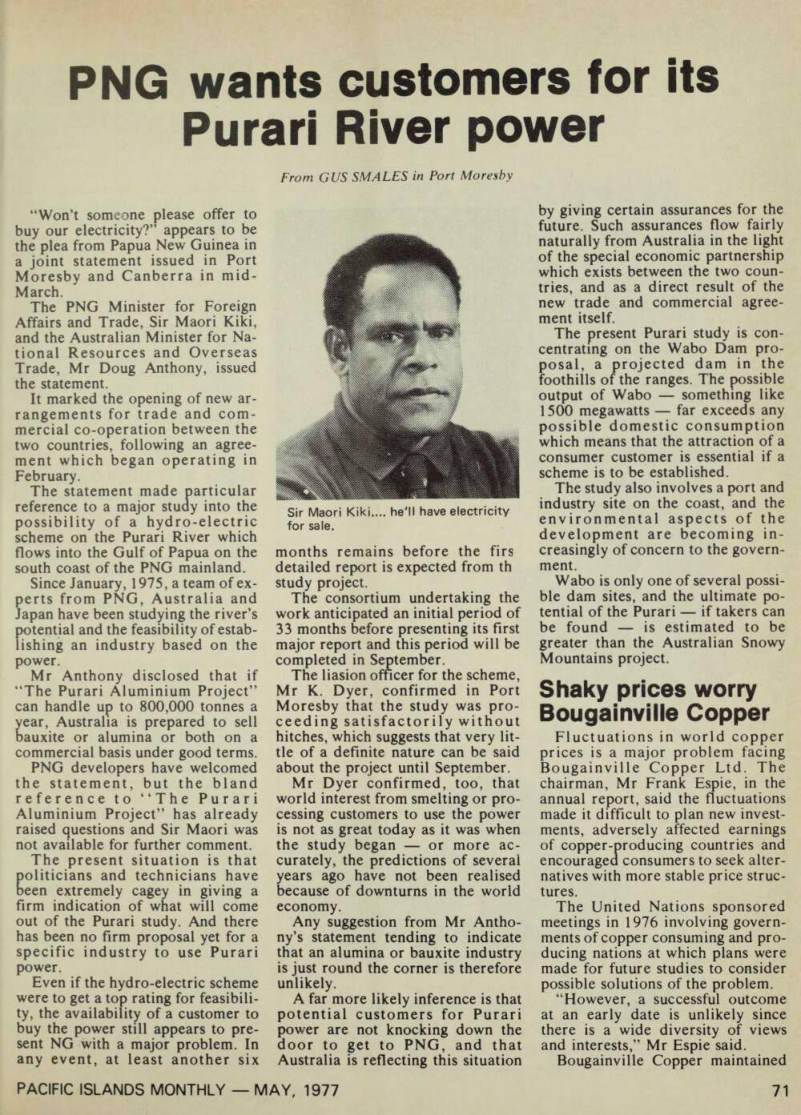
The PNG Minister for Foreign Affairs and Trade, Sir Maori Kiki, and the Australian Minister for Na tional Resources and Overseas Trade, Mr Doug Anthony, issued the statement.
It marked the opening of new ar rangements for trade and com mercial co-operation between the two countries, following an agree ment which began operating in February.
The statement made particular reference to a major study into the possibility of a hydro-electric scheme on the Purari River which flows into the Gulf of Papua on the south coast of the PNG mainland.
Since January, 1975, a team of ex perts from PNG, Australia and Japan have been studying the river’s potential and the feasibility of estab lishing an industry based on the power.
Mr Anthony disclosed that if “The Purari Aluminium Project” can handle up to 800,000 tonnes a year, Australia is prepared to sell bauxite or alumina or both on a commercial basis under good terms.
PNG developers have welcomed the statement, but the bland reference to “The Purari Aluminium Project” has already raised questions and Sir Maori was not available for further comment.
The present situation is that Politicians and technicians have een extremely cagey in giving a firm indication of what will come out of the Purari study. And there has been no firm proposal yet for a specific industry to use Purari power.
Even if the hydro-electric scheme were to get a top rating for feasibili ty, the availability of a customer to buy the power still appears to pre sent NG with a major problem. In any event, at least another six
months remains before the firs detailed report is expected from th study project.
The consortium undertaking the work anticipated an initial period of 33 months before presenting its first major report and this period will be completed in September.
The liasion officer for the scheme, Mr K. Dyer, confirmed in Port Moresby that the study was pro ceeding satisfactorily without hitches, which suggests that very lit tle of a definite nature can be said about the project until September.
Mr Dyer confirmed, too, that world interest from smelting or pro cessing customers to use the power is not as great today as it was when the study began or more ac curately, the predictions of several years ago have not been realised because of downturns in the world economy.
Any suggestion from Mr Antho ny’s statement tending to indicate that an alumina or bauxite industry is just round the corner is therefore unlikely.
A far more likely inference is that potential customers for Purari power are not knocking down the door to get to PNG, and that Australia is reflecting this situation
by giving certain assurances for the future. Such assurances flow fairly naturally from Australia in the light of the special economic partnership which exists between the two coun tries, and as a direct result of the new trade and commercial agree ment itself.
The present Purari study is con centrating on the Wabo Dam pro posal, a projected dam in the foothills of the ranges. The possible output of Wabo something like 1500 megawatts far exceeds any possible domestic consumption which means that the attraction of a consumer customer is essential if a scheme is to be established.
The study also involves a port and industry site on the coast, and the environmental aspects of the development are becoming in creasingly of concern to the govern ment.
Wabo is only one of several possi ble dam sites, and the ultimate po tential of the Purari if takers can be found is estimated to be greater than the Australian Snowy Mountains project.
Shaky prices worry
Bougainville Copper
Fluctuations in world copper prices is a major problem facing Bougainville Copper Ltd. The chairman, Mr Frank Espie, in the annual report, said the fluctuations made it difficult to plan new invest ments, adversely affected earnings of copper-producing countries and encouraged consumers to seek alter natives with more stable price struc tures.
The United Nations sponsored meetings in 1976 involving govern ments of copper consuming and pro ducing nations at which plans were made for future studies to consider possible solutions of the problem.
“However, a successful outcome at an early date is unlikely since there is a wide diversity of views and interests,” Mr Espie said.
Bougainville Copper maintained
Sir Maori Kiki... he'll have electricity for sale.
a watching brief on those develop ments, and had exchanged views with the PNG Government. The effect of the fluctuations on the government was reduced by setting up a mineral resources stabilisation fund, which acted as a buffer be tween the variable revenues re ceived by the government from Bougainville Copper. The fund helped to ensure a regular transfer of funds to finance a steady programme of government spend ing.
Mr Espie said the net effect on the company’s overall position follow ing currency changes between the kina and the Australian dollar was favourable.
The managing director, Mr D. C.
Vernon, said that at the end of 1976 reserves of ore were just over 800 million tonnes averaging 0.45% copper and 0.51 gm gold a tonne.
All is not
gold at Vatukoula
Emperor Mines Ltd reported a loss of $486,000 in the six months to December 31, 1976, compared with a profit of $270,000 in the previous corresponding half-year, although in 1975-76 there was an overall loss of $381,857.
In February and March the com pany was plagued with a strike at Vatukoula and this could cause a further loss in the current half-year, even though there had been a steady rise in the price of gold in recent weeks. The directors in a brief com ment on the latest half-year said fac tors which affected earnings were general strikes, resulting in the loss of production, and the substantial drop in the price of gold.
The company carried out a threat to close the mine in February and only re-opened after the Fiji Government guaranteed to provide up to $2 million to offset losses in the next 28 months. During the closure a number of skilled employees found jobs elsewhere and do not want to go back to Vatukoula.
The Emperor chairman, Mr J.
Reid, said if the company could not get sufficient skilled labour it would have to train the workers it already had in the required skills. Emperor has an extensive training program me, covering many tradesmen such as mechanics, electricians and plumbers.