approach to Micronesians
pp. 33-35 · Read in the full issue

This bugging business —a new approach to Micronesians
From a correspondent on Saipan
US Secretary of State Cyrus Vance and newly-appointed In terior Secretary Cecil Andrus have called for t,op-level talks with Marshalls and Caroline Islands leaders to discuss strained relations caused by recent disclosures of “spying” on island negotiators by the Central Intelligence Agency (CIA) and a recent US veto of Micronesian Congress legislation to set up a 200-mile limit around the vast Pacific Trust Territory.
Several State Department re presentatives personally delivered invitations to legislative leaders throughout Micronesia in March to attend a meeting in late April or early May at a mutually-agreeable location. Both Vance and Andrus assured Micronesian leaders of in terest in “close relations with Micronesia and confidence that we can negotiate an agreement on the future status of Micronesia”.
Relations between the US and Micronesian leaders have cooled
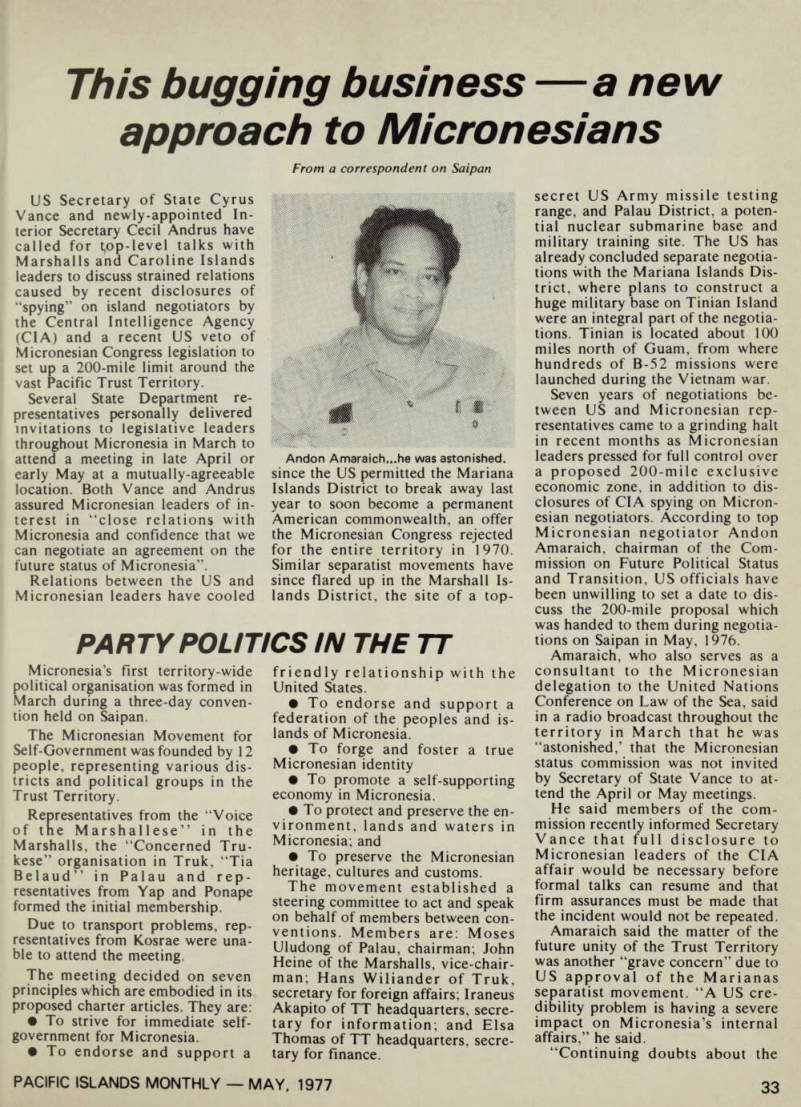
Andon Amaraich...he was astonished, since the US permitted the Mariana Islands District to break away last year to soon become a permanent American commonwealth, an offer the Micronesian Congress rejected for the entire territory in 1970.
Similar separatist movements have since flared up in the Marshall Is lands District, the site of a top
secret US Army missile testing range, and Palau District, a poten tial nuclear submarine base and military training site. The US has already concluded separate negotia tions with the Mariana Islands Dis trict, where plans to construct a huge military base on Tinian Island were an integral part of the negotia tions. Tinian is located about 100 miles north of Guam, from where hundreds of B-52 missions were launched during the Vietnam war.
Seven years of negotiations be tween US and Micronesian rep resentatives came to a grinding halt in recent months as Micronesian leaders pressed for full control over a proposed 200-mile exclusive economic zone, in addition to dis closures of CIA spying on Micron esian negotiators. According to top Micronesian negotiator Andon Amaraich, chairman of the Com mission on Future Political Status and Transition, US officials have been unwilling to set a date to dis cuss the 200-mile proposal which was handed to them during negotia tions on Saipan in May, 1976.
Amaraich, who also serves as a consultant to the Micronesian delegation to the United Nations Conference on Law of the Sea, said in a radio broadcast throughout the territory in March that he was “astonished,’ that the Micronesian status commission was not invited by Secretary of State Vance to at tend the April or May meetings.
He said members of the com mission recently informed Secretary Vance that full disclosure to Micronesian leaders of the CIA affair would be necessary before formal talks can resume and that firm assurances must be made that the incident would not be repeated.
Amaraich said the matter of the future unity of the Trust Territory was another “grave concern” due to US approval of the Marianas separatist movement. “A US cre dibility problem is having a severe impact on Micronesia’s internal affairs,” he said.
“Continuing doubts about the
eventual United States policy on separate negotiations are interfering with progress of the negotiations.
The success of the future status question of the Trust Territory de pends on a firm, persistent, con tinued, and unambiguous policy from the United States which must be spelled out now,” Amaraich declared.
According to Micronesian law, the commission is required to secure an agreement of “free association” with the United States which will ac commodate a sovereign Microne sian government, including a 200mile limit. An attempt by the Con gress of Micronesia in February to enact a 200-mile law was vetoed by the US high commissioner. On February 26, however, island law makers rejected the veto and the matter now rests with the US Department of Interior to decide.
Word of the veto prompted bitter criticism from many Micronesian lawmakers, including Senator Bailey Olter, chairman of the com mission’s subcommittee on future political status. Senator Olter said the US enacted its own 200-mile law, “then turns around and tells its friend, the Trust Territory, that it is wrong for us to do the same”. He said the US veto was inconsistent with the Charter of the United Na tions, the Trusteeship Agreement and international law.
“The US has turned the Trustee ship and Micronesia upside down and thoroughly shaken everything out of it. It has become painfully ap parent to me that the Trusteeship system is working the way the United States wants it to and not the way the community of nations in tended it to be,” he said.
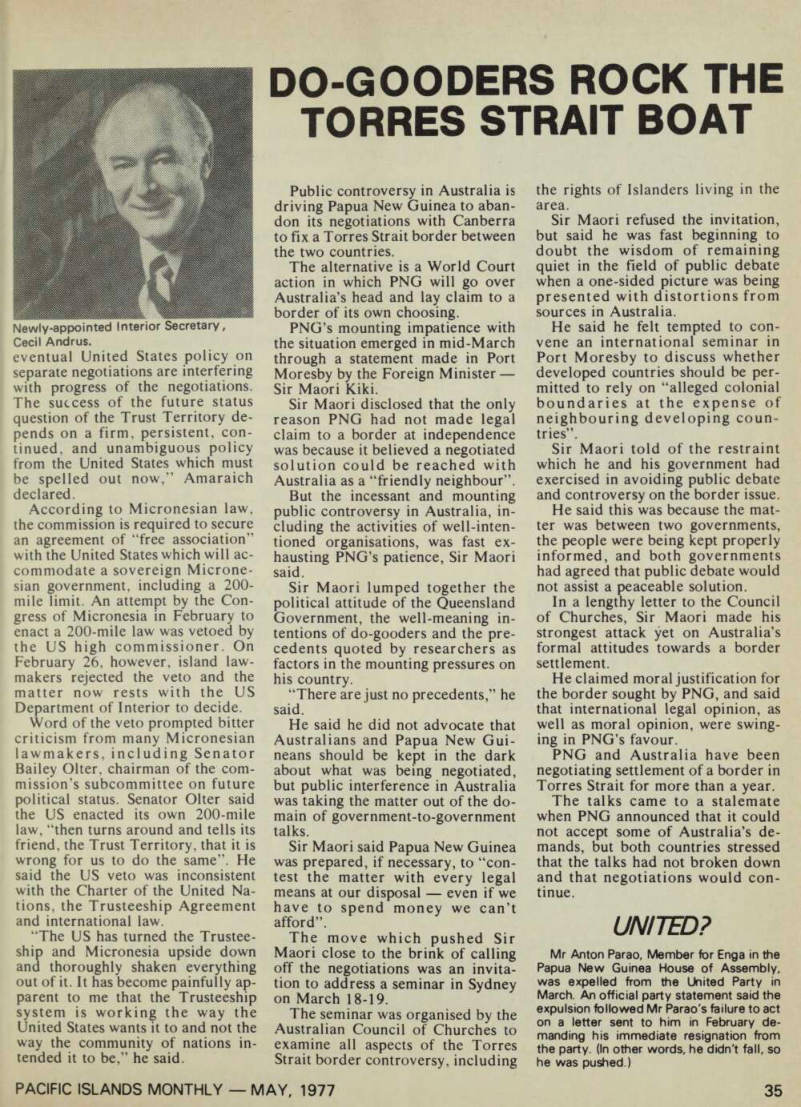
Newly-appointed Interior Secretary, Cecil Andrus.