Tropicalities
pp. 27-31 · Read in the full issue

The ‘Super Tribe ,
has a birthday
The Pacific Islands Regiment, of Papua New Guinea, grown from a unit of Papua New Guineans fighting beside Australians on the Kokoda Trail, is 37 years old. A regimental parade review by the Defence Min ister, Sir Maori Kiki, marked the anniversary on Saturday March 12 at Taurama base in Port Moresby.
Sir Maori told the green uniformed troops that tribal jealousies and personal greed were still the main factors undermining the new nationalism of Papua New Guinea. The regiment was over coming these influences by drawing men from all parts of the country and training them to serve shoulder to shoulder in the national interest.
The Pacific Islands Regiment which some critics have called a new “super tribe” in its own right is the main infantry strength of the PNG Defence Force. Its history goes back to the Pacific Islands Brigade which Australia recruited in 1940 from the Owen Stanley Ranges to the north and from the coastal plains across the ranges.
The men of the brigade fought beside Australians to stem the last thrust of the Japanese at Buna, at Gona, and on the Kokoda Trail.
The brigade and other localised units were then formed into the Pacific Islands Regiment which became the Australian Army’s Papua New Guinea element. The regiment originally had Australian officers and NCOs and Papua New Guinean troops, but Australians were progres sively phased out. It was absorbed into the autonomous defence struc ture of PNG in 1975, although a few Australians still serve on secondment.
The regiment has two battalions one based in Port Moresby and the other in Wewak.
Sir Maori told the troops that of all the problems of modern-day Papua New Guinea, the one which worried
him most was lack of unity. Greedy interests, based on tribal or personal ambitions, could break up the country he said.
“First and foremost we must be Papua New Guineans” he said.
Fossil House
or something else?
Nauru House, the republic’s multi million dollar piece of real estate in Melbourne, scheduled for opening in mid-April, has acquired a nickname which is somewhat unprintable and certainly annoys the Nauruans in the tower.
According to columnist Keith Dunstan in his “A Place in the Sun” in the Melbourne Sun, “One thing is making them unhappy in that lofty tower. It has the unfortunate reputation of being called... ah... Bird what-not house, in honour of the two little obelisks outside of so-called bird droppings.
“The Nauru people insist that Nauru was never composed of bird droppings. The phospate actually is fossilised marine life. Nauru was forced to the surface by an ocean upheaval.
“So APITS apologises for giving Nauru House the wrong name. Now the taxi drivers will have to think of something else.
“How about Fossil House?”
A fashion in
armour plate
In many of the smaller Pacific Islands countries local manufacturers often find it difficult to maintain a steady production programme as often deliveries of their materials from overseas countries may be inter rupted.
This was the dilemma that faced Les Winn, of Rarotonga, who makes ballet and gymnasium shoes, when before last Christmas he found that his stocks of raw materials were exhausted. However, Les soon found a profitable way of employing his staff, and incidentally, of using one
raw material which is in almost unlimited supply on Rarotonga.
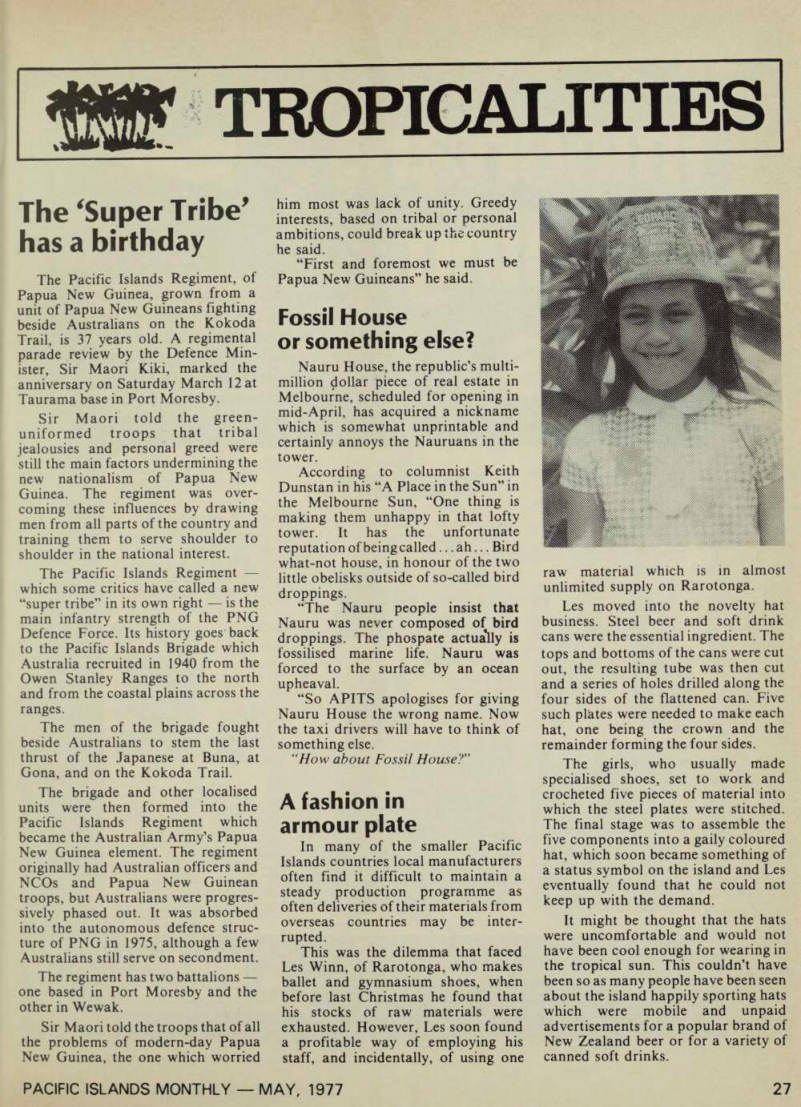
Les moved into the novelty hat business. Steel beer and soft drink cans were the essential ingredient. The tops and bottoms of the cans were cut out, the resulting tube was then cut and a series of holes drilled along the four sides of the flattened can. Five such plates were needed to make each hat, one being the crown and the remainder forming the four sides.
The girls, who usually made specialised shoes, set to work and crocheted five pieces of material into which the steel plates were stitched.
The final stage was to assemble the five components into a gaily coloured hat, which soon became something of a status symbol on the island and Les eventually found that he could not keep up with the demand.
It might be thought that the hats were uncomfortable and would not have been cool enough for wearing in the tropical sun. This couldn’t have been so as many people have been seen about the island happily sporting hats which were mobile and unpaid advertisements for a popular brand of New Zealand beer or for a variety of canned soft drinks.
A ‘nation’ of
motorcyclists
At the end of last year, the people of Pitcairn Island carried out their annual head-counting and came up with a total of 74.
Now, they’ve had a census of domestic animals and vehicles and per head of population, must have the highest percentage of two-wheel vehicles anywhere in the world 38 motor-cycles, which works out at one per two persons (almost), so that with a driver and one riding pillion, the whole population could be on wheels all at the same time.
The survey also came up with a total of 14 dogs, 47 tame cats (approx), six pet goats, a Muscovey duck and 578 domestic fowl (approx). There were also three Mini-moke vehicles and 20 Pitcairn wheelbarrows as well as 22 privately-owned canoes.
The statistics department, if there is one, revealed that the Pitcairners caught 6807 fish in 1976.
Miscellany, the island’s newsletter, also reports that, thanks to the British Royal Engineers and others, the islanders now have a new jetty, at least three times larger than the original one, an improved road from the Landing to the Edge, more space for the Landing and increased income for those who’ve toiled for months on the new jetty.
New director for
famous aquarium
Noumea’s famous aquarium, oper ated for the past 20 years by Dr and Mrs R. Catala-Stucki, has been transferred to the Noumea City Council and will be operated by the French research institute ORSTOM.
The Catalas founded the aquarium in 1956, and maintained a wondrous collection of marine life, including 10 special tanks of fluorescent corals.
These are in a darkroom periodically illuminated by ultra-violet rays to reveal their extraordinary array of colours.
From July 1, the new director of the aquarium will be 39-year-old New Caledonian Yves Magnier, who graduated in science in France before serving in Madagascar and with ORSTOM in Noumea.
Added to the lifetime efforts of the Catalas, the Noumea aquarium will now benefit from ORSTOM aid, which will include the construction of a new annexe for scientific purposes.
Yves Magnier has indicated this could
be used for research into pollution and organisms of medicinal use.
Meanwhile, rare Caledonian bird life recently aroused strong pleas for protection when it was alleged in Noumea that illegal trafficking was taking place in the island’s curious cagou bird and brightly-coloured parrots, fetching $ A 2,000 a pair. These birds may be enjoyed, legally, at the Parc Forestier in Noumea and Mr Bregula’s park in Port Vila.
The ages-old
war on bugs Since the beginning of time, mankind has been trying to figure out ways to discourage bugs from biting. Smearing mud on the skin worked pretty well, as did grease from the tallow of slain beasts.
When the bugs got particularly bad a long hollow reed provided the ultimate escape. The user would just lie down under the water and* breathe through the reed.
Modern science didn’t really ad dress the repellent problem until 1942. The United States was at war in the jungles of the Pacific Islands and insects were laying more soldiers low than were enemy bullets. The meanest enemy of all was the malaria mosquito, Anopheles quadrimaculatus. But there were also men serving in areas where the yellow fever mosquito, Aedes aegypti, was a problem, as well as other disease-bearing insects varieties of ticks, fleas and body lice.
Work started in earnest in Orlan do, Florida, in April 1942, at the
Bureau of Entomology and Plant Quarantine. Old-time ingredients were checked along with a number of exotic newcomers. Citronella oil, for example, rated almost as high as many of the more modern re pellents. (Many old bushmen know that hanging a clump of green ferns in front of the tent opening will keep the night mosquito-free, ferns being a natural source of citronella oil.) By 1951, 11,000 different com pounds had been tested in the Orlando laboratories. About this time, promising research began to emerge with a family of repellent materials called N, N
diethylamides. The most promising
was a material called N, N-diethyl meta-touluamide. It not only effec
tively repelled mosquitos, but also
turned off ticks and fleas.
The material was nicknamed “DEET”. It was safe for use on skin and cotton military clothing. In a 100% concentration, it was 100% effective from 24 hours to a week and longer, depending on condi tions.
Cut-price for
Cooks' women
Well there must be a few places in the world to-day where the female of the species has so strengthened her position in society that, for her, hair dressing costs less than for her male counterpart.
On Rarotonga, in a small shop at the rear of the Empire Theatre, Miri, from the island of Atiu, has operated a barber’s shop for a dozen years or more. Pinned to the wall is his scale of
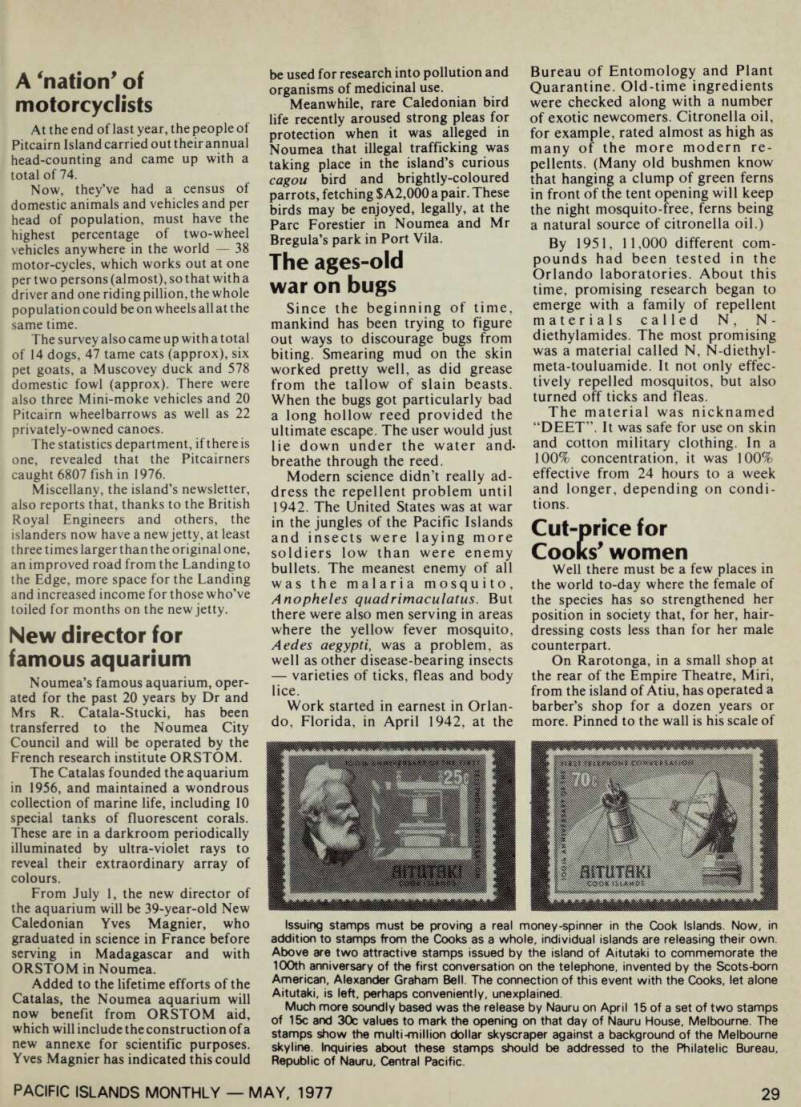
Issuing stamps must be proving a real money-spinner in the Cook Islands. Now, in addition to stamps from the Cooks as a whole, individual islands are releasing their own.
Above are two attractive stamps issued by the island of Aitutaki to commemorate the 100th anniversary of the first conversation on the telephone, invented by the Scots-born American, Alexander Graham Bell. The connection of this event with the Cooks, let alone Aitutaki, is left, perhaps conveniently, unexplained.
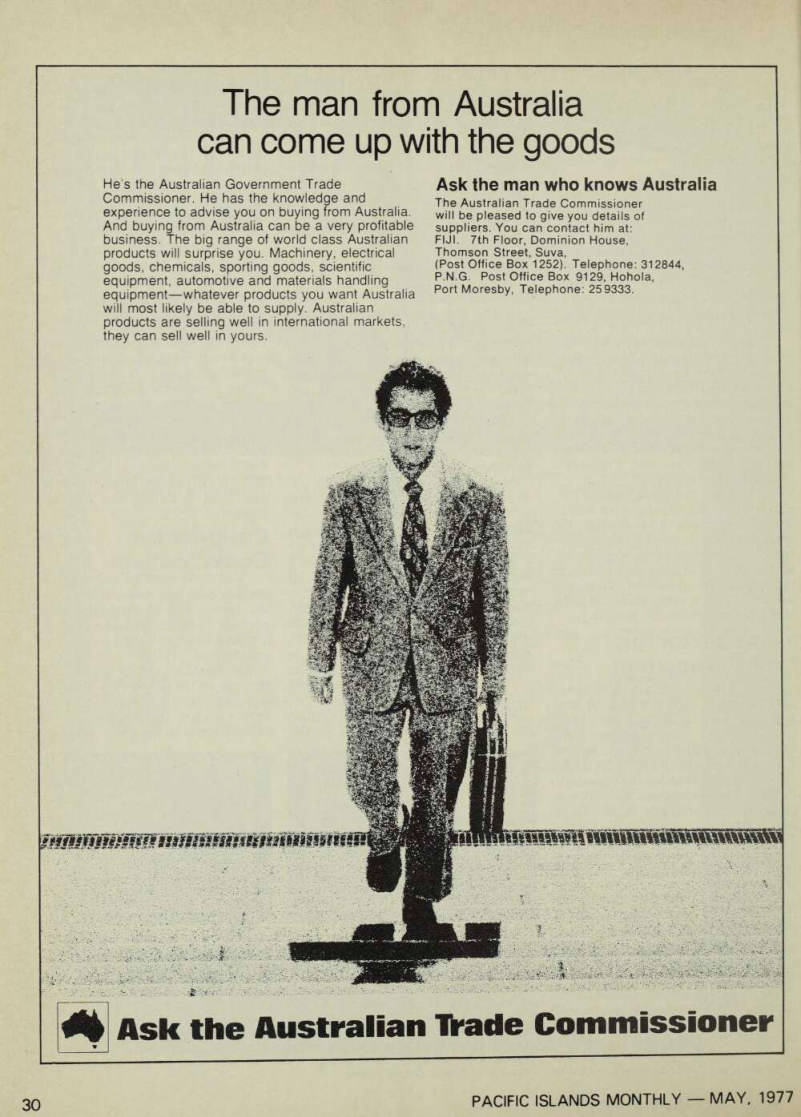
Much more soundly based was the release by Nauru on April 15 of a set of two stamps of 15c and 30c values to mark the opening on that day of Nauru House, Melbourne. The stamps show the multi-million dollar skyscraper against a background of the Melbourne skyline. Inquiries about these stamps should be addressed to the Philatelic Bureau, Republic of Nauru, Central Pacific.
charges! Men’s haircuts 60c; women’s haircuts 40c; children’s haircuts 20c.
The follows the cryptic message
Kare Te Kaiou No Credit.
A bookish
sort of knight
Sir John Yocklunn, one of the PNG Government’s “backroom boys” who, along with the Foreign Minister Sir Maori Kiki, was knighted by the Queen in 1975 “for services to politics and the government”, has been confirmed in the job in which he has been “acting” for some time that of National Librarian.
Regarded by many as the possessor of one of the best brains in the country, Sir John is finding his days are crowded. He is National Treasurer for the Pangu Party, a hecticjob at present with the general elections imminent, and his programme for the National Library is gathering impetus as the K 2 million library HQ, Australia’s independence gift, takes shape.
In Sydney recently, he was making contacts which, he hopes, will benefit the National Library.
It is destined to play a big part in PNG’s development, co-ordinating most existing library services, pro viding services to the various provincial governments and all services which need to be on a national scale.
He’d like to see a library service working in every town and village throughout the country, many of them being operated by travelling libraries, but one big obstacle to that is the lack of roads.
Sir John, who was born in Canton, China, grew up in Western Australia where his parents had a property.
A graduate of the University of Western Australia, he had two BA degrees one for languages, the other for political science when he went to England in 1973 and completed an MA course in librarianship at the University of Sheffield.
His PNG career began in 1968 when he left Canberra where he was with the National library, joined the Pangu Party, was vice-president of the party within a year, became principal private secretary to Mr Somare and accompanied him on his visits to China and the Philippines.
PlM’s sure Sir John would be delighted if anyone, wishing to help such a worthy cause as a library service, sent their surplus volumes to Papua New Guinea.