lining has a grey cloud
pp. 16-17 · Read in the full issue
Return to Enewetak: every silver lining has a grey cloud
By Jim Hall of Micronesian News Service
A participant in the March return of the Enewetak people to their an cestral home expressed one re servation along with his feeling of elation. He was Representative Ata ji Balos, 38, of the Congress of Micronesia, who represents not only the people of Enewetak but those of Bikini, Kwajalein, Rongelap and Utirik.
Balos, speaking to the press after the luau in honour of the returnees, said that he hoped that the United States would have a programme of periodic medical examinations for the Enewetak people.
He said that the US "had gained much scientific knowledge because of the testing and so it should bear the responsibility if someone becomes ill as a result of living on these islands”.
Balos noted that because of fallout from the Bikini tests, the people of Rongelap and Utirik were still affected after 20 years. He said: "I am not a scientist, but who knows what will happen in the future?”
Balos also expressed some disap pointment with the conditions at Japtan Island. He said that although Japtan has much better soil than Ujelang and there are more fish in the lagoons, there was not sufficient water for the Enewetak people when they arrived. He said that their main staples were breadfruit and pan danus, and yet there were only coconut trees on Japtan. “I wish there has been more preparations for the return,” he said.
Representative Balos had played a significant part in effecting the return of the Enewetak people to their home.
In 1968, after Balos graduated from the University of Guam, he worked for the Trust Territory Government as an assistant district affairs officer. His duties consisted of travelling to the various outlying islands by field trip vessel and meet
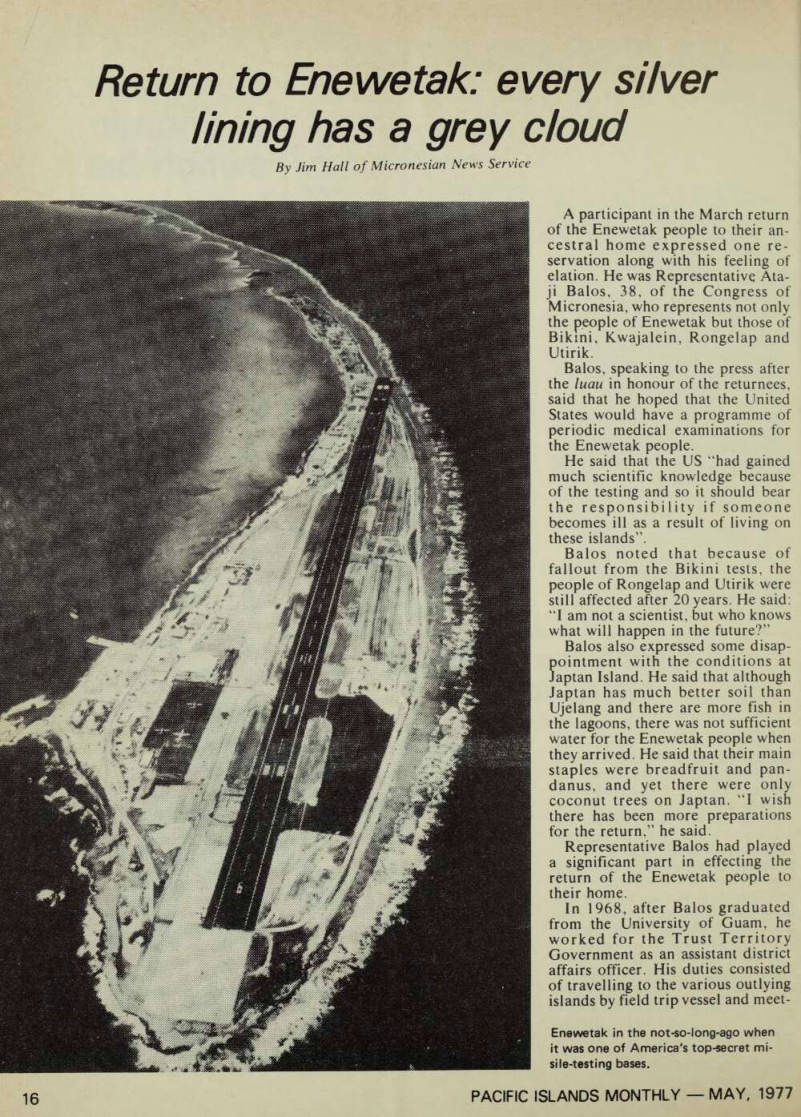
Enewetak in the not-so-long-ago when it was one of America's top-secret mi sile-testing bases.
ing with the island leaders to learn of their problems.
Early one morning in October of 1968, his ship docked off Ujelang and he went ashore to meet with the magistrate and members of the municipal council. He was unaware of the fact that the people of Ujelang had decided to abandon the island and so while the council was con ducting the meeting, all the rest of the islanders, over 300 of them, went aboard the field trip vessel, crowding it with men, women and children from bow to stern.
Finally, the council told Balos of the plan to go to Majuro and aban don Ujelang. They told him that “nobody really cares about us”.
They said they were virtually starv ing and did not even have copra to trade.
Balos told me: “I totally agree with you. Give me a chance to see what I can do.” He noted that the ship was severely overloaded and he feared that many people would die should the ship leave and encounter a storm.
Balos pleaded with them to come off, but they refused. “The women were particularly adamant,” Balos said. The magistrate. John Abraham, brother of the chief, said, “Give him a chance.” But many per sons refused to leave the ship. The negotiations continued for four hours.
Finally, an agreement was reach ed in which the ship was to put ashore whatever flour and rice was available. In addition, Balos agreed to remain behind until the situation on Ujelang was alleviated.
Balos said that the people wanted a field trip vessel to return in two weeks with supplies or they would “feed him to the sharks”. Word was sent by the ship’s captain to the-then district administrator Dwight Heine, concerning the situation on the island and exactly two weeks later the field ship returned. Balos said that the people were very happy and killed chickens and pigs for a big party.
“They trusted me from then on,”
Balos said.
Afterwards Balos quit his govern ment job because it was too re strictive. “I decided to run for the Congress of Micronesia,” Balos said, “so I could do what I could to help the people.”
His first task was to ensure that the people received the interest
from SUSI. 4 million trust fund.
Then he requested that a group be allowed to return to Enewetak and for the first time, Balos said, they were aware that a missile-testing programme was still going on.
Balos then went to Micronesian Legal Services for help. The ML,S filed a law suit in federal district court in Honolulu for a restraining order to stop the testing.
Finally, the Department of Defence agreed in 1972 to bring the Ujelang council members to meet in Enewetak. Balos said. “They took us to see the craters on the northern side and it was the first time we learned that two islands were gone.
The landowners were really sad their islands had disappeared.”
Balos said that he felt at that time the United States had finally begun to feel concerned. Soon they were giving the problem their full at tention. Subsequently, Balos said, he began to focus his attention on the other problems of his district.
Balos concluded by saying that
the move to Japtan was not an altogether happy occasion. In ad dition to the lack of preparation, he said it was “very difficult for the people because they had to leave their friends and relatives”. He said the Enewetak people are a very close-knit group and “they like to go together all the time”. The real hap py day, he said, will be when “they are all here together and self-suffi cient at last”.
A later report says that the 56 people young children, infants, young adults and a few who remem bered the departure so many years ago who returned on the Militobi seemed genuinely pleased with what they saw as they went ashore.
The children quickly ran to the sandy beach and through the village area where, unlike Ujelang, there were a few rocky areas. The older folk sat under nearby palm trees to enjoy a little rest. Others strolled through the converted Butler build ing which were to be their tempor ary homes until new ones are built.