Fred Maedola, The Solomons
pp. 14-15 · Read in the full issue
Troubadour Extraordinary
By staffman MALCOLM SALMON
"Send a telegram or a letter ad dressed 'Fred Maedola, Solomon Islands', and it'll get to him all right," Mr Fraser Hickox told PIM in March.
Mr Hickox, a representative of Sohbu (Australia), was in Sydney with a particular job on his hands helping to see that everything went smoothly with the making of a cassette recording of 12 songs written and sung by Fred Maedola, troubadour-extraordinary of the Solomon Islands.
He wanted to make the point that Mr Maedola's fame in his own country spreads far beyond Fote Village on Malaita, where he was born 37 years ago. Indeed, it is rapidly growing in other Island countries Papua New Guinea, the New Hebrides, and as far afield as Nauru.
The cassette recording project (under the Singsing label) is jointly sponsored by Sohbu, a Japanese based firm active in forestry, fish
ing and the making of video-cass ettes in Papua New Guinea, and Living Sound, a subsidiary of Chan nel 9 of Sydney.
Taking time off from his re cording work, Fred Maedola talked to PIM about how it all started.
He said; "When i was a boy at district school, I was already in terested in music. I particularly lik ed the records of Slim Dusty. I suppose I wanted from the start to do something like them about the daily lives of my own people."
So, Australia's renewed ex ponent of the country-western style of music really started some thing.
Fred has already written about 30 songs in Pidgin, many of which have been recorded.
PIM asked him to outline some of the themes of his songs. His answers gave more than one clue to his success, especially among town-dwelling Melanesian com munities.
There were straight love songs -Come Close Long Mi, Think Long Mi.
There was zest for the good things of life, personal and material his song Pick Up Girl Long Mote Bake (motor bike) ex presses a common aspiration of young men from just about any where.
There was pathos Come Home Boy tells of a father writing to his absent son, informing him his mother has just died and that now he must return home.
There was acid social comment Lucky Girls tells of the envy of married folk for the "freedom” of women who are divorced; Oh Dar ling Me Losim You Now is the la ment of an absent boyfriend who has heard that his loved one is playing fast and loose with other fellows while he is away.
There was humour Time Mi Sick Long Number Nine recalls a spell Fred had in hospital ("Number Nine” was a World War II US ser vicemen's term for hospital) and tells how pleased some people were to believe that Fred was "finis”, and the nasty shock they got when they eventually learned he was out of hospital and still alive and kicking.
There was straight descriptive material, laced with humour Waitim Fish Long Market Place de scribes the crowds waiting for the
fishermen to come in with their catch at Honiara, the smelling of the fish by prospective buyers to make sure they were fresh and the haggling over prices.
Fred drew on his nine years' ex perience as a policeman to write another song. Mi Sit Down Inside Jail, which tells of the brooding of a prisoner on his fate.
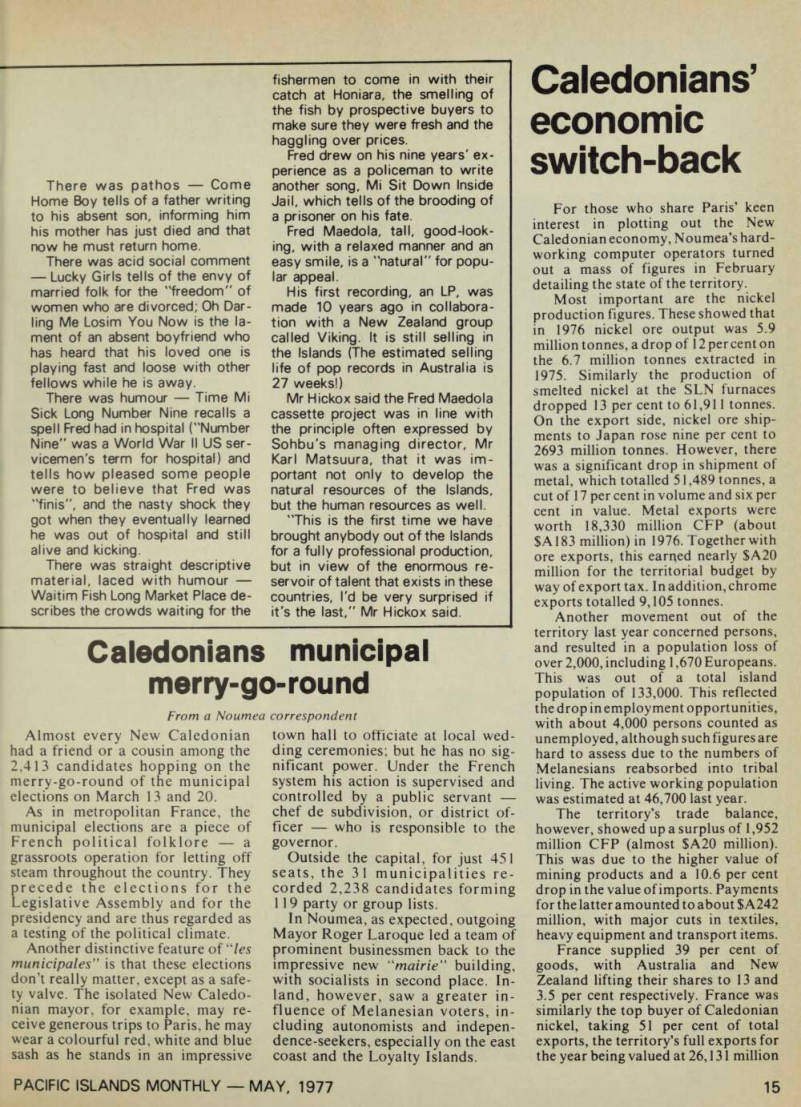
Fred Maedola, tall, good-look ing, with a relaxed manner and an easy smile, is a "natural” for popu lar appeal.
His first recording, an LP, was made 10 years ago in collabora tion with a New Zealand group called Viking. It is still selling in the Islands (The estimated selling life of pop records in Australia is 27 weeks!) Mr Hickox said the Fred Maedola cassette project was in line with the principle often expressed by Sohbu's managing director, Mr Karl Matsuura, that it was im portant not only to develop the natural resources of the Islands, but the human resources as well.
"This is the first time we have brought anybody out of the Islands for a fully professional production, but in view of the enormous re servoir of talent that exists in these countries. I'd be very surprised if it's the last,” Mr Hickox said.