Solomons independence problems
pp. 13-89 · Read in the full issue
of “when?”, “how?”, “who?”
By ALAN GILL who was in Honiara
Members of the Solomon Islands Legislative Assembly will travel to London soon to thrash out with the British Government questions affecting the “when?” and “how?” of Solomons’ independence.
As this issue of PIM went to press, it was not yet decided who, or in deed, how many members of the as sembly, would take part in the ac tual negotiations.
A suggestion raised a few weeks ago, that all 38 members of the as sembly make the trip to London leaving the Governor, Mr Colin Allan, to mind the fort is likely to cause raised eyebrows in Whitehall.
And Her Majesty’s Government’s collective eyebrows are likely to rise even higher at the formula for inde pendence proposed by the assembly on March 3.
This calls for, initially, a monarchy with the Queen as Head of State, to be followed, a year later, by the automatic creation of a re public unless the move should be blocked, in the interim period, by a two-thirds vote in the assembly, in which case a constitutional monarchy would be retained.
Not that Britain is opposed to in dependence for the Solomon Is lands. Indeed, HMG (to use the jargon of expatriate public servants) has shown a willingness, bordering on relief, which some residents find unflattering.
However, diplomatic sources in Honiara believe that Britain will re ject the proposed independence for mula on the grounds that it is too complicated a not-very-practical compromise aimed primarily at placating the various shades of opi nion within the assembly itself.
Britain is expected to make a counter-offer of immediate inde pendence as a constitutional monarchy or immediate indepen dence as a republic ... without ‘ifs’ and ‘buts’ or half-measures. In either event, full independence could be achieved before the end of 1977.
The proposed independence con stitution was drawn up with the help of a globe-trotting Kenyan Indian lawyer, Professor Yash Ghai, 38,
who specialises in constitutional matters. Professor Ghai, who was warmly thanked by MPs of all view points and political persuasions, is professor of law at Uppsala Univer sity in Sweden.
The Solomons has had internal self-government since January, 1976, with the idea, at that time, that full independence should follow 12 months later or as soon after as practicable. The original in dependence scheme, drawn up by a constitutional committee, was refer red back to the assembly, last Sep tember for further consideration, in the belief that the general public had not been given sufficient chance to air their views. To remedy this, the assembly arranged for consulta tions with eight local councils and seven special interest groups.
The original report called for the creation of a constitutional monarchy within the British Com monwealth. Differences were pri marily over the extent of power that should be held locally and how the decision should be made to appoint someone to represent the Queen in the Solomons.
Curiously, the Australian press and television, while making much of Mr Whitlam’s “Queen of Sheba”
remark in his address to Queen Elizabeth during the recent Silver Jubilee royal tour, hardly mention ed the issue independence for the Solomons which had inspired the Australian Federal Opposition Leader’s jest. (The incident took place during the Queen’s official welcome in King’s Hall, Parliament House, Canberra. After an address by the Prime Minister, Mr Malcolm Fraser, it was Gough Whitlam’s turn to speak. It was a lighthearted con vivial welcome until Whitlam paus ed to note that the people of the Solomon Islands had asked Elizabeth to be their Queen. “What next?” cracked Whitlam. “The Queen of Sheba?”) The Queen of the Solomons- Queen of Sheba just might have been relegated to a lower place in Mr Whitlam’s repertoire of gags had he been present at the debate, a few days earlier, in the Honiara As sembly building.
Events of November, 1975 (when the Governor-General of Australia, Sir John Kerr, sacked Whitlam from office) were much in the assembly’s mind.
It was decided that on indepen dence the Queen’s representative would be a Governor-General who must be a Solomon Islands citizen.
A year after independence, the Governor-General would auto matically become the first President of the Republic of Solomons. (The words ‘British’ and ‘Protectorate’ were dropped from the former title, British Solomon Islands Protec torate, upon the granting of internal self-government, in 1976. The change caused confusion to librarians and archivists in consular offices, who now have to file material about the region under a different letter of the alphabet.) The proposals infer that the head of state will not be what is termed an “executive President” as in the United States. He must act on the advice of his Prime Minister who will be elected by the House.
The exact powers of the President are open to doubt. A chart in the of ficial newspaper, the Solomons
News Drum, published by the Solomon Islands Information Ser vice, describes the President’s sole as “ceremonial”. Elsewhere, the paper states that the President can dismiss the Prime Minister if parlia ment passes a motion of no-con fidence in him by an absolute ma jority.
Inevitably, there is speculation as to who will be the first Governor- General (and a year later the first President) of the new nation, and who will be its first Prime Minister.
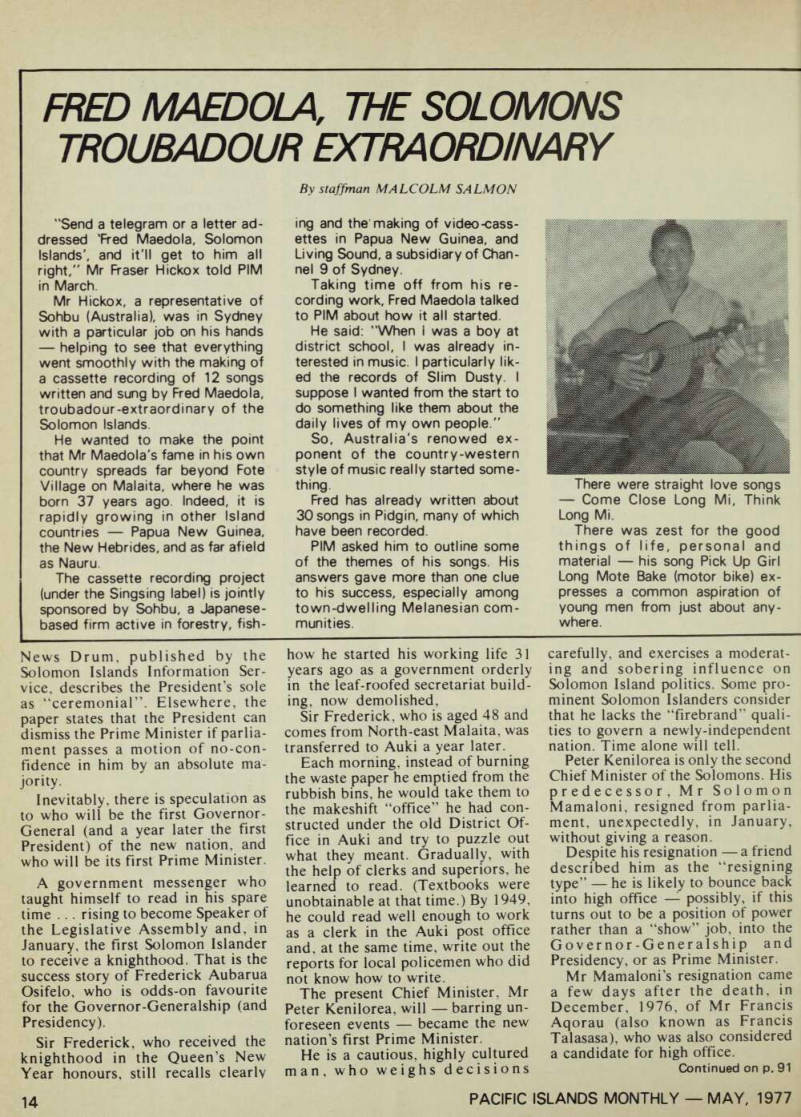
A government messenger who taught himself to read in his spare time ... rising to become Speaker of the Legislative Assembly and. in January, the first Solomon Islander to receive a knighthood. That is the success story of Frederick Aubarua Osifelo, who is odds-on favourite for the Governor-Generalship (and Presidency).
Sir Frederick, who received the knighthood in the Queen’s New Year honours, still recalls clearly
how he started his working life 31 years ago as a government orderly in the leaf-roofed secretariat build ing, now demolished, Sir Frederick, who is aged 48 and comes from North-east Malaita, was transferred to Auki a year later.
Each morning, instead of burning the waste paper he emptied from the rubbish bins, he would take them to the makeshift “office” he had con structed under the old District Of fice in Auki and try to puzzle out what they meant. Gradually, with the help of clerks and superiors, he learned to read. (Textbooks were unobtainable at that time.) By 1949, he could read well enough to work as a clerk in the Auki post office and, at the same time, write out the reports for local policemen who did not know how to write.
The present Chief Minister, Mr Peter Kenilorea, will barring un foreseen events became the new nation’s first Prime Minister.
He is a cautious, highly cultured man, who weighs decisions
carefully, and exercises a moderat ing and sobering influence on Solomon Island politics. Some pro minent Solomon Islanders consider that he lacks the “firebrand” quali ties to govern a newly-independent nation. Time alone will tell.
Peter Kenilorea is only the second Chief Minister of the Solomons. His predecessor, Mr Solomon Mamaloni, resigned from parlia ment, unexpectedly, in January, without giving a reason.
Despite his resignation a friend described him as the “resigning type” he is likely to bounce back into high office possibly, if this turns out to be a position of power rather than a “show” job, into the Governor-Generalship and Presidency, or as Prime Minister.
Mr Mamaloni’s resignation came a few days after the death, in December, 1976, of Mr Francis Aqorau (also known as Francis Talasasa), who was also considered a candidate for high office.
Continued on p. 91
Mr Aqorau, who was 48, suffered a fatal heart attack while playing tennis in Honiara. Among a highly superstitious people there is even a Nguzunguzu war god effigy at the gates of Government House his death was blamed by some people on custom medicine (witchcraft). It is even alleged by some that Mamaloni, in his wisdom, resigned in order to forestall a similar fate a suggestion I do not take seriously.
The second man to graduate, Mr Bartholomew Ulufa’alu, is regarded as the nearest thing in Solomons politics to an official Opposition leader and is considered very much a man to watch.
Mr Ulufa’alu, who is 26, was edu cated at Aruligo secondary school and the University of Papua New Guinea where he obtained a Bachelor of Arts degree in econ omics. He was president and general secretary of the Solomon Islands General Workers’ Union before being elected.
Another figure to watch is the Chief Secretary’s Principal Private Secretary (equivalent to Secretary to the Cabinet), Mr Francis Bogotu, who is regarded as a leading cultural and intellectual figure, and a possible future political leader.
The absence of political parties, certainly as these are understood in Western parliaments, is an unusual feature of Solomons political life.
In an interview with the indepen dent newspaper, Melanesian Nius, the Chief Minister, Mr Kenilorea, said: “The two initial political par ties, the People’s Progressive Party and the United Solomon Islanders’
Party, appear to have died out.”
Like Kenilorea, most MPs in the country are independents.
“I’ve had a lot of talk about ‘bringing down the government’ from the Opposition group. But on the other hand a lot of independents have told me privately not to worry, as they’re not interested in submit ting to the kind of political dis cipline needed to make an opposi tion effective,” the Chief Minister said.
“I believe that if we can integrate our Solomon Island attitudes at a national level, we can govern our countrv without oarties. But if
political parties must develop, and there seems to be some evidence now that they will, then the govern ment must ensure stability by ensur ing majority support.”
At present the government is, in fact, the cabinet, with all other MPs regarded as being ‘‘in opposition”.
This means that when an individual or group gains power, he and they immediately become a minority as regards vote-counting in the as sembly.
Another factor to be taken into account in Solomons politics is the very remoteness of many of the islands.
The hundreds of islands and atolls the exact total has never been estimated extend about 900 miles in a south-easterly chain from Papua New Guinea across the Coral Sea, about 1,200 miles north-east of Australia.
It is hardly surprising, therefore, that many Solomon Islanders think of themselves as Malaita men or Ysabel men, and have a distinctly befuddled notion of the islands as a geographical or political entity.
I put this point to Mr Kenilorea, who agreed that a problem existed, but said he was hopeful that the gap could be narrowed by education and that independence would create a sense of national unity.
Prospectors hope
for oil in Tonga
Webb-Tonga is confident that the first major oil well discovered in Polynesia will be in Tonga, where Webb-Tonga is prospecting. Mr Rod Warters, a geologist, and presi dent of Warpet Exploration Ltd, of Canada, who is manager of the Webb-Tonga project, said that under Tongatapu oil could extend down as far as 3,350 metres.
Webb-Tonga knew of several areas where there were oil seepages on the surface. It was apparent there had been oil generated on Tongatapu. It was a question of finding the mother lode. Mr War ters would not hazard a guess on how long a major oil field on an is land the size of Tongatapu would last.
Mr Aqorau.