‘Fiji for
pp. 8-10 · Read in the full issue
Fijians’ brings these islands to the brink
From ROBERT KEITH-REID in Suva
Complacent supporters of Fiji’s ruling Alliance Party who thought the country’s complex voting system gave a virtual guarantee of perpetual power for the Alliance, were shocked numb in March/April after the first general elections for the House of Representatives since 1972. Fiji’s 278,000 voters (out of a population of half a million) handed out a result which sent the nation into constitutional crisis.
The general election was the second since independence from Britain in 1970. But, compared with the election of 1972, it was a far, far more complex process due to the emergence of a third significant political force, the Fijian Nationalist Party, and factional pressures inside both the Alliance and the NFP.
In 1972 it was a straight fight, the Alliance versus the NFP.
Race is a fact of life, as Fiji politicans comment frequently in discussing the communal problems confronting a country in which 51 % of the population is Indian and the balance mainly Fijian, with a smattering of Europeans, Chinese, other Islanders and mixed-race peoples.
In 1972, it was a forgone conclusion that, as the Fiji Constitution guaranteed non-Indians control of 30 of the 52 seats in parliament, and as the Alliance had the total support of this group, plus the support of about 25% of Indian electors, it would win.
So it did, 33 seats to 19 over the NFP. But, a lot of things have happened since then.
First, one of the Alliance’s Fijian MPs, Mr Sakiasi Butadroka, turned out to be too anti-Indian for a party basing its policies on the preservation of communal harmony.
He left it three years ago, although not resigning his Fijian communal seat, and formed the Fijian Nationalist Party with the motto “Fiji for the Fijians”.
Since then, there has been waver-
ing in the Alliance in other directions, although the disunity there has certainly been nothing compared to the troubles in the National Federation Party.
The results of the elections were known by early April.
While the NFP won 26 seats, the Alliance got 24, eight less than its previous 32.
The Fijian Nationalist Party which, as far as the Alliance was concerned, was the cause of the whole upset, won one seat and independent candidate Ratu Osea Gavidi took one of the Alliance’s 12 Fijian communal seats.
The result left the NFP with a majority that did not give it the control G f parliament it had to have if it was to ge t any legislation passed. The NFP sat down to hours of discussing a way out of the impasse while stunnec i Alliance cabinet ministers, after nearly 11 years of unchallenged power, packed their bags and left t h e ir ministerial offices.
Prime Minister Ratu Sir Kamisese Mara handed in his resignation on April 5, coldly refused offers of a coalition deal received from the NFP and challenged it to try to form a government.
The Alliance expectation was that t h e NFP would be forced to do so but WO uld soon topple not only because of its nil majority but because of intense leadership rivalries within its ranks.
But then Ratu Osea Gavidi, who had campaigned with the promise to remain an independent, threatened
to upset the applecart by announcing that he would back the NFP and give it a working majority to be able to form a government in the national in terest.
Next day, he said he had changed his mind, apparently after persuasion by the Alliance, The NFP was back to the prospect ofrule without power again, and after much haggling amongst members of its parliamentary group, agreed logo for a deal with the Alliance. While some local observers had predicted that the Alliance might get its majori ty cut by an alarming amount, no one, least of all the NFP had expected it would lose the election, “A very pleasant surprise,” was how the NFP’s boss, Siddiq Koya, put it after keeping his Lautoka Indian seat in a tough battle against a former NFP man, Raojibhai Patel.
So why the Alliance loss?
There were several factors, but the main one was undoubtedly the deci sion of about 20,000 Fijians to vote for the two-year-old Fijian Na tionalist Party and its unpleasant “anti-Indian and Fiji for the Fijian” creed instead of for the Alliance as before.
The Alliance, which had com pletely underestimated the draw of the Fijian Nationalists, predicted that all its 17 candidates would lose their deposits, had a horrible surprise, True, only one Nationalist did get to parliament and this was the party’s leader, former Alliance assistant minister Sakeasi Butadroka, who kept his Fijian communal seat by
soundly beating his Alliance oppo nent. But many other FNP candidates got up to 4,000 votes each, so splitting the Fijian vote in many of the 25 “na tional” seats, of which the Alliance had held the majority and, hence, the overall parliamentary majority.
This lack of support meant that the NFP picked up seats it would never have otherwise obtained.
Alliance losses included three cabinet ministers, Ratu Josua Toganivalu (Agriculture) and Mr Sakiasi Waqanivavalagi (Lands and Mines) while Education Minister, Peniame Naqasima was beaten unex pectedly for his Fijian Sigatoka seat by Ratu Gavidi, a popular young chief of the area.
A jubilant Sakeasi Butadroka, who said he was praying for an NFP victo ry to prove his claims to Fijians tuat Fiji was really controlled by the In dians, was able to cry; “My prayers have been answered,” which he did.
Ratu Mara took the defeat a little
cynically, saying, “It is quite obvious
that the Fijians blame us for being pro-Indian, particularly the Na tionalists and the Indians have blam ed us for being pro-Fijian.”
Fijians would have to “blame themselves” for any mess they found the country in as a result of deserting the Alliance, he warned, and added that he still thought the Fiji Constitu tion was the best one the country could have.
At this point, events began to move quickly.
Fiji’s burly, belligerent Opposi tion leader, Siddiq Koya, 53, drove up to Government House in Suva four days after the end of the elec tion, supremely confident that he was about to become Fiji’s first In dian Prime Minister.
Half an hour after his departure from the Opposition office in the Government Building he returned a downcast, and furious man.
He’d been told by the Governor- General, Ratu Sir George Cakobau, Fiji’s paramount chief and a former
Alliance Minister, that Ratu Sir Kamisese Mara had been reap pointed to the post.
A Government House statement broadcast to a stunned nation a few minutes later explained why.
The Governor-General, it said, having considered all relevant cir cumstances, had come to the conclu sion that despite the NFP’s 26 seats in parliament, it was Ratu Mara who commanded the support of the ma jority of the 52 parliamentarians, and who therefore, under the terms laid down by the Constitution, was the man who should be made Prime Minister.
Ratu Mara was back in his hastily vacated Prime Minister’s office and had appointed a new cabinet just over an hour after Koya had been dismaved by the Governor-General.
“It’s amazing,” confessed Ratu Mara, describing how he felt about the sudden reversal of his fortunes.
“The summons to Government House this afternoon came out of the blue. I did not expect it at all.”
The NFP quickly put out a state ment complaining that the Gover nor-General acted without con sultation with Koya or any other party source.
"We have a written Constitution and it is a pity that the constitutional processes were not allowed to take their course” it said.
As Ratu Mara went to mass at the
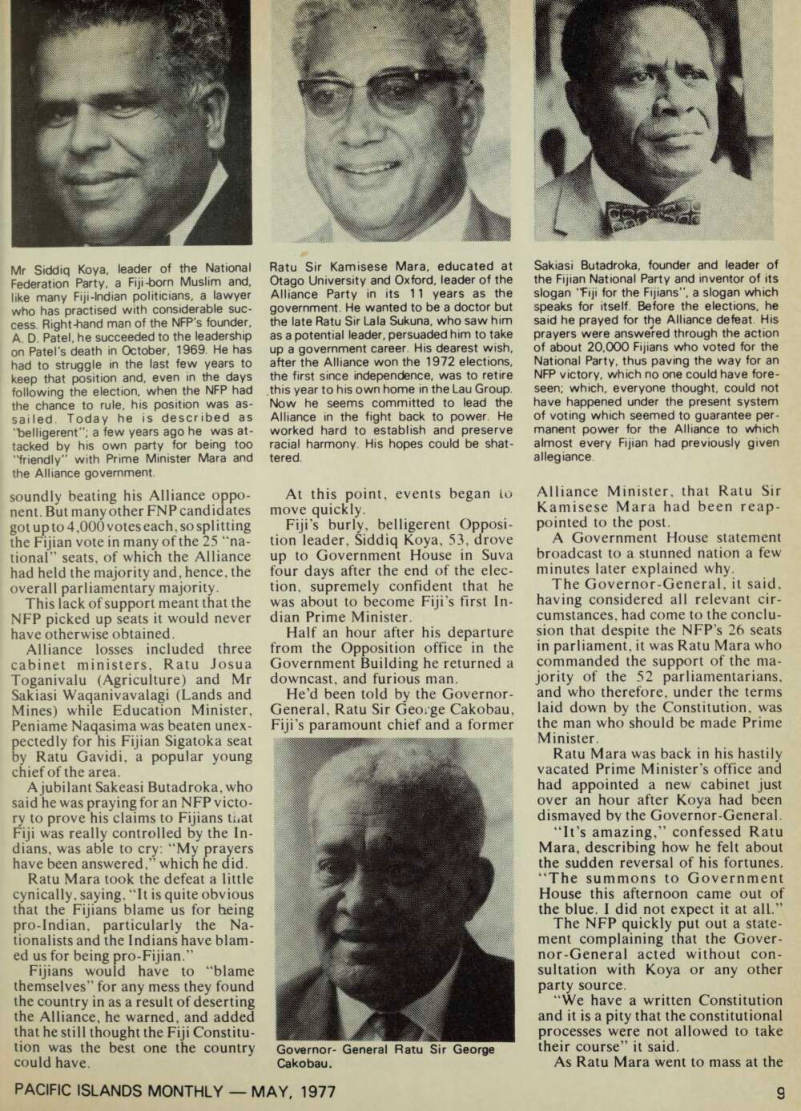
Mr Siddiq Koya, leader of the National Federation Party, a Fiji-born Muslim and, like many Fiji-Indian politicians, a lawyer who has practised with considerable suc cess. Right-hand man of the NFP's founder, A. D. Patel, he succeeded to the leadership on Patel's death in October, 1969. He has had to struggle in the last few years to keep that position and, even in the days following the election, when the NFP had the chance to rule, his position was as sailed. Today he is described as "belligerent"; a few years ago he was at tacked by his own party for being too "friendly” with Prime Minister Mara and the Alliance government.
Ratu Sir Kamisese Mara, educated at Otago University and Oxford, leader of the Alliance Party in its 11 years as the government. He wanted to be a doctor but the late Ratu Sir Lala Sukuna, who saw him as a potential leader, persuaded him to take up a government career. His dearest wish, after the Alliance won the 1972 elections, the first since independence, was to retire this year to his own home in the Lau Group.
Now he seems committed to lead the Alliance in the fight back to power. He worked hard to establish and preserve racial harmony. His hopes could be shat tered.
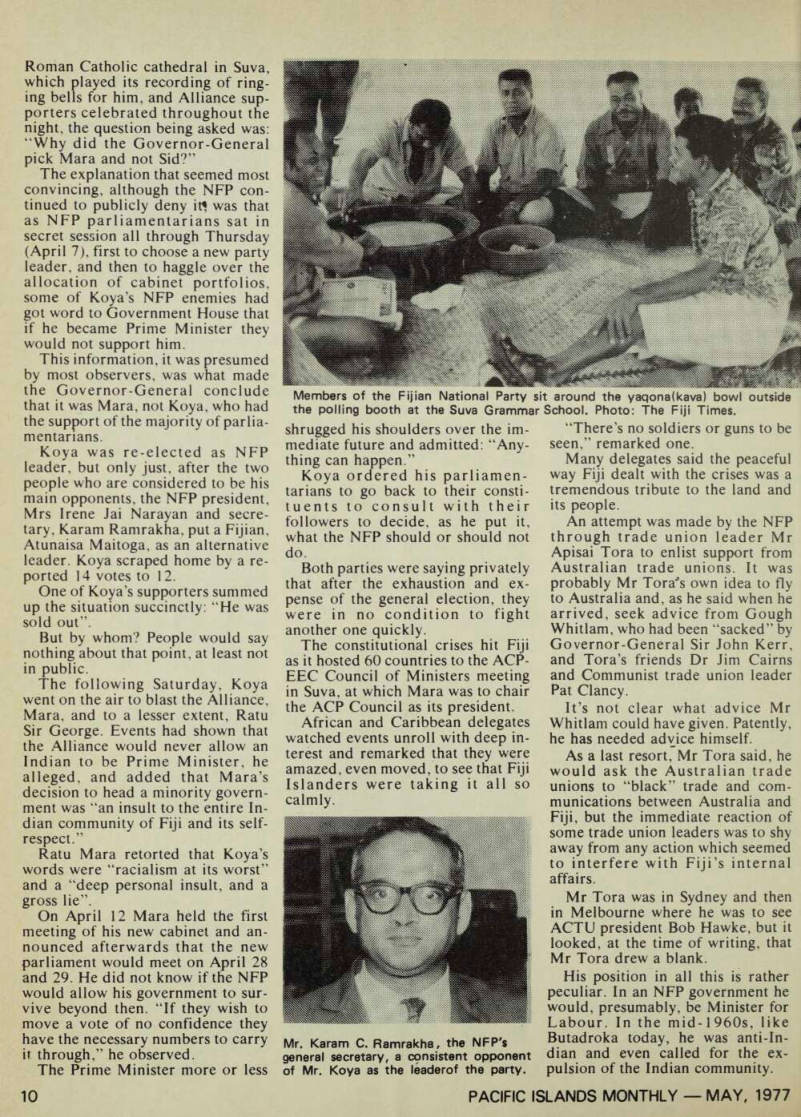
Governor- General Ratu Sir George Cakobau.
Sakiasi Butadroka, founder and leader of the Fijian National Party and inventor of its slogan "Fiji for the Fijians”, a slogan which speaks for itself. Before the elections, he said he prayed for the Alliance defeat His prayers were answered through the action of about 20,000 Fijians who voted for the National Party, thus paving the way for an NFP victory, which no one could have fore seen; which, everyone thought, could not have happened under the present system of voting which seemed to guarantee per manent power for the Alliance to which almost every Fijian had previously given allegiance.
Roman Catholic cathedral in Suva, which played its recording of ring ing bells for him, and Alliance sup porters celebrated throughout the night, the question being asked was: “Why did the Governor-General pick Mara and not Sid?”
The explanation that seemed most convincing, although the NFP con tinued to publicly deny it* was that as NFP parliamentarians sat in secret session all through Thursday (April 7), first to choose a new party leader, and then to haggle over the allocation of cabinet portfolios, some of Koya’s NFP enemies had got word to Government House that if he became Prime Minister they would not support him.
This information, it was presumed by most observers, was what made the Governor-General conclude that it was Mara, not Koya, who had the support of the majority of parlia mentarians.
Koya was re-elected as NFP leader, but only just, after the two people who are considered to be his main opponents, the NFP president, Mrs Irene Jai Narayan and secre tary, Karam Ramrakha, put a Fijian, Atunaisa Maitoga, as an alternative leader. Koya scraped home by a re ported 14 votes to 12.
One of Koya’s supporters summed up the situation succinctly: “He was sold out”.
But by whom? People would say nothing about that point, at least not in public.
The following Saturday, Koya went on the air to blast the Alliance, Mara, and to a lesser extent, Ratu Sir George. Events had shown that the Alliance would never allow an Indian to be Prime Minister, he alleged, and added that Mara’s decision to head a minority govern ment was “an insult to the entire In dian community of Fiji and its self respect.”
Ratu Mara retorted that Koya’s words were “racialism at its worst” and a “deep personal insult, and a gross lie”.
On April 12 Mara held the first meeting of his new cabinet and an nounced afterwards that the new parliament would meet on April 28 and 29. He did not know if the NFP would allow his government to sur vive beyond then. “If they wish to move a vote of no confidence they have the necessary numbers to carry it through,” he observed.
The Prime Minister more or less
shrugged his shoulders over the im mediate future and admitted; “Any thing can happen.”
Koya ordered his parliamen tarians to go back to their consti tuents to consult with their followers to decide, as he put it, what the NFP should or should not do.
Both parties were saying privately that after the exhaustion and ex pense of the general election, they were in no condition to fight another one quickly.
The constitutional crises hit Fiji as it hosted 60 countries to the AGP EEC Council of Ministers meeting in Suva, at which Mara was to chair the ACP Council as its president.
African and Caribbean delegates watched events unroll with deep in terest and remarked that they were amazed, even moved, to see that Fiji Islanders were taking it all so calmly.
“There’s no soldiers or guns to be seen,” remarked one.
Many delegates said the peaceful way Fiji dealt with the crises was a tremendous tribute to the land and its people.
An attempt was made by the NFP through trade union leader Mr Apisai Tora to enlist support from Australian trade unions. It was probably Mr Tora J s own idea to fly to Australia and, as he said when he arrived, seek advice from Gough Whitlam, who had been “sacked” by Governor-General Sir John Kerr, and Tora’s friends Dr Jim Cairns and Communist trade union leader Pat Clancy.
It’s not clear what advice Mr Whitlam could have given. Patently, he has needed advice himself.
As a last resort, Mr Tora said, he would ask the Australian trade unions to “black” trade and com munications between Australia and Fiji, but the immediate reaction of some trade union leaders was to shy away from any action which seemed to interfere with Fiji’s internal affairs.
Mr Tora was in Sydney and then in Melbourne where he was to see ACTU president Bob Hawke, but it looked, at the time of writing, that Mr Tora drew a blank.
His position in all this is rather peculiar. In an NFP government he would, presumably, be Minister for Labour. In the mid-19605, like Butadroka today, he was anti-In dian and even called for the ex pulsion of the Indian community.
Members of the Fijian National Party sit around the yaqona(kava) bowl outside the polling booth at the Suva Grammar School. Photo: The Fiji Times.
Mr. Karam C.Ramrakha, the NFP's general secretary, a consistent opponent of Mr. Koya as the leaderof the party.