McAuley, poet of the Pacific
p. 51 · Read in the full issue
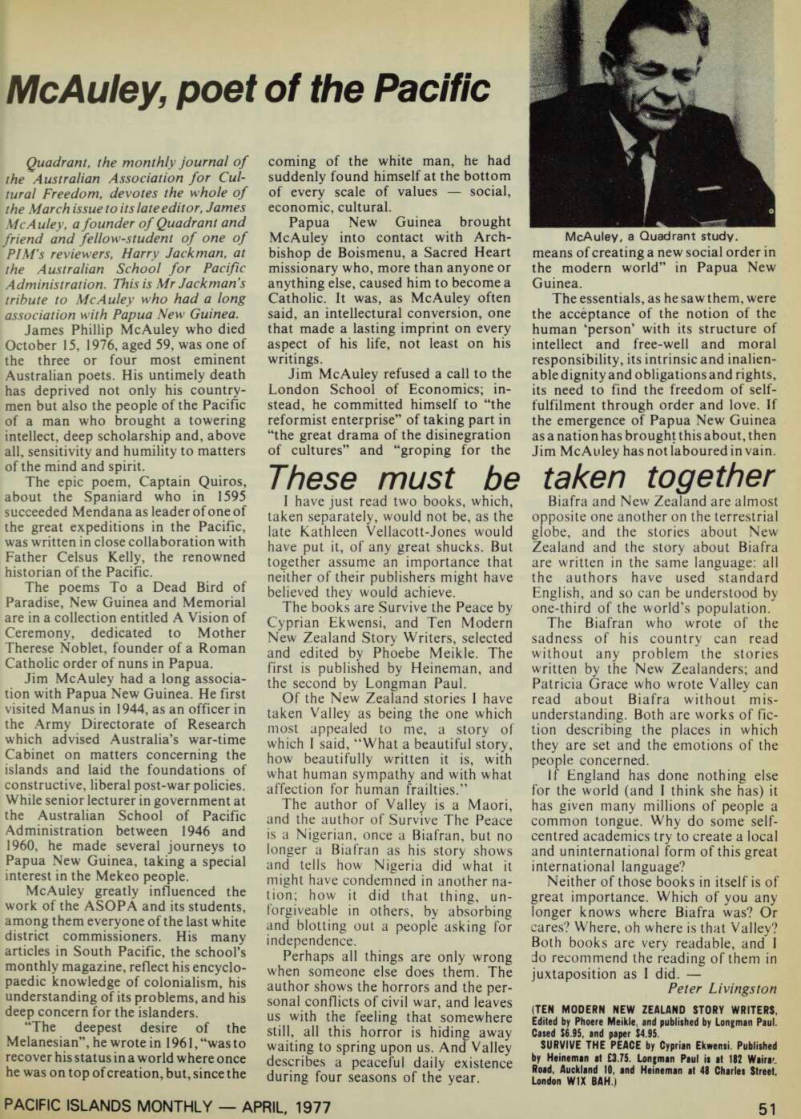
Quadrant, the monthly journal of the Australian Association for Cul tural Freedom, devotes the whole of the March issue to its late editor, James McAuley, a founder of Quadrant and friend and fellow-student of one of PlM’s reviewers, Harry Jackman, at the Australian School for Pacific Administration. This is Mr Jackman’s tribute to McAuley who had a long association with Papua New Guinea.
James Phillip McAuley who died October 15, 1976, aged 59, was one of the three or four most eminent Australian poets. His untimely death has deprived not only his country men but also the people of the Pacific of a man who brought a towering intellect, deep scholarship and, above all, sensitivity and humility to matters of the mind and spirit.
The epic poem, Captain Quiros, about the Spaniard who in 1595 succeeded Mendana as leader of one of the great expeditions in the Pacific, was written in close collaboration with Father Celsus Kelly, the renowned historian of the Pacific.
The poems To a Dead Bird of Paradise, New Guinea and Memorial are in a collection entitled A Vision of Ceremony, dedicated to Mother Therese Noblet, founder of a Roman Catholic order of nuns in Papua.
Jim McAuley had a long associa tion with Papua New Guinea. He first visited Manus in 1944, as an officer in the Army Directorate of Research which advised Australia’s war-time Cabinet on matters concerning the islands and laid the foundations of constructive, liberal post-war policies.
While senior lecturer in government at the Australian School of Pacific Administration between 1946 and 1960, he made several journeys to Papua New Guinea, taking a special interest in the Mekeo people.
McAuley greatly influenced the work of the ASOPA and its students, among them everyone of the last white district commissioners. His many articles in South Pacific, the school’s monthly magazine, reflect his encyclo paedic knowledge of colonialism, his understanding of its problems, and his deep concern for the islanders.
“The deepest desire of the Melanesian”, he wrote in 1961, “was to recover his status in a world where once he was on top of creation, but, since the
coming of the white man, he had suddenly found himself at the bottom of every scale of values social, economic, cultural.
Papua New Guinea brought McAuley into contact with Arch bishop de Boismenu, a Sacred Heart missionary who, more than anyone or anything else, caused him to become a Catholic. It was, as McAuley often said, an intellectural conversion, one that made a lasting imprint on every aspect of his life, not least on his writings.
Jim McAuley refused a call to the London School of Economics; in stead, he committed himself to “the reformist enterprise” of taking part in “the great drama of the disinegration of cultures” and “groping for the
means of creating a new social order in the modern world” in Papua New Guinea.
The essentials, as he saw them, were the acceptance of the notion of the human ‘person’ with its structure of intellect and free-well and moral responsibility, its intrinsic and inalien able dignity and obligationsand rights, its need to find the freedom of self fulfilment through order and love. If the emergence of Papua New Guinea as a nation has brought this about, then Jim McAuley has not laboured in vain.
McAuley, a Quadrant study.