Gold and purple patches in
p. 45 · Read in the full issue
the Queen's Islands tour
The Silver Jubilee Pacific tour of Queen Elizabeth II began with a one-day visit to Western Samoa on February 11.
The occasion was marked by an exchange of honours between the Queen and Western Samoa’s Head of State, Malietoa Tanumafili 11.
The latter was invested by the Queen with the Collar Badge and Star of the GCMG (Knight Grand Gross of the Most Distinguished Order of St Michael and St George).
He in turn conferred upon the Queen the Grand Order of Vailima, an honour specially created to mark the first visit by a reigning British monarch to Western Samoa.
Vailima is an apt symbol of the links between Samoa and Britain: the house bearing this name, at the foot of Mt Vaea outside Apia, is the re sidence of today’s Western Samoan Head of State, and was originally the home of the British writer, Robert Louis Stevenson when he lived and died in Samoa in the 1880 s.
Fears that the Queen would be re ceived coolly by the population in return for the cold shoulder suffered by Western Samoa’s Head of State when he was in Britian last year were unfounded: the public welcome was spontaneous and warm.
But problems on this first Royal visit to Western Samoa came from another quarter, the behaviour of the police. The rounding-up of seven harmless, discharged mental patients on the eve of the visit, alleg ed police brutality towards enthusiastic crowds at Mulinuu, and their repeated rough-housing and obstruction of visiting pressmen left a bad taste in local mouths which the newfy-appointed Commissioner of Police, Sir Angus Sharp, will have his work cut out to wash away.
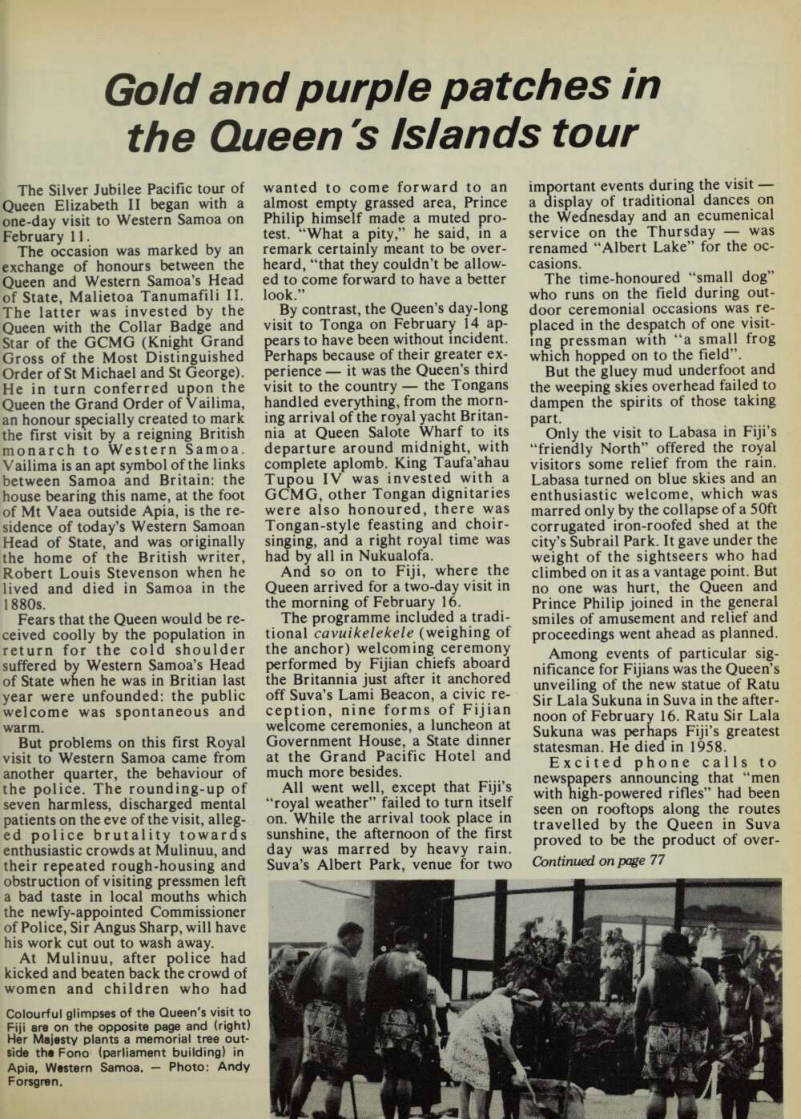
At Mulinuu, after police had kicked and beaten back the crowd of women and children who had Colourful glimpses of the Queen's visit to Fiji are on the opposite page and (right) Her Majesty plants a memorial tree out side the Fono (parliament building) in Apia, Western Samoa. Photo: Andy Forsgren.
wanted to come forward to an almost empty grassed area, Prince Philip himself made a muted pro test. “What a pity,” he said, in a remark certainly meant to be over heard, “that they couldn’t be allow ed to come forward to have a better look.”
By contrast, the Queen’s day-long visit to Tonga on February 14 ap pears to have been without incident.
Perhaps because of their greater ex perience it was the Queen’s third visit to the country the Tongans handled everything, from the morn ing arrival of the royal yacht Britan nia at Queen Salote Wharf to its departure around midnight, with complete aplomb. King Taufa’ahau Tupou IV was invested with a GCMG, other Tongan dignitaries were also honoured, there was Tongan-style feasting and choir singing, and a right royal time was had by all in Nukualofa.
And so on to Fiji, where the Queen arrived for a two-day visit in the morning of February 16.
The programme included a tradi tional cavuikelekele (weighing of the anchor) welcoming ceremony performed by Fijian chiefs aboard the Britannia just after it anchored off Suva’s Lami Beacon, a civic re ception, nine forms of Fijian welcome ceremonies, a luncheon at Government House, a State dinner at the Grand Pacific Hotel and much more besides.
All went well, except that Fiji’s “royal weather” failed to turn itself on. While the arrival took place in sunshine, the afternoon of the first day was marred by heavy rain.
Suva’s Albert Park, venue for two
important events during the visit a display of traditional dances on the Wednesday and an ecumenical service on the Thursday was renamed “Albert Lake” for the oc casions.
The time-honoured “small dog” who runs on the field during out door ceremonial occasions was re placed in the despatch of one visit ing pressman with “a small frog which hopped on to the field”.
But the gluey mud underfoot and the weeping skies overhead failed to dampen the spirits of those taking part.
Only the visit to Labasa in Fiji’s “friendly North” offered the royal visitors some relief from the rain.
Labasa turned on blue skies and an enthusiastic welcome, which was marred only by the collapse of a 50ft corrugated iron-roofed shed at the city’s Subrail Park. It gave under the weight of the sightseers who had climbed on it as a vantage point. But no one was hurt, the Queen and Prince Philip joined in the general smiles of amusement and relief and proceedings went ahead as planned.
Among events of particular sig nificance for Fijians was the Queen’s unveiling of the new statue of Ratu Sir Lala Sukuna in Suva in the after noon of February 16. Ratu Sir Lala Sukuna was perhaps Fiji’s greatest statesman. He died in 1958.
Excited phone calls to newspapers announcing that “men with high-powered rifles” had been seen on rooftops along the routes travelled by the Queen in Suva proved to be the product of over-
Continued on page 77