Magazine
pp. 34-35 · Read in the full issue
When German cruiser Nurnberg called at Fanning Island
By Sherman Lee Pompey
In September, 1914, it was re ported that a German submarine squadron was en-route to Christmas Island in the Pacific and that it had been ordered to destroy the cable station at Fanning Island. The Ü boats were part of Admiral von Spec’s China Squadron.
The Fanning Island residents had expected the arrival of a German cruiser for about three weeks, but no one thought that the Germans would actually attempt to seize the island, especially since the British Govern ment knew of the location of the Numberg and the Leipsig.
However, the women on the is land were very suspicious. They kept a man on the lookout for two weeks, and, on September 7, two ships which proved to be the Nurnberg and a collier, were sighted. They both flew the French flag and the islanders were so sure that they were friendly vessels that preparations were made to launch a boat from shore and show them an anchorage.
The friendly mission had hardly started when two boatloads of Ger mans put out at full speed for shore.
J. Beckerleg’s eyewitness account relates that, “They did not even wait for the boats to ground on the beach, but jumped into the water waist deep and, with fixed bayonets and drawn revolvers commanded the surprised little garrison of Fanning islanders to surrender. They rushed on shore and mounted a Maxim gun, which was trained on the cable headquarters. Marines were posted all around the station while officers and sailors, armed with rifles, made their way to the office building.”
The cable station employees were hard at work and were paralysed to see a German officer at the door of the operating room with a revolver.
“Take your hands of those keys,
all of you,” he commanded. All but one of the operators complied. One did not hear the command because of the receiver strapped on his head, Not until one of his companions shouted to him did he realise his position. The men were made to line up along the wall while sailors with axes smashed the delicate and valuable instruments.
“A great deal of valuable mechanism was left intact, showing their knowledge of cable instruments was crude.”
A cable message had been conspicuously posted saying that the Nurnberg or Leipsig was due any day. One of the German officers saw this, and with a smile said, “Rather interesting, don’t you think. I’ll take this as a souvenir.”
Another party was engaged near the shore end of the cable, trying to
locate it. Failing to do this, heavy charges of dynamite were planted and the cable blown to bits. A crew from the collier grappled for the ca ble further out to sea, intending to do further damage. Another party planted gun-cotton and dynamite in the engine rooms, the boiler rooms, refrigeration plant and the dynamo rooms. The explosions from these charges were terrific, but no one was hurt.
A search was made of the offices and a number of valuable papers were taken. A few hours later an of ficer returned and summoned a detachment of men. The papers had revealed that there were several valuable instruments buried on the island; also a quantity of arms and ammunition. There was a large sum of money in the office safe. The safe was blown and the money taken.
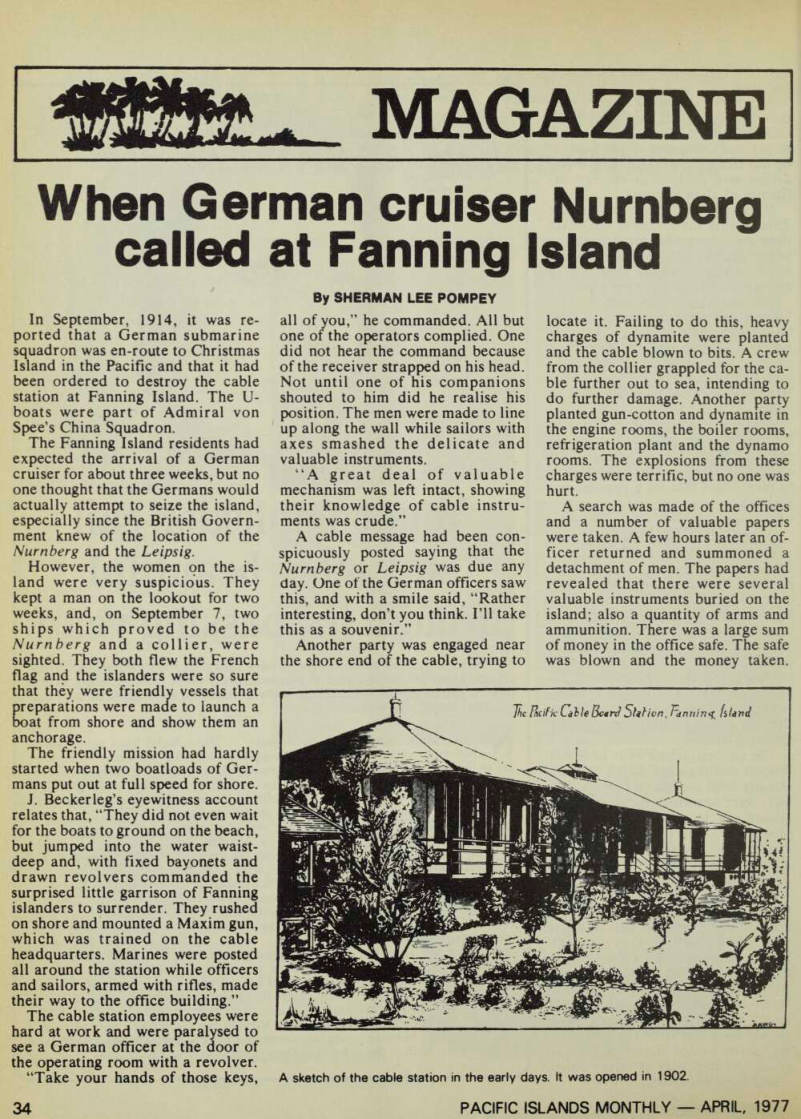
A sketch of the cable station in the early days. It was opened in 1902.
The post office also was not spared.
The Germans appropriated stamps valued at £33-6-6d.
The officer in charge of this sec tion of the expedition apologised and said that it was the first time that he had ever acted the part of a burglar. The buried instruments were blown up and the guns and am munition seized.
Through all this devastation “the courtesy extended by these German officers was most marked. They ex pressed themselves to be greatly surprised that no armed resistance was offered, as they had every reason to believe that Great Britain had taken precaution to defend this important outpost”.
The officers and men worked with feverish haste and seemed anxious to get away. The cable employees’ private quarters were left un molested.
“A little humour was injected into the occasion when one of the Ger man soldiers borrowed a saw from one of the cable employees and fell ed a giant flagpole at the top of which flew a British flag.”
The pole was cut into sections and the saw and the flag were taken on board the Nurnberg as souvenirs.
The officers of the Nurnberg seemed to have a complete knowledge of what was going on in the outside world and seemed to possess as much information as those who had been in daily cable communication with the mainland.
The collier was carefully disguis ed and there was nothing about her to indicate her identity. She was of about 2,000 tons and had a com plete grappling outfit on board. Her men seemed experts at this work.
The Germans completed their work in about 12 hours, then they headed west-north-west towards the Marshall Islands.
When the Nurnberg left, Hugh Greig made his famous dive and brought up the severed ends of the cable, but the stores and spare parts were a mess. The men of the cable station were completely isolated from the outside world with little prospect of early relief. The station had no facilities for handling and repairing the cables and there was no cable available for bridging the cap caused by the severed ends
dragging apart.
A mass of wreckage was all that remained of the instruments and the plant. However, ingenuity, courage
and resource were forthcoming, and in this vital part all the cable station personnel were grateful to Hugh Greig.
Cable-repair work was a specialised field, but these men suc ceeded in buoying the ends to a plat form contrived of planks and bar rels, and above this shark-infested area they successfully com municated with Suva by means of a covered wire stretched between the severed ends.
It was a temporary measure, like using a pickaxe for a grapnel. Skilful work was also carried out by the ca ble staff who reconstructed instru ments from the debris by piecing together serviceable parts and pre paring the station for the permanent reopening of communications.
Communication was established in two weeks and the cable company rewarded Hugh Greig with £2O for his services.
Captain E. L. Tindall of the Kestrel, a converted Chilean gun boat, was sent to Fanning Island under commission from the British Cable Board in London with a full supply of cargo and cable materials necessary for the repairs of the damage that the Cable Board sur mised had been done. The Kestrel arrived off the north end of Fanning Island at daybreak on September 25.
The chief engineer was told to bank the fire so that smoke would not be visible and they crept up to
the island cautiously, the surround ing waters being surveyed from the masthead. They were looking for war vessels and found none.
Then they headed for the harbour and saw a ship’s boat with a crew ap parently grappling for the broken cable. They were greeted upon their arrival by Superintendent A. Smith and his staff, “and our welcome was a genuine one”.
The devastation caused by the Germans was apparent before they had even landed. Evidence of the free use of gun-cotton and dynamite could be seen yards from shore. The landing buoy was demolished.
“Although none of the residents of Fanning Island had suffered any personal injury from the German landing force, the feeling against the British Government in not giving this important station their naval protection was quite marked.”
Estimates of the damage was $150,000.
There were 26 white men, four white women and 200 natives on the island at the time of the raid. • The author, Mr Sherman Lee Pompey, is a research historian at the University of Oregon in the United States. His account of the German raid on Fanning is prob ably the fullest yet written. The cruiser Nurnberg was subse quently sunk by Admiral Sturdee’s squadron in the battle of the Falkland Islands.
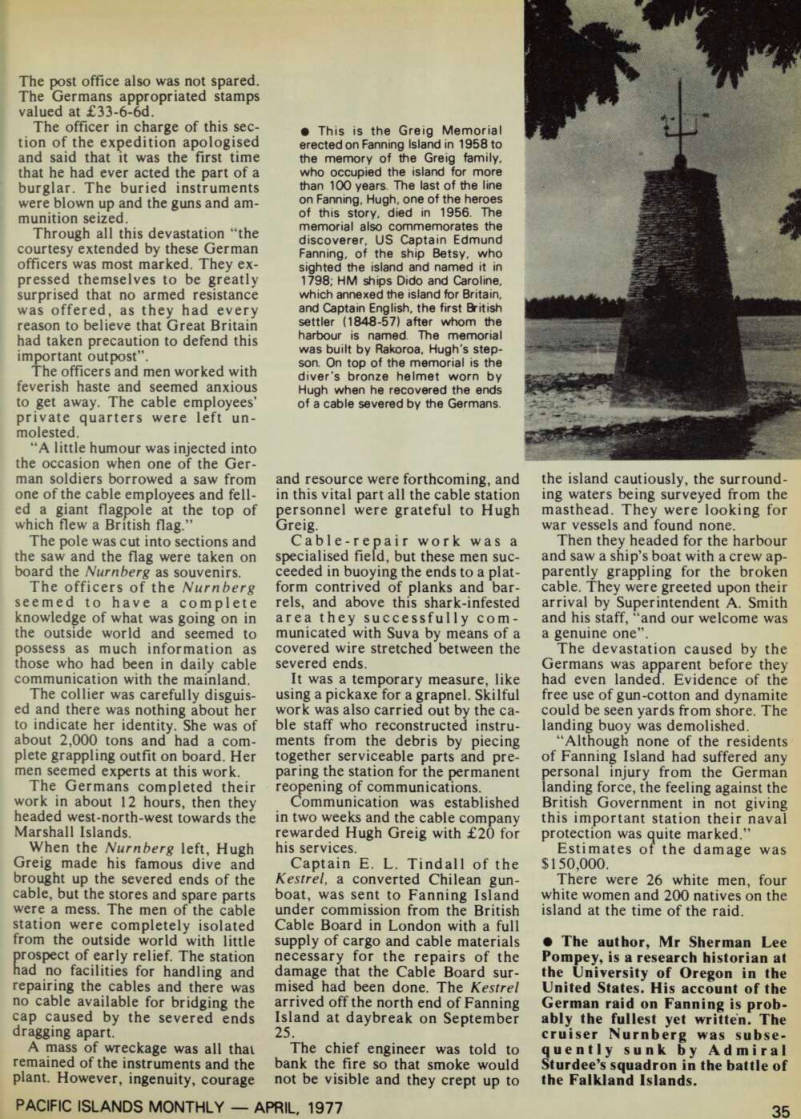
• This is the Greig Memorial erected on Fanning Island in 1958 to the memory of the Greig family, who occupied the island for more than 100 years. The last of the line on Fanning, Hugh, one of the heroes of this story, died in 1956. The memorial also commemorates the discoverer, US Captain Edmund Fanning, of the ship Betsy, who sighted the island and named it in 1798, HM ships Dido and Caroline, which annexed the island for Britain, and Captain English, the first British settler (1848-57) after whom the harbour is named. The memorial was built by Rakoroa, Hugh's step son. On top of the memorial is the diver's bronze helmet worn by Hugh when he recovered the ends of a cable severed by the Germans.