Putting The People Of Noumea On
p. 15 · Read in the full issue
Their Feet
From PA UL STERLING in Noumea Visitors to Noumea doubtlessly remember the traffic with amuse ment, annoyance or nostalgia.
Tourists who ventured to hire cars were either very brave, or extremely imprudent. Pedestrians had the choice of being hunted down mercilessly on pedestrian crossings or scrambling their way through cars parked on footpaths, on crossroads, across driveways or in the middle of the street.
Accustomed to a system where practically all the rules of the road were gaily ignored, the people of Noumea admired the courteous and law-abiding attitude of their Anglo- Saxon neighbours, admitting that in their own town four wheels and an in ternal combustion engine were the arms of selfish and bloodthirsty in dividualism.
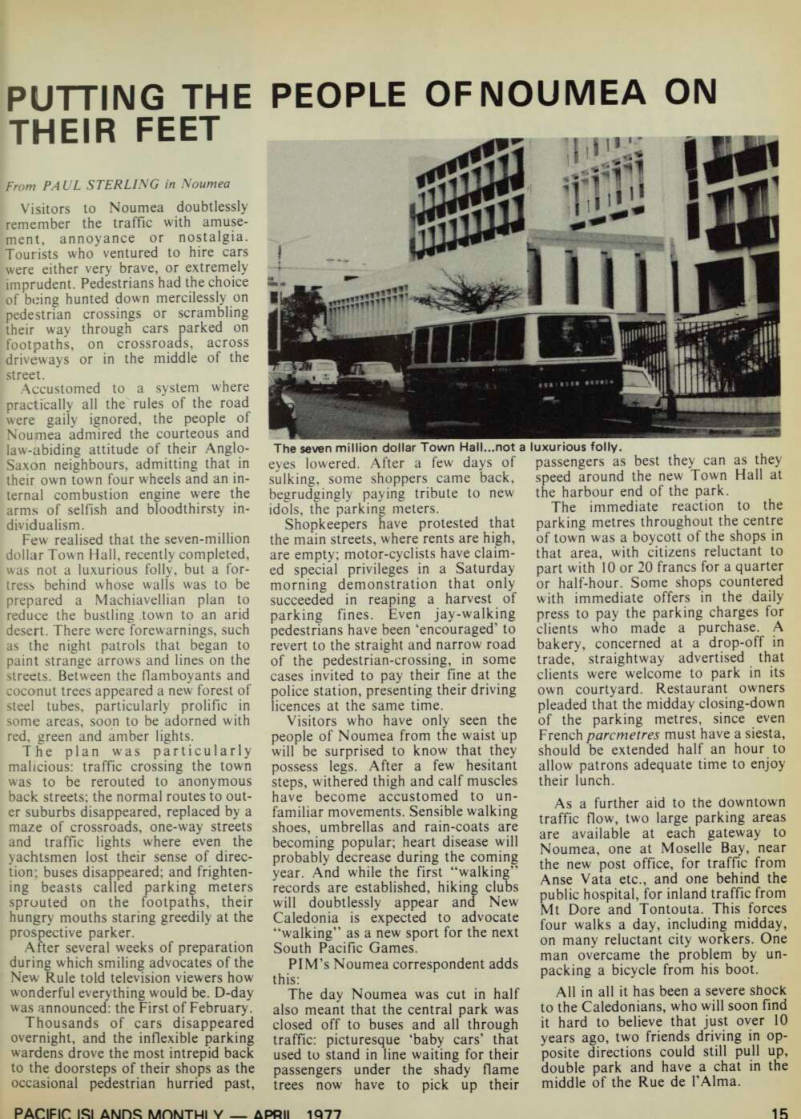
Few realised that the seven-million dollar Town Hall, recently completed, was not a luxurious folly, but a for tress behind whose walls was to be prepared a Machiavellian plan to reduce the bustling town to an arid desert. There were forewarnings, such as the night patrols that began to paint strange arrows and lines on the streets. Between the flamboyants and coconut trees appeared a new forest of steel tubes, particularly prolific in some areas, soon to be adorned with red, green and amber lights.
The plan was particularly malicious: traffic crossing the town was to be rerouted to anonymous back streets; the normal routes to out er suburbs disappeared, replaced by a maze of crossroads, one-way streets and traffic lights where even the yachtsmen lost their sense of direc tion; buses disappeared; and frighten ing beasts called parking meters sprouted on the footpaths, their hungry mouths staring greedily at the prospective parker.
After several weeks of preparation during which smiling advocates of the New Rule told television viewers how wonderful everything would be. D-day was announced: the First of February.
Thousands of cars disappeared overnight, and the inflexible parking wardens drove the most intrepid back to the doorsteps of their shops as the occasional pedestrian hurried past,
eyes lowered. After a few days of sulking, some shoppers came back, begrudgingly paying tribute to new idols, the parking meters.
Shopkeepers have protested that the main streets, where rents are high, are empty; motor-cyclists have claimed special privileges in a Saturday morning demonstration that only succeeded in reaping a harvest of parking fines. Even jay-walking pedestrians have been ‘encouraged’ to revert to the straight and narrow road of the pedestrian-crossing, in some cases invited to pay their fine at the police station, presenting their driving licences at the same time.
Visitors who have only seen the people of Noumea from the waist up will be surprised to know that they possess legs. After a few hesitant steps, withered thigh and calf muscles have become accustomed to unfamiliar movements. Sensible walking shoes, umbrellas and ram-coats are becoming popular; heart disease will probably decrease during the coming year. And while he first walking records are established, hiking clubs will doubtlessly appear and New Caledonia is expected to advocate wa king as a new sport for the next So D “ , h . c ! tk Games. this M * N ° Umea corres P ondent adds The day Noumea was cut in half also meant that the central park was closed off to buses and all through traffic: picturesque ‘baby cars’ that used to stand in line waiting for their passengers under the shady flame trees now have to pick up their
passengers as best they can as they speed around the new Town Hall at the harbour end of the park.
The immediate reaction to the parking metres throughout the centre of town was a boycott of the shops in that area, with citizens reluctant to part with 10 or 20 francs for a quarter or half-hour. Some shops countered with immediate offers in the daily press to pay the parking charges for clients who made a purchase. A bakery, concerned at a drop-off in trade, straightway advertised that clients were welcome to park in its own courtyard. Restaurant owners pleaded that the midday closing-down of the parking metres, since even French parcmetres must have a siesta, should be extended half an hour to allow patrons adequate time to enjoy their lunch.
As a further aid to the downtown traffic flow, two large parking areas are available at each gateway to Noumea, one at Moselle Bay, near the new post office, for traffic from Anse Vata etc., and one behind the public hospital, for inland traffic from Mt Dore and Tontouta. This forces four walks a day, including midday, on many reluctant city workers. One man overcame the problem by un packing a bicycle from his boot.
All in all it has been a severe shock to the Caledonians, who will soon find it hard to believe that just over 10 years ago, two friends driving in op posite directions could still pull up, double park and have a chat in the middle of the Rue de I’Alma.
The seven million dollar Town Hall...not a luxurious folly.