the rage
p. 14 · Read in the full issue
Softball’s the rage in PNG
From RICHARD JONES in Papua New Guinea Men and women softballers in multi-coloured uniforms playing competition matches are a common sight in all Papua New Guinea towns on Saturday and Sunday afternoons.
Softball is the young nation’s fastest-growing sport. It really blossomed after the PNG women’s softball side at the Guam South Pacific Games in 1975 defeated the home team 8-7 in the final to take out the gold medal.
There are now 26 women’s teams playing every Saturday in Port Moresby alone. They are grouped into four grades, including a students’ division for high school, university and teachers’ college players.
The capital also boasts 24 men’s teams in three grades. More teams are being formed all the time, clamouring for admission to the official competitions.
There’s quite an international flavour to the softball competition in Port Moresby. Japanese residents in the city have formed a team named, without any great originality, Fuji. A number of Filipino residents play with another side called Wantoks (“one talks”, friends).
There are eight men’s softball teams in Lae, and six in Madang.
On New Ireland no fewer than 26 women’s teams battle it out every weekend. There are also regular women’s competitions in Lae, Rabaul, Goroka, Wewak, Mt Hagen and Madang.
The former secretary of the Port Moresby Men’s Softball Association, Mr Lapaseng Meli, who has taken a position with the New Ireland provincial government secretariat hopes soon to start up a men’s competition in his home province.
At the Guam Games, the PNG men’s team came third of the three teams entered. The players couldn’t cope with the ultra-fast pitching and big hitting of the Guam and Micronesian teams, who played off for the gold medal.
If softball is included as one of the sports for the 1979 Games scheduled
for Suva, Fiji, organisers are hopeful that the PNG men will offer Guam and Micronesia much stiffer competition.
President of the PNG Softball Federation, Mr Peter Barlow, says: “Our biggest headache at present, because of the rapid spread of the game, is providing competent officials to umpire at all matches.
“We’ve been affiliated with the international softball body since 1974, so we’re able to run umpiring clinics and theory examinations.
“We may have to revise our methods of setting the examinations so that greater emphasis can be placed on the verbal rather than the written aspect, to suit local conditions.’’
He added: “We don’t want teams dropping out because of a feeling that umpiring standards haven’t kept pace with the growth of the game.”
There is no doubt that the game will spread from the towns to the villages.
When urban-based public servants or employees of private businesses take their leave and return to their villages throughout the country, the chances are that they go home armed with a softball and bat ready for scratch games with relatives and friends.
In any case, bats and balls can fairly easily be improvised. Proper equipment is fairly expensive, but not
prohibitively so.
Cups Of Gold
Exports of cocoa and coffee are expected to earn about $l5O million for Papua New Guinea in 1977. Both commodities have been in short supply on world markets for more than a year, and rarely a month passes without a further rise in prices. The export policy for these commodities will now be largely in the hands of the PNG Investment Corporation, which has taken over all the foreign shareholdings in the country’s biggest coffee and cocoa exporter, Angco Pty Ltd. The takeover cost the corooration about K 4.3 million.
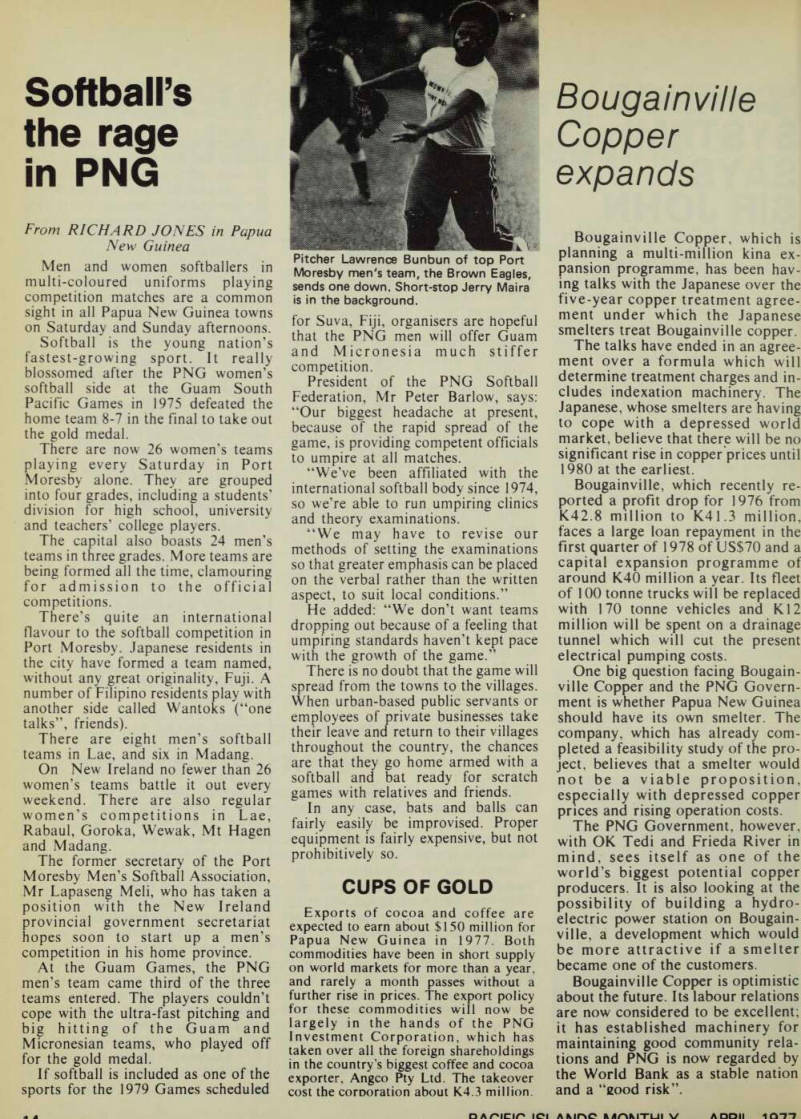
Pitcher Lawrence Bunbun of top Port Moresby men's team, the Brown Eagles, sends one down, Short-stop Jerry Maira is in the background.