System’
p. 13 · Read in the full issue
Change
Says
Sir John
Sir John Guise, Governor- General of Papua New Guinea until his resignation became effective on February 28, thinks his country should modify its Westminster style of government.
Sir John said in March he believ ed PNG should have what he called a “semi-Westminster system”, re taining its present parliamentary processes but appointing non elected members to the Cabinet.
Under his proposal the Police Commissioner and the Defence Force commander would be among officials holding Cabinet rank.
But he doesn’t want a republic and he believes PNG should remain a member of the Commonwealth of Nations.
This was the first time Papua New Guinea had heard Sir John’s detail ed opinions on government since his disenchantment with the office of Governor-General.
He refused to discuss detailed reasons for his resignation, saying “History will prove whether my ac tion was right or wrong.”
But he said he had acted in what he believed was the right spirit of the office, filling a position of liaison between “the ordinary man and woman and the government”.
He said this sometimes entailed
talking to 20 or 30 “ordinary peo ple” during the course of a day’s work “and without this nonsense of appointments and bureaucratic
red tape”.
Some sections of the government had not been in favour of what he was doing, and he had finally exer cised “my right as a private citizen to live as a private citizen”.
Sir John did not confirm or deny rumours that he is to re-enter politics.
But he had told pressmen earlier that he would not make up his mind for another three weeks about whether he would be a candidate in the general elections to be held in
May.
A group of children showered Sir John with frangipani petals as he left Government House in Port Moresby for the last time at sunset on Febru ary 28.
His successor as Governor- General, Sir Tore Lokoloko, was sworn in on March 1.
In a speech following the ceremo ny, Sir Tore told a crowded parlia ment that Sir John was “a far from usual man”.
In a broad hint that he would like to see Sir John back in politics, he added: “I hope he will return as a statesman to continue giving his ser vice to the nation.”
Despite earlier indications that he would not be active in politics, Sir Tore foreshadowed an activist role for himself when he said that, as Governor-General, he wanted to be consulted and advised, and to give advice and make decisions, and not just be Head of State.
The new Governor-General doesn’t like the Government House decor which he has inherited from Sir John Guise.
Sir John had the interior walls decorated lavishly with tribal-type murals, with hard reds and blacks
predominating in the colours. But Sir Tore said in Port Moresby, “As far as I am concerned it looks too much like a museum”.
Many of the murals are painted directly on the walls, and Sir Tore plans to call in painters to brush them out. He said he would retain a few of the less-obtrusive murals, but the big ones covering large expanses of the interior walls would be removed.
While the work is being carried out Sir Tore is living in the guest bungalow in the grounds of Government House.
He expected to move into Government House late in March to prepare for receiving the Queen on March 23.
Sir John lived in the bungalow permanently during his term of office, and used Government House only for official occasions.
The new Governor-General and Lady Lokoloko have 10 children aged from six to 26. One is married.
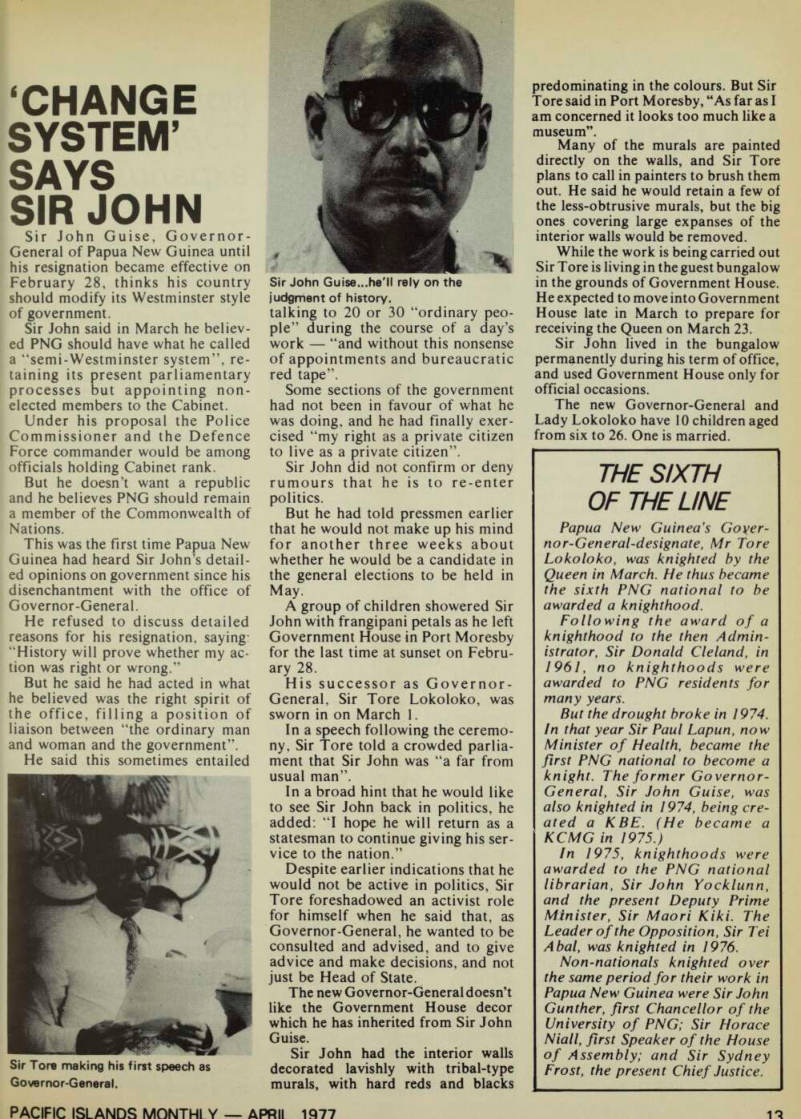
Sir Tore making his first speech as Governor-General.
Sir John Guise...he'll rely on the judgment of history.