Guam’S Gamblers Will Go To The
pp. 8-9 · Read in the full issue
Dogs But Not To Casinos
From TOM BRISLIN in Guam
The US Pacific Territory of Guam will move this year in the further sanc tioning of several types of organised gambling for the island.
A greyhound racing track is scheduled to open in the earlier part of the year, and another to begin con struction. Both will engage in pari mutuel wagering, approved and con trolled by the island government.
Both racing tracks are primarily supported by Asian-based investors who hope to capitalise on Guam’s fledgling tourist industry which, to date, has offered first-class beachfront hotels and duty-free shopping, but lit tle in the way of organised recreational activities.
The institution of pari-mutuel bet ting was approved last year by the island government in a move to in crease local revenues. Measures call ing for the legalisation of complete casino-type gambling, however, fell far short of government and com munity acceptance.
Several highly-spirited public debates both for and against casino gambling marked the year on Guam.
Most hotel interests attempted to gather support for the legalisation of casino gambling as the catalyst to bring Guam out of its economic slump.
A small but significant core of island legislators at first expressed support of the idea, but most recanted when community support proved adverse and they became afraid that their position would seriously hamper their re-election chances late last year.
The Governor of Guam, Ricardo J.
Bordallo, has been outspoken in his opposition to casino-type gambling on the grounds that it would likely in troduce elements of organised crime to the island and destroy the traditional life-styles.
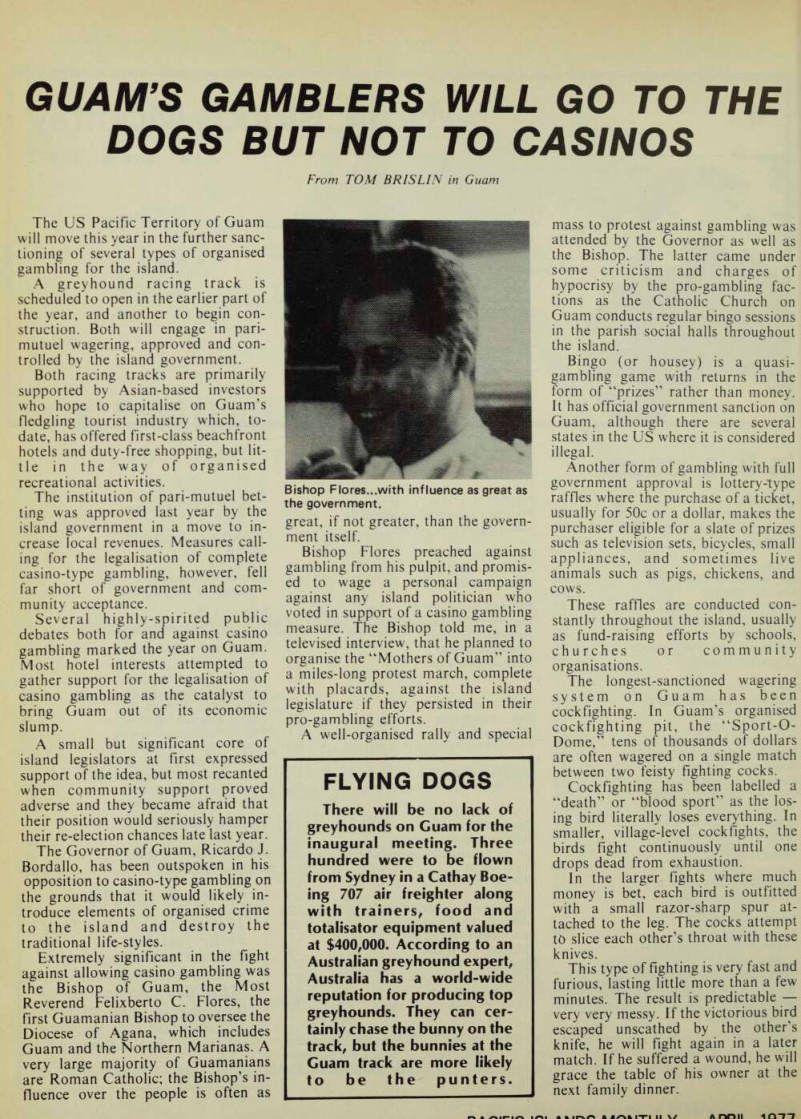
Extremely significant in the fight against allowing casino gambling was the Bishop of Guam, the Most Reverend Felixberto C. Flores, the first Guamanian Bishop to oversee the Diocese of Agana, which includes Guam and the Northern Marianas. A very large majority of Guamanians are Roman Catholic; the Bishop’s in fluence over the people is often as
great, if not greater, than the govern ment itself.
Bishop Flores preached against gambling from his pulpit, and promis ed to wage a personal campaign against any island politician who voted in support of a casino gambling measure. The Bishop told me, in a televised interview, that he planned to organise the “Mothers of Guam” into a miles-long protest march, complete with placards, against the island legislature if they persisted in their pro-gambling efforts.
A well-organised rally and special
mass to protest against gambling was attended by the Governor as well as the Bishop. The latter came under some criticism and charges of hypocrisy by the pro-gambling fac tions as the Catholic Church on Guam conducts regular bingo sessions in the parish social halls throughout the island.
Bingo (or housey) is a quasi gambling game with returns in the form of “prizes” rather than money.
It has official government sanction on Guam, although there are several states in the US where it is considered illegal.
Another form of gambling with full government approval is lottery-type raffles where the purchase of a ticket, usually for 50c or a dollar, makes the purchaser eligible for a slate of prizes such as television sets, bicycles, small appliances, and sometimes live animals such as pigs, chickens, and cows.
These raffles are conducted con stantly throughout the island, usually as fund-raising efforts by schools, churches or community organisations.
The longest-sanctioned wagering system on Guam has been cockfighting. In Guam’s organised cockfighting pit, the “Sport-O- Dome,” tens of thousands of dollars are often wagered on a single match between two feisty fighting cocks.
Cockfighting has been labelled a “death” or “blood sport” as the los ing bird literally loses everything. In smaller, village-level cockfights, the birds fight continuously until one drops dead from exhaustion.
In the larger fights where much money is bet, each bird is outfitted with a small razor-sharp spur at tached to the leg. The cocks attempt to slice each other’s throat with these knives.
This type of fighting is very fast and furious, lasting little more than a few minutes. The result is predictable very very messy. If the victorious bird escaped unscathed by the other’s knife, he will fight again in a later match. If he suffered a wound, he will grace the table of his owner at the next family dinner.
Bishop Flores...with influence as great as the government.
Cockfighting is a traditional sport on Guam, a remnant of the Spanish culture, and no attempt has been made by the government to outlaw it.
Only the wagering is controlled and duly recorded for tax purposes.
There is a tremendous amount of il legal gambling that occurs on Guam, mostly games of card and dice. Police raids on gambling “dens” often gather some quite prominent local citizens into the net.
The game of poker is perhaps the most favoured form of illegal gambl ing. This can be seen at any of the Guamanian funeral wakes, where for three days before the funeral prayers are said for the deceased.
In older times, the trek from one village to another took a complete day, so attendants at a wake always stayed in and around the home of the host, and were treated to daily feasts.
This tradition still holds and Guama nian wakes are also times of fiesta style eating and drinking as well as praying.
Since the men are expected to per form an all-night vigil during the three days, they pass their time by playing cards and wagering.
At christening fiestas for newborn babes one is also likely to see the men retreat to a room in the house for some serious card playing and wager ing. Often a portion of the winnings is donated to the newborn.
There was a brief period several years ago when Guam taverns and bistros contained electronic slot machines that were played with regularity. The machines did not pay off in cash, but rather in tallied “points” that could be translated into further free replays of the machine.
When the player tallied enough points, he would simply inform the proprietor that the machine had malfunctioned, and could he please have a cash rebate for his ac cumulated points.
It was a silly ritual, but practised with straight faces by everyone to avoid charges of direct gambling.
The future outlook for gambling on Guam is dim to dark. With such strong opposition to organised casino gambling from both government and church sources, it is doubtful that the issue will re-emerge soon.
Saipan has outlawed gambling, and it is doubtful that they will re-enter the field, even though they are hoping to build a tourist-based economy.
In the meantime, there are still plenty of ways Guamanians can wager part of their pocket money.