It's Not The Suitor Who Goes
p. 35 · Read in the full issue
On His Knees On Niue
From Stafford L. K. Guest on Niue.
Polynesian courting and marriage customs are many and varied.
Although some of the traditional rituals are slowly dis appearing some of the older islanders are maintaining customary procedure for marriage proposals and wedding ceremonies for their children.
On Niue Island (population 3,700), one of the largest coral islands in the world situated in the triangle formed by Tonga, Samoa and the Cook Islands, bride selec tion by a boy’s parents has slowly gone out of fashion. But many parents still observe a type of for mal marriage proposal custom.
I recently had the honour of participating in a Niuean uta vagahau which is a party of delegates who visit a girl’s parents to ask for a bride.
In this case, a boy’s father had travelled 1,400 miles from Auckland to Niue to seek permis sion for his son to marry.
The courting couple both live in Auckland and were not present at the meeting.
The young man’s father arrang ed an appointment with the girl’s parents and at the agreed time turned up with seven members of his family. Although the delegates did not enter the discussion, their presence appeared to provide moral support for the boy’s father.
During the discussion the ques tion of venue for the marriage was raised. The boy’s father suggested that the couple marry in Auckland in 10 months time. The girl’s parents readily consented.
Unlike a traditional marriage proposal, the boy’s father did not offer gifts or food to the girl’s parents. I was told that in past years a young man’s parents could turn up to a uta vagahau with presents, food and money only to be told ”our daughter is worth much more than this go away and come again”.
The girl’s parents in this inst ance did not expect gifts and offered the visiting delegation
refreshments and food at the end of the talks.
Up until the mid-ISOOs Niue was strongly divided. Those who lived in the northern part of the island, and whose ancestors are believed to have migrated from Samoa, seldom had contact with those in the southern part of the island who were believed to be descendants of Tongan war par ties.
Inter marriage was uncommon.
In pre-missionary times com munities in the north and south of the island were constantly at war.
Important warriors or toas would sometimes choose wives when the girls were born. These marriages were usually for the purpose of cementing family alliances.
Edwin Loeb in History and Tradition of Niue (published in 1926) states that adult proposals took the form of a man sending a taro pudding usually about a fathom in length, to the woman he wanted to marry. If the woman refused the proposal her mother or aunt ate the pudding.
The acceptance of a proposal ended with a large feast. As in the islands, women preferred men who were brave warriors, good planters and fishermen. Men preferred women who were skilful weavers and virgins.
In post-missionary days, ’ living
together” without having been
through a formal religious
ceremony was frowned upon.
When Niue was annexed to New Zealand in 1903 a Suppression of Immorality ordinance was intro duced. This act gave the Resident Commissioner power to fine un
married people ’’living together as
man and wife to the scandal of the community” and to impose fines on single women living 'in sin” with married men.
This act is not enforced on Niue
nowadays. Many young couples
who marry often already have several children. Marriage ceremonies are held in church followed by a large feast.
After the feast the couple will sit together while relatives and friends place paper money in their hair and lengths of material are wound around them.
Guests will also roll coins into material stretched in front of the
bride and bridegroom offering
blessings.
Niueans, although now self governing, have retained New Zealand citizenship and with the ever-increasing trend for young people to migrate to Auckland many traditional customs are
slowly disappearing.
It is those families who retain the old customs, although in a less formal manner, who will make sure they do not disappear com pletely.
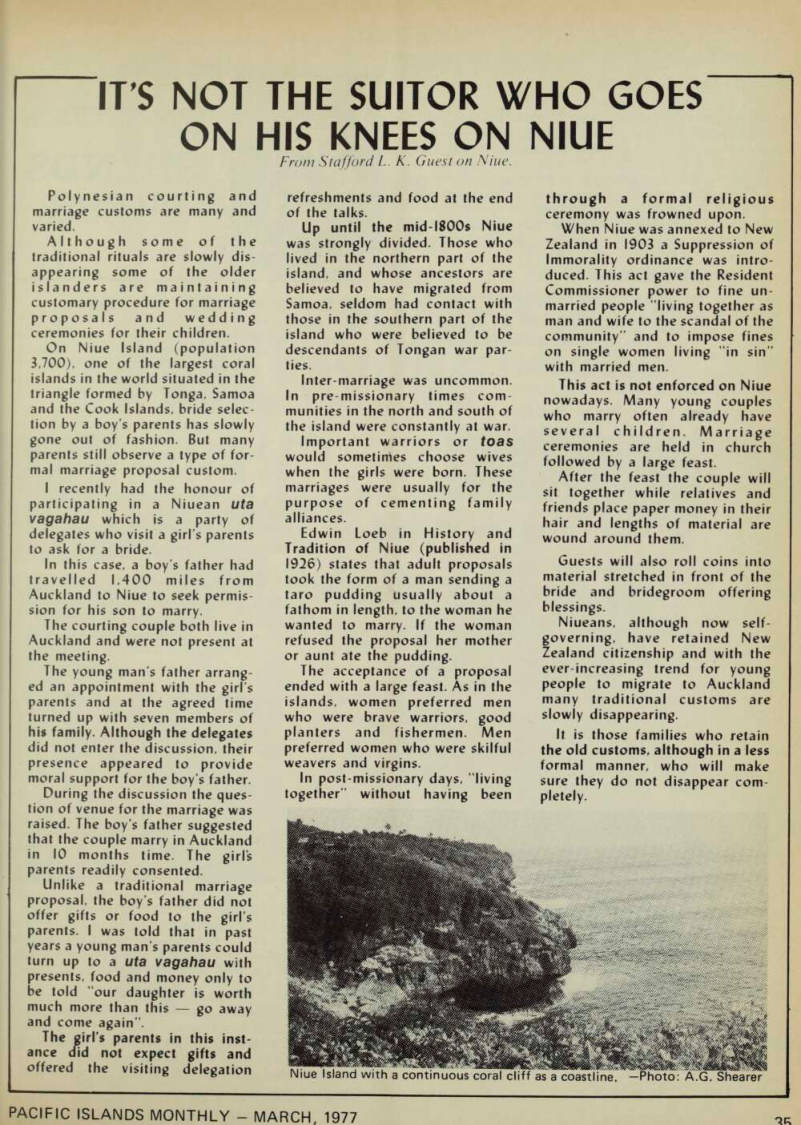
Niue Island with a continuous coral cliff as a coastline. —Photo: A.G. Shearer