Tropicalities
pp. 23-25 · Read in the full issue

PNG’s bird flies
over a garage
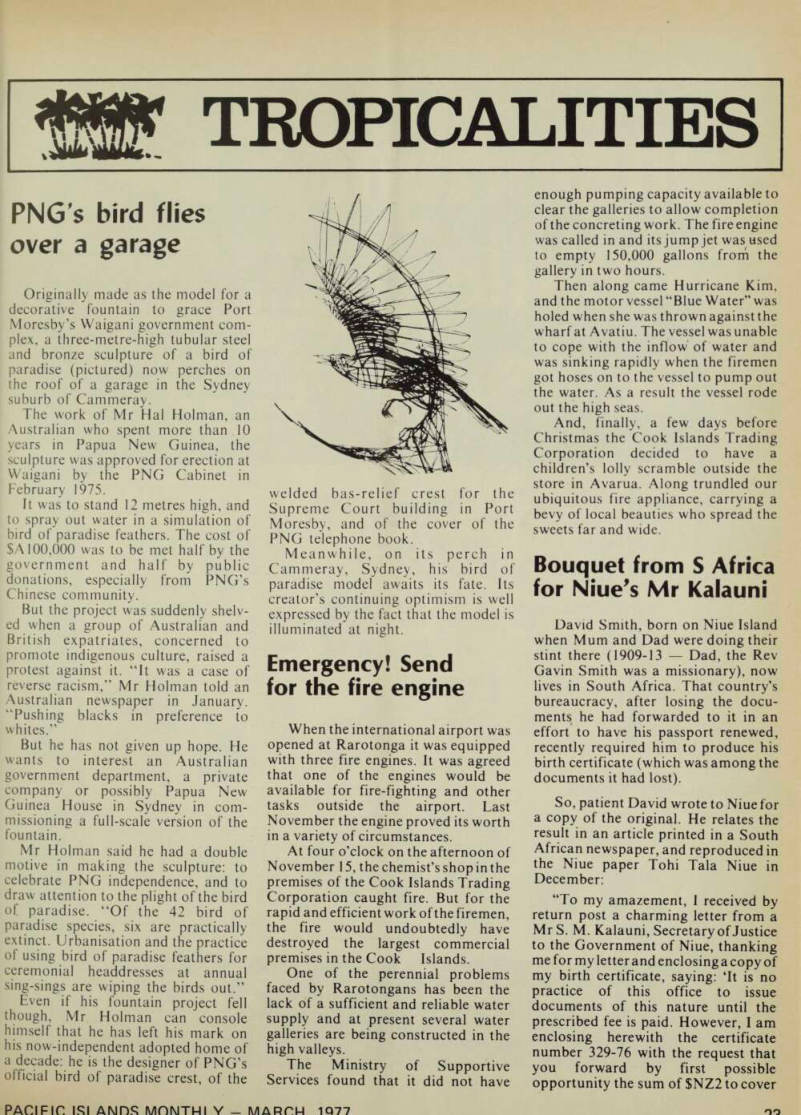
Originally made as the model for a decorative fountain to grace Port Moresby’s Waigani government com plex, a three-metre-high tubular steel and bronze sculpture of a bird of paradise (pictured) now perches on the roof of a garage in the Sydney suburb of Cammeray.
The work of Mr Hal Holman, an Australian who spent more than 10 years in Papua New Guinea, the sculpture was approved for erection at Waigani by the PNG Cabinet in February 1975.
It was to stand 12 metres high, and to spray out water in a simulation of bird of paradise feathers. The cost of $A 100,000 was to be met half by the government and half by public donations, especially from PNG’s Chinese community.
But the project was suddenly shelv ed when a group of Australian and British expatriates, concerned to promote indigenous culture, raised a protest against it. “It was a case of reverse racism,” Mr Holman told an Australian newspaper in January.
“Pushing blacks in preference to whites.”
But he has not given up hope. He wants to interest an Australian government department, a private company or possibly Papua New Guinea House in Sydney in com missioning a full-scale version of the fountain.
Mr Holman said he had a double motive in making the sculpture: to celebrate PNG independence, and to draw attention to the plight of the bird of paradise. “Of the 42 bird of paradise species, six are practically extinct. Urbanisation and the practice of using bird of paradise feathers for ceremonial headdresses at annual sing-sings are wiping the birds out.”
Even if his fountain project fell though, Mr Holman can console himself that he has left his mark on his now-independent adopted home of a decade: he is the designer of PNG’s official bird of paradise crest, of the
welded bas-relief crest for the Supreme Court building in Port Moresby, and of the cover of the PNG telephone book.
Meanwhile, on its perch in Cammeray, Sydney, his bird of paradise model awaits its fate. Its creator’s continuing optimism is well expressed by the fact that the model is illuminated at night.
Emergency! Send
for the fire engine
When the international airport was opened at Rarotonga it was equipped with three fire engines. It was agreed that one of the engines would be available for fire-fighting and other tasks outside the airport. Last November the engine proved its worth in a variety of circumstances.
At four o’clock on the afternoon of November 15, the chemist’s shop in the premises of the Cook Islands Trading Corporation caught fire. But for the rapid and efficient work of the firemen, the fire would undoubtedly have destroyed the largest commercial premises in the Cook Islands.
One of the perennial problems faced by Rarotongans has been the lack of a sufficient and reliable water supply and at present several water galleries are being constructed in the high valleys.
The Ministry of Supportive Services found that it did not have
enough pumping capacity available to clear the galleries to allow completion of the concreting work. The fire engine was called in and its jump jet was used to empty 150,000 gallons from the gallery in two hours.
Then along came Hurricane Kim, and the motor vessel “Blue Water” was holed when she was thrown against the wharf at Avatiu. The vessel was unable to cope with the inflow of water and was sinking rapidly when the firemen got hoses on to the vessel to pump out the water. As a result the vessel rode out the high seas.
And, finally, a few days before Christmas the Cook Islands Trading Corporation decided to have a children’s lolly scramble outside the store in Avarua. Along trundled our ubiquitous fire appliance, carrying a bevy of local beauties who spread the sweets far and wide.
Bouquet from S Africa
for Niue’s Mr Kalauni
David Smith, born on Niue Island when Mum and Dad were doing their stint there (1909-13 — Dad, the Rev Gavin Smith was a missionary), now lives in South Africa. That country’s bureaucracy, after losing the docu ments he had forwarded to it in an effort to have his passport renewed, recently required him to produce his birth certificate (which was among the documents it had lost).
So, patient David wrote to Niue for a copy of the original. He relates the result in an article printed in a South African newspaper, and reproduced in the Niue paper Tohi Tala Niue in December; “To my amazement, 1 received by return post a charming letter from a Mr S. M. Kalauni, Secretary of Justice to the Government of Niue, thanking me for my letter and enclosing a copy of my birth certificate, saying: ‘It is no practice of this office to issue documents of this nature until the prescribed fee is paid. However, I am enclosing herewith the certificate number 329-76 with the request that you forward by first possible opportunity the sum of $NZ2 to cover
the expenses involved in producing this document.
“‘I am also enclosing undercover of this letter pamphlets about Niue which I hope you will find interesting. These are sent with the compliments of the Niue Government.’ ”
Mr Smith commented: “What a contrast to the usual departmental correspondence. I found the brochure highly interesting . . .
“Written in the Secretary’s hand writing alongside photographs in the brochure were remarks like ‘This would be your house’, and This was your father’s church’.
“Oh for a civil service like this!”
Solomons schoolboys
"hoard of history”
What is described as “a hoard of Solomons history” was discovered in January by a group of students from the Roman Catholic Vocational School at Vanga Point, Kolom bangara Island in the Western Solomons.
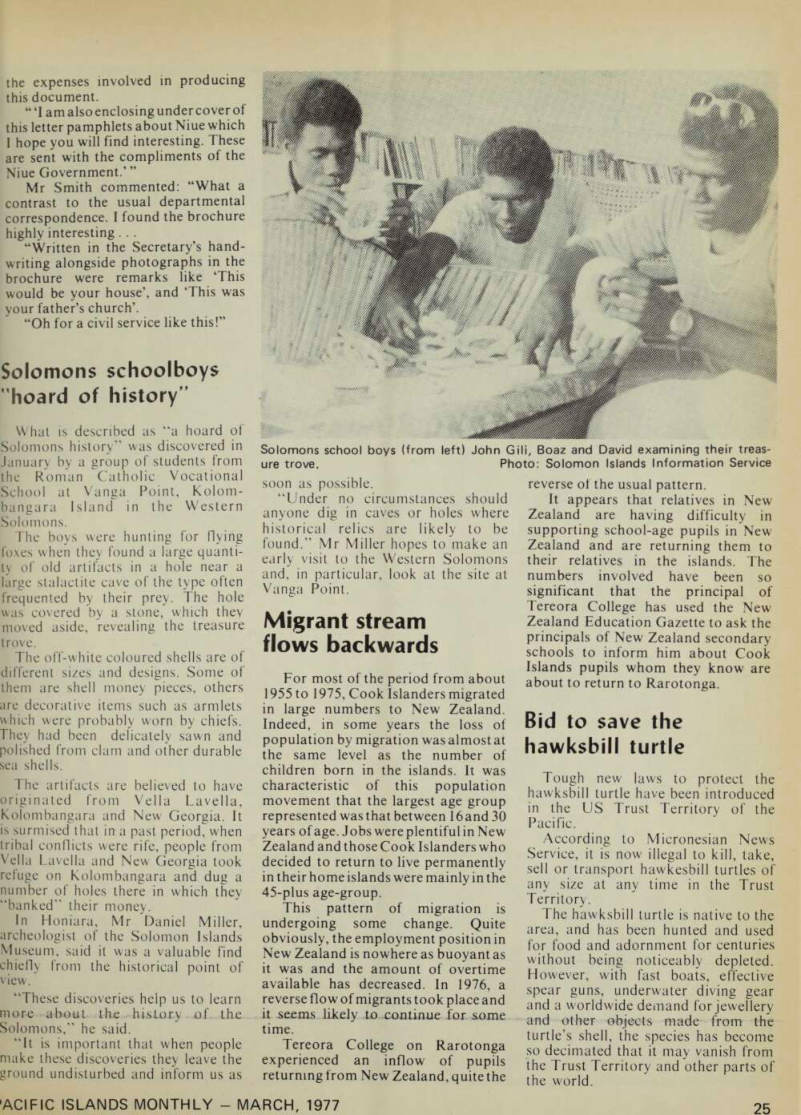
The boys were hunting for flying foxes when they found a large quanti ty of old artifacts in a hole near a large stalactite cave of the type often frequented by their prey. The hole was covered by a stone, which thev moved aside, revealing the treasure trove.
The off-white coloured shells are of different sizes and designs. Some of them are shell money pieces, others are decorative items such as armlets which were probably worn by chiefs.
They had been delicately sawn and polished from clam and other durable sea shells.
The artifacts are believed to have originated from Vella Lavella, Kolombangara and New Georgia. It is surmised that in a past period, when tribal conflicts were rife, people from Vella Lavella and New Georgia took refuge on Kolombangara and dug a number of holes there in which they “banked” their money.
In Honiara, Mr Daniel Miller, archeologist of the Solomon Islands Museum, said it was a valuable find chiefly from the historical point of view.
“These discoveries help us to learn more about the history of the Solomons,” he said.
“It is important that when people make these discoveries they leave the ground undisturbed and inform us as
soon as possible.
“Under no circumstances should anyone dig in caves or holes where historical relics are likely to be found.” Mr Miller hopes to make an early visit to the Western Solomons and, in particular, look at the site at Vanga Point.
Migrant stream
flows backwards
For most of the period from about 1955 to 1975, Cook Islanders migrated in large numbers to New Zealand.
Indeed, in some years the loss of population by migration was almost at the same level as the number of children born in the islands. It was characteristic of this population movement that the largest age group represented was that between 16 and 30 years of age. Jobs were plentiful in New Zealand and those Cook Islanders who decided to return to live permanently in their home islands were mainly in the 45-plus age-group.
This pattern of migration is undergoing some change. Quite obviously, the employment position in New Zealand is nowhere as buoyant as it was and the amount of overtime available has decreased. In 1976, a reverse flow of migrants took place and it seems likely to continue fox some time.
Tereora College on Rarotonga experienced an inflow of pupils returning from New Zealand, quite the
reverse of the usual pattern.
It appears that relatives in New Zealand are having difficulty in supporting school-age pupils in New Zealand and are returning them to their relatives in the islands. The numbers involved have been so significant that the principal of Tereora College has used the New Zealand Education Gazette to ask the principals of New Zealand secondary schools to inform him about Cook Islands pupils whom they know are about to return to Rarotonga.
Bid to save the
hawksbill turtle
Tough new laws to protect the hawksbill turtle have been introduced in the US Trust Territory of the Pacific.
According to Micronesian News Service, it is now illegal to kill, take, sell or transport hawkesbill turtles of any size at any time in the Trust Territory.
The hawksbill turtle is native to the area, and has been hunted and used for food and adornment for centuries
without being noticeably depleted.
However, with fast boats, effective spear guns, underwater diving gear and a worldwide demand for jewellery and other objects made from the turtle’s shell, the species has become so decimated that it may vanish from the Trust Territory and other parts of the world.
Solomons school boys (from left) John Gili, Boaz and David examining their treas ure trove.
Photo: Solomon Islands Information Service