Somare In Indonesia -
pp. 14-15 · Read in the full issue
Two Worlds Meet
From GUS SMALES in Port Moresby
Indonesia, adjoining Papua New Guinea and outnumbering it in population by 40 to one, has long projected a bogey image to most Papua New Guineans.
The situation goes back to the
early 1960 s when Indonesia launch
ed a mini-war (one paratrooper per half mile dropped in darkness) against the Dutch, who then con trolled the western half of the New Guinea land mass.
The intervention by the United Nations, the international disavowal of any Dutch rights and Indonesia’s subsequent take-over of what is now Irian Jaya became a highly emotive chapter in Asian and Pacific history.
“Liberation” the Indonesians called it, but many Papua New Gui neans who recognise an ethnic brotherhood on the western side of their land mass, have never been quite convinced.
For the first time they saw the hardships and inconveniences which a strictly-controlled border can bring to border-dwelling families, and in the years which followed the take-over there have been frequent allegations from border-crossing refugees of Indonesian repression.
In recent years a more sophisti cated and doctrinaire attitude has entered the criticism.
So-called Black Power supporters in Papua New Guinea have branded Indonesia as a neo-colonialist na tion intruding on Melanesia, and in one incident which strained the offi cial friendship between the two countries, university students in Port Moresby trampled an Indone sian flag.
Politicians, too, have not been slow to sense the feeling of the elec torate and in a milder way have ad ded to the erosion of the Indonesian popularity poll.
The practically-minded Papua New Guinea Government has found itself in an invidious position, balancing on one hand the obvious need for a peaceful co-existence and on the other the more emotional issues at home.
Where Papua New Guinea has been satisfied that border crossers
have a legitimate or humane right under international protocol to re main in Papua New Guinea, refuge has been granted.
Recently 157 permissive residents who came across the border more than five years ago were granted citizenship, a move which irritated Indonesia and added to undercur rents of friction.
Officially the two countries are friendly neighbours; each has an embassy in the other’s capital, and of all the borders which Papua New Guinea shares with its neighbours the Indonesian one is the only one properly defined and established by mutual treaty.
Officially, too, the Papua New Guinea Prime Minister, Mr Somare, has always preached friendship, co operation and close ties with In donesia, although his comments have often suggested an element of no option in the arrangement.
“You don’t annoy a sleeping lion,” he told his parliament not long ago, with an eye to the disparity in size, population and strength be tween the two countries.
This was the background against which Mr Somare recently accepted an invitation from President Suhar to of Indonesia and spent a one week state visit there, leaving behind the political sniping of some of his countrymen who accused him of playing to the Indonesian camp.
The first point which was brought home very quickly to members ot Mr Somare’s party was that there is little deep-seated similarity between the Indonesian brand of national security and nationhood and the Papua New Guinean brand.
This has nothing to do with the acceptability of co-existence and co operation, but it strengthened Mr Somare’s belief which he ex pressed strongly at the end of the tour that Indonesia is an integral part of South-east Asia and Papua New Guinea is an integral part of the Pacific.
If PNG can be a bridge between two regions it will gladly accept the responsibility, Mr Somare said, but any connection with ASEAN will be
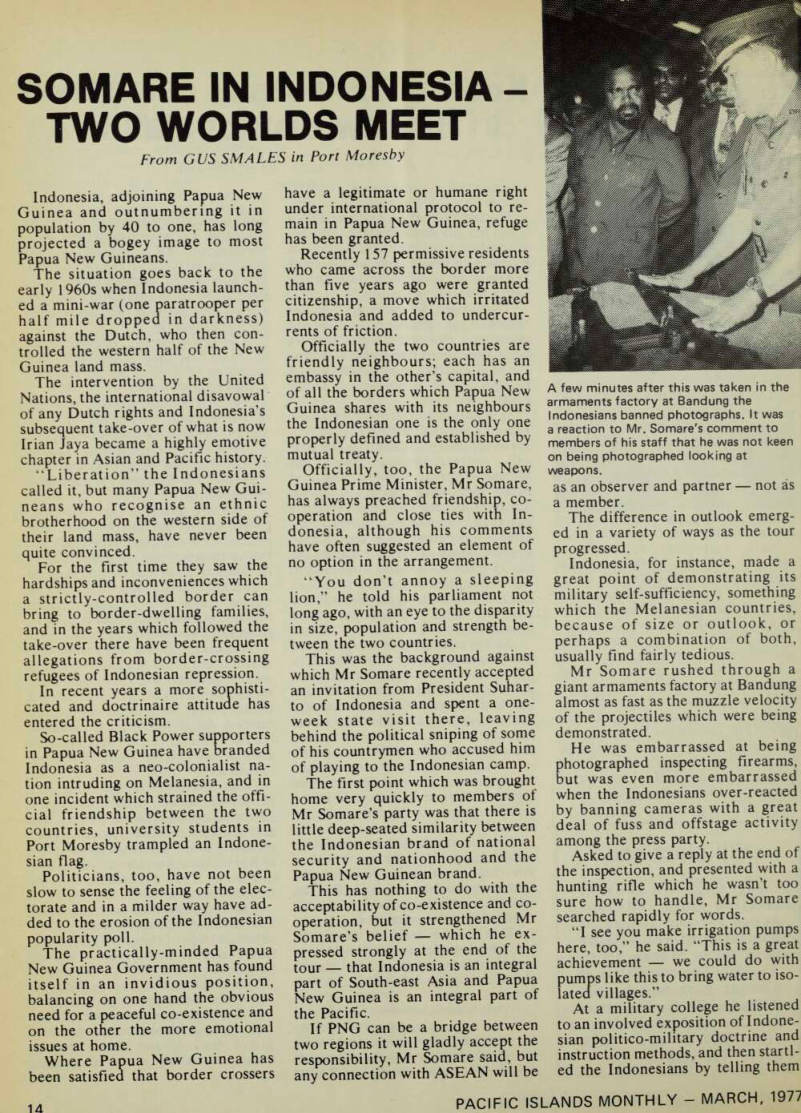
A few minutes after this was taken in the armaments factory at Bandung the Indonesians banned photographs. It was a reaction to Mr. Somare's comment to members of his staff that he was not keen on being photographed looking at weapons. as an observer and partner not as a member.
The difference in outlook emerg ed in a variety of ways as the tour
progressed.
Indonesia, for instance, made a great point of demonstrating its military self-sufficiency, something which the Melanesian countries, because of size or outlook, or perhaps a combination of both, usually find fairly tedious.
Mr Somare rushed through a giant armaments factory at Bandung almost as fast as the muzzle velocity of the projectiles which were being demonstrated.
He was embarrassed at being photographed inspecting firearms, but was even more embarrassed when the Indonesians over-reacted by banning cameras with a great deal of fuss and offstage activity among the press party.
Asked to give a reply at the end of the inspection, and presented with a hunting rifle which he wasn’t too sure how to handle, Mr Somare searched rapidly for words.
“I see you make irrigation pumps here, too,” he said. “This is a great achievement we could do with pumps like this to bring water to iso lated villages.”
At a military college he listened to an involved exposition of Indone sian politico-military doctrine and instruction methods, and then startl ed the Indonesians by telling them
he was not aware of the details of the curriculum at his own Joint Services Training College in Lae.
Immersed in dedication to their own structure, the Indonesians seemed unsure whether Mr Somare was pulling their leg or playing a very deep game.
The large-scale use of military personnel for civilian and security type duties was another activity which Mr Somare found at odds with his own type of society.
From a political and diplomatic point of view the focal point of the tour and the point which prob ably least is known about was the two-hour private talk held in Jakar ta between Mr Somare and Presi dent Suharto.
The bones of it emerged in the of ficial and fairly generalised com munique which the two leaders released, but the details have yet to be written.
One thing was obvious, however, and that was that Mr Somare came away from the talks much more at ease over his country’s relationship with Indonesia.
He is believed to be satisfied that much of the friction over border crossers arises from military fac tions directly associated with border affairs, and that the Indonesian leadership puts the border situation into a far more rational perspective.
In the official communique the two leaders agreed that “measures had to be taken’’ to prevent the border being used by groups who crossed in either direction to plan subversion against the other side.
The two leaders also agreed in the communique that the affairs of East Timor, where Indonesia took over last year, were internal matters for Indonesia.
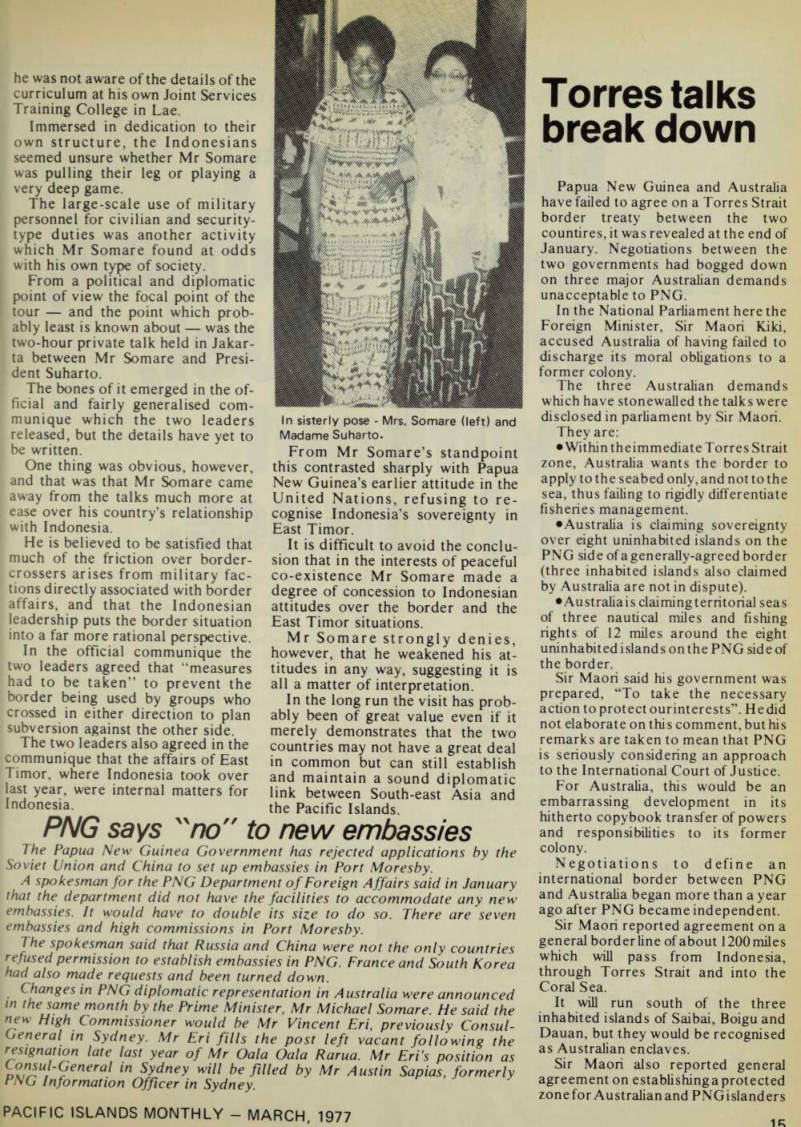
In sisterly pose - Mrs. Somare (left) and Madame Suharto.
From Mr Somare’s standpoint this contrasted sharply with Papua New Guinea’s earlier attitude in the United Nations, refusing to re cognise Indonesia’s sovereignty in East Timor.
It is difficult to avoid the conclu sion that in the interests of peaceful co-existence Mr Somare made a degree of concession to Indonesian attitudes over the border and the East Timor situations.
Mr Somare strongly denies, however, that he weakened his at titudes in any way, suggesting it is all a matter of interpretation.
In the long run the visit has prob ably been of great value even if it merely demonstrates that the two countries may not have a great deal in common but can still establish and maintain a sound diplomatic link between South-east Asia and the Pacific Islands.