signposts on the way ahead
pp. 8-76 · Read in the full issue
The Independent Gilberts
Chief Minister looks at the signposts on the way ahead
The Gilbert islanders expect to declare their independence from Britain in June, 1978. How do they view their chances of success as a free and independent state? What about the Banabans’ demand for transfer of sovereignty of their former home, Ocean Island, fromthe Gilberts toFiji?How do the Gilberteseseetheir future relationship with the Ellice islanders, former partners in the Crown Colony, who also hope for independence in 1978? Speaking for his people in an interview on January 6 with Barrie MacDonald, Lecturer in Pacific History at Massey University (NZ), Mr Naboua Ratieta, Chief Minister of the Gilberts, gives answers to these questions, and many others, in the report below. The Chief Minister agreed to the interview provided it appeared in PIM.
Barrie MacDonald is in the Gilberts helping with a Workshop on a history of the Gilbertese people.
MACDONALD: Chief Minister, shortly after your return from the constitutional talks in London, you announced that self-government would be introduced on November 1, 1976; the British Government then put the date back to January 1,1977. Why?
RATIETA: I think it was because the British Government acted for political expediency; I think they would like to please other people, other than the Gilberts and they would like to show that they are giving all the chances to try to make peace with everybody concerned like us, the Rabi Islanders and the Fijians (because the Ocean Islanders are citizens of Fiji now). Also, because they said they believed that the decision of the court could have a bearing on the implementation of self government if we were given it on November 1 before the court decision came out, so they asked us to defer the thing until January 1.
MACDONALD: In the House of Assembly’s recent meeting you introduced a motion which criticised the intervention of third parties in your relationship with the British Govern ment. You did not name names at that time but the motion was apparently directed at Fiji. Was this the case, and how has this incident affected your relationship with Fiji and other Pacific countries?
RATIETA: Well, in the interests of regionalism I thought that Fiji should not have intervened in these cases without consulting us because, after all, we are moving towards a fuller consultation between sovereign nations in the Pacific and if one leader of one nation goes behind the others’
backs and does his thing with the British Government then I think it is not in the interests of co-operation as
friendly neighbours.
MACDONALD: Do you intend to raise this issue at the next meeting of the South Pacific Forum?
RATIETA: I don’t know. I think things have cooled off and people, despite their first angry reaction to this intervention, seem to be able to understand Fiji’s position now as acting on behalf of its citizens, the Banabans, and not, as before, of trying to become an impartial mediator.
MACDONALD: What was your reaction to the court decisions on the Banaban case?
RATIETA: I think we are very happy that there is nothing in the judgments in these cases that affects us or our independence, or ourinternal self-government, or our share of the
royalties.
MACDONALD: Do you expect further talks on independence?
RATIETA: I made it clear to the
minister in London responsible tor us, Lord Goronwy-Roberts, that there is no point in us meeting with the Banabans or anybody else if the Banabans insist on not considering anything but independence.
MACDONALD: Would you con tinue to oppose independence for Ocean Island after the exhaustion of phosphates in 1978?
RATIETA: Yes, we oppose independence not because of phos phate but as a matter of principle. It is one of our islands and it is not going to be taken by another country.
MACDONALD: Would you en visage Ocean Island being inhabited or used in any way after the exhaustion of phosphates?
RATIETA: Well, we thought it was going to be a very expensive exercise to live on Ocean Island after the exhaustion of phosphates but if some Ocean Islanders insist on living there then I think we should give them some kind of services.
MACDONALD: Phosphate is expected to finish in the second half of 1978, a few months after Gilbert Islands independence. What are the chances of the independent Gilberts being able to meet recurrent costs of
government?
RATIETA: As far as using our reserves is concerned, we have about $35 million in our reserves which is being kept by our brokers in London (James Capel). If we have to use those to balance our budget, provided we do not exceed our recurrent expenditure as at present, it will take about seven years to finish our royalties but we are planning to cut down unnecessary expenditure and also to find other means of supplementing our income,
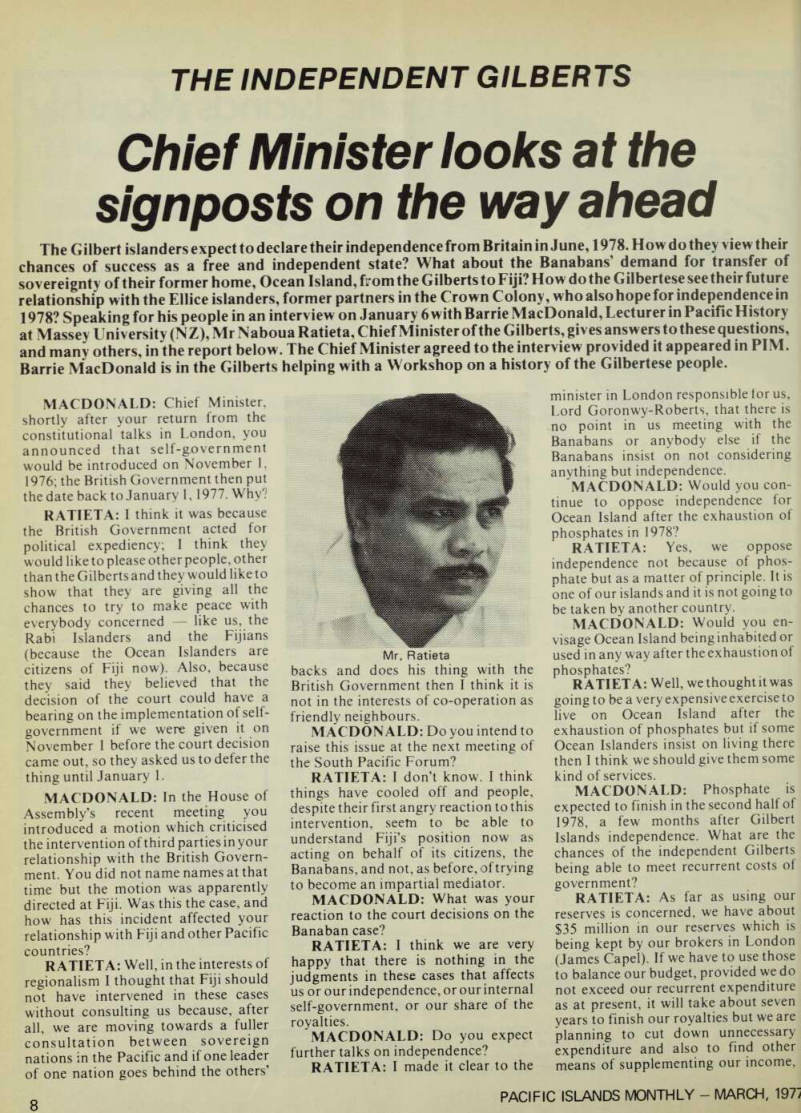
Mr. Ratieta
for example by fisheries. As you know, we have been negotiating with the Japanese to establish a fisheries industry here. They came here in December and had an on-shore-based survey. On the results of this survey they are going to send another survey which is going to bring a ship. But thing that the Japanese have been emphasising to us is that their hands are tied because we are not yet independent and, maybe when we are independent, they can give us more money; as you know they will not then be restricted by their regulations governing their aid to other countries.
MACDONALD: You said the reserves might last seven years; do you expect to use the capital of the reserve fund as well as the interest from it?
RATIETA: We don’t want to but if we have to use the capital and interest it will take only seven years to finish the reserves but we hope by that time we will have discovered other income. We are hoping that the brine shrimp industry at Christmas Island will come into production very shortly.
MACDONALD: As far as the development budget is concerned, your major source of aid is still the United Kingdom with, for 1977, about $2,7 million, about $1 million from Australia and about $.2 million from New Zealand. Do you expect this pattern of aid to continue and do you expect, or hope for, any change with self-government or independence?
RATIETA: As I said, the Japanese said they will be able to give us more money after independence and we are hoping that, because we are nearer to the Australians and the New Zealanders, and because they think they would like to increase their aid to the Pacific countries, we might get more from them as time goes on. We are determined that in our indep endence talks we should be able to get something from the British Govern ment like the Seychelles are getting.
They have managed to get a deal that the British Government will balance their recurrent budget for the next five years after independence.
MACDONALD: So you will be looking for specific guarantees for development capital and perhaps, even, for recurrent expenditure?
Ratieta: Yes.
MACDONALD: The local con tribution to development expenditure for 1977 is about $1.5 million. One of the major budgeted areas for this expenditure is the purchase of Fanning and Washington islands; what is the
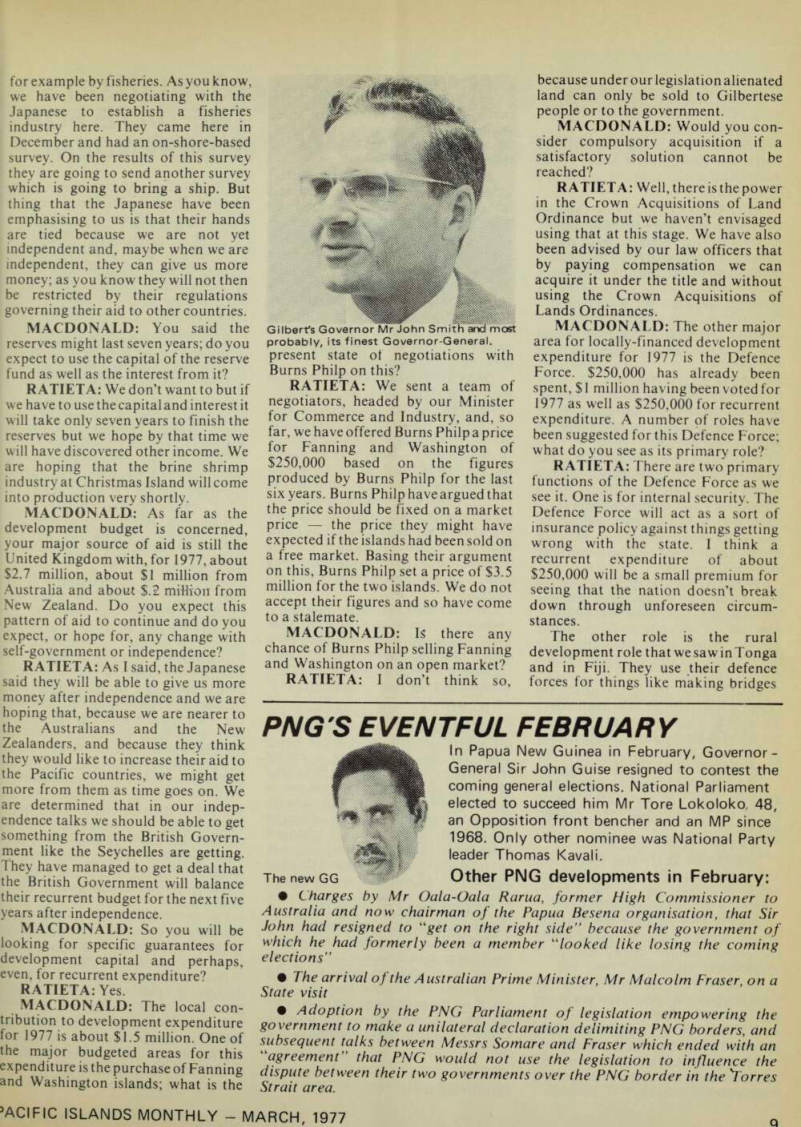
Gilbert's Governor Mr John Smith and most probably, its finest Governor-General. present state of negotiations with Burns Philp on this?
RATIETA: We sent a team of negotiators, headed by our Minister for Commerce and Industry, and, so far, we have offered Burns Philp a price for Fanning and Washington of $250,000 based on the figures produced by Burns Philp for the last six years. Burns Philp have argued that the price should be fixed on a market
price the price they might have
expected if the islands had been sold on a free market. Basing their argument on this. Burns Philp set a price of $3.5 million for the two islands. We do not accept their figures and so have come to a stalemate.
MACDONALD: Is there any
chance of Burns Philp selling Fanning
and Washington on an open market?
RATIETA: I don’t think so,
because under our legislation alienated land can only be sold to Gilbertese people or to the government.
MACDONALD: Would you con sider compulsory acquisition if a satisfactory solution cannot be reached?
RATIETA: Well, there is the power in the Crown Acquisitions of Land Ordinance but we haven’t envisaged using that at this stage. We have also been advised by our law officers that by paying compensation we can acquire it under the title and without using the Crown Acquisitions of Lands Ordinances.
MACDONALD: The other major area for locally-financed development expenditure for 1977 is the Defence Force. $250,000 has already been spent, $ 1 million having been voted for 1977 as well as $250,000 for recurrent expenditure. A number of roles have been suggested for this Defence Force; what do you see as its primary role?
RATIETA: There are two primary functions of the Defence Force as we see it. One is for internal security. The Defence Force will act as a sort of insurance policy against things getting wrong with the state. I think a recurrent expenditure of about $250,000 will be a small premium for seeing that the nation doesn’t break down through unforeseen circum stances.
The other role is the rural development role that wesawinTonga and in Fiji. They use their defence forces for things like making bridges
and causeways and we are also envisaging that we will do the same thing here with our Defence Force helping the councils.
Another thing is that the Defence Force will also perform some of the ceremonial duties that the police are doing now.
MACDONALD: Is this Defence Force seen as a strike-breaking unit?
RATIETA: Strikes lawful under our legislation but if the strikers do break laws like starting to burn the place down or looting shops or any of these things, then we would need a force trained to contain them.
MACDONALD: In a strike, would the force be used to run essential services?
RATIETA: It could be.
MACDONALD: If the primary function is internal security, why could this not be achieved by extending the present police force?
RATIETA: We are advised that the police as a law enforcement agency would not be able to do things that a well-trained and mobile security force could do. And we are cutting down on the police force where the Defence Force is taking over things previously done by them MACDONALD: 1976 also saw the final separation of the Ellice from the Gilberts with the Ellice becoming a separate dependancy under the name Tuvalu. What have been the main implications of this partition for the Gilbert Islands?
RATIETA: It seems that the Gilbertese have more jobs available to them. We’ve suffered in certain areas but we’ve managed so far, in others, say in the field of doctors, to continue employing Tuvaluan doctors here.
MACDONALD: How would you describe the present relationship between Tuvalu and the Gilbert Islands?
RATIETA: As amicable as ever.
MACDONALD: Has there been any noticeable effect from the loss of Ellice civil servants a loss of efficiency or a drop in standards?
RATIETA: We have not felt that very much because, in cases where Gilbertese cannot cope, we have employed expatriates.
MACDONALD: How many ex patriates have you employed as a direct result of separation?
RATIETA: I think we have increased by perhaps half-a-dozen.
MACDONALD: How many ex patriates are in the civil service and the Development Autority?
RATIETA: About 160.
MACDONALD: Are there time tables for the localisation of these positions or timetables for local isation you want to meet before
independence?
RATIETA: We have a Select Committee to go into this problem and its report is being considered by government at the moment. We have extended the terms of reference; before, committees have usually done this exercise for the Civil Service only.
But this last Select Committee has considered the Development Autority employees as well. I don’t think the Gilberts will ever get rid of all its expatriates but we will try to make them as few as possible.
MACDONALD: Are you satisfied with the present rate of localisation?
RATIETA: Yes, in a sense, because the driving force behind localisation before when we had a colonial type of government was that we would like to get Gilbertese to be policy makers and now, with a ministerial system, Gilbertese people are policy makers so it doesn’t really matter now who does what. Butsolongasweknow that the Gilbertese people are the bosses around the place the main thing now is to get jobs for the Gilbertese
people.
MACDONALD: The ministerial system has now been in operation for about three years and you have been Chief Minister for that time. What have been the major developments and changes in your role in that time?
RATIETA: When we had the membership system, just before the ministerial system, we did not know what do do and it was a rather frustrating experienc for us. But as the Governor at that time pointed out, it was a time for learning, and we were certainly learning. With the advent of the ministerial system we changed from being inactive to being active in the field of policy-making and that has made, I think, most of our ministers feel more self-confident.
MACDONALD: What have been the major difficulties or frustrations?
RATIETA: I think the major frustration is that we can’t do as much as we would like to because of the constraints of finance and the time taken on preparing a project here and
getting it approved by the Foreign
Commonwealth Office, which is not easy.
Continued on p. 76
MACDONALD: Are aid donors prepared to accept your priorities in terms of development expenditure or do you find that sometimes they attempt to impose priorities upon you?
RATIETA: Sometimes they at tempt to impose priorities, I think, largely, because the money is theirs and they’ve got this paternalistic attitude of using their money in the way they think will benefit us most, but not necessarily the way we think.
MACDONALD: The past three years have seen the emergence of a
‘government’ and an ‘opposition’.
What is it in terms of political philosophy that gives each of these groups its coherence and distinguishes between them?
RATIETA: I think that we haven’t got parties started off at the grass roots; parties here are more politicians’ clubs than anything else. What gets the people to converge in these so-called parties are the personalities concerned.
MACDONALD: Do you see party politics as being important at the next general election? Would you try to
establish a grass-roots organisation foi your National Progressive Party 01 would you be happier with you: members campaigning on a persona basis?
RATIETA: I think we will try i both ways because, even thougl parties have not been very successfu
here, parties are the coming thing
They are coming very slowly but the; are surely coming. In the case of th trade union movement, the union i becoming more and more political an< maybe will have a party based on th
labour philosophy.
MACDONALD: What sort c philosophy would you see your part being based on?
RATIETA: I think all parties in thi small place, where there aren’t any ric people, should have a tendency t become socialistic and we can’t sa that, because those people are goin labour, we are going conservative there aren’t any true blue-blood torie here.
MACDONALD: Looking at th composition of your present cabine seven of the eight members are froi the six northern islands and only or from the 10 southernmost islands c the group. Of the eight ministers fi\ are, or have been, associated with th Catholic Church. Do you see religio as a possible basis for party politics i the Gilbers?
RATIETA: I hope that the tim will never come. The decision t appoint ministers on my part is nc based on religion, or on geography, appoint the people that I think can d the job from among the people in th House within that limitation an people who I think can co-operal because the major advantage of havir parties here is that they get legislatio that government wants passed throug the House with a minimum of fuss an without any further need for lobbyinj MACDONALD: After a delay c two months, the Gilbert Islands is sell governing. What future steps do yo see on the path to independence?
RATIETA: We are setting ou target for independence for June, 197£ and this is known also to the Britis Government because we said thi during our meeting in London fo internal self-government. But befor we do that we would like to have th fullest consultation with the people o the constitution they would like V have. We are going to have Continued on p. 78
constitutional convention in May this year and after that we will know what kind of constitution should be drafted by the legal experts.
MACDONALD: The Gilbert Islands is due foranelection by March, 1978; do you see that election as confirming a constitution for in dependence?
RATIETA: Yes. The British Government insists on an election to show the other side of the coin whether there are people who do not like the constitution and, if so, they can vote for people who will oppose it.
MACDONALD: What sort of constitution would you prefer?
RATIETA: My personal opinion is to try to keep our constitution as simple and as inexpensive as possible so I would prefer to see a constitution like our neighbours in Nauru have.
MACDONALD: Looking for ward to independence, what sort of international relationships do you envisage for the Gilberts? Would they, for example, extend to the United Nations?
RATIETA: We are hoping after independence to beome members of the British Commonwealth of Nations and also to play our part in the Pacific amongst the Pacific sovereign states.
We would like to participate fully in the South Pacific Forum and the SPCand any other regional organisation in the Pacific.
We would like to be members of the specialised UN agencies like the World Health Organisation and the UNDP because we can benefit from them. But having a representative at the UN or a post in Washington or New York would be foolish. We have discussed this with other leaders in the Pacific and since some in the Pacific like Papua New Guina and Fiji, and Australia and New Zealand are members of the UN we can discuss our views and stand up together and they can take it to the United Nations for us.
Vanuaaku Pati
A resolution of the sth Con gress of the New Hebrides Na tional Party held in Tautu village, Malekula, decided that the party will henceforth be known as the Vanuaaku Pati. The resolution re jected the name “New Hebrides” as “a colonial relic” and declared that the country should hen ceforth be known as Vanuaaku, “Our Land”. The party’s name was changed as a consequence of this decision.