They’ll fly again from Nadzab,
pp. 57-62 · Read in the full issue
Pacific Transport
They’ll fly again from Nadzab, the war-time airstrip
Nadzab airport, which will replace the historic Lae airport on the north coast of Papua New Guinea, is ex pected to be open again by mid-1977, according to the PNG Department of Transport.
Nadzab, 38 km from Lae in the plain-like lower reaches of the Markham Valley, was one of a com plex of military airports established in PNG during the Pacific War.
The old runway has been complete ly reformed and resealed, and ter minal and service buildings are now almost complete.
In the course of last year there were complaints from some airline operators and the public about the shift of major airline operations from Lae to Nadzab. It was claimed that unless Nadzab was to be built to full international trunk standards and thus provide a new service, then the move was little more than an in convenience.
PNG’s Transport Minister, Mr Bruce Jephcott, then examined a rationalisation policy for the two air ports.
After the study, he said it was clear that many people in the Lae hinterland relied on cheap aircraft charters to market their produce in Lae and to buy supplies. Accordingly, the Lae airport would remain available for light aircraft on local operations, but in the interests of safe ty all other aircraft movements would use Nadzab.
The Lae airport, now in the centre of a built-up area, was established nearly 50 years ago to serve the New Guinea goldfields. For several years in the 1930 s it handled more air cargo than all other world airports com bined.
The Department of Transport has indicated that there would eventually be a review of the need for an international-standard airport at Nadzab, but this was not felt necessary at present.
After 30 years Nadzab is coming to life again, this time to play an impor tant part in Papua New Guinea’s air communications. And, for the second
time in three decades, Australia is playing a major part by providing K 6.16 million to cover the cost of civil works (K 3 million) being carried out by a South Korean firm, Hyundai Constructions, and buildings (K 2 million) being built by Morobe Constructions.
Hyundai, which recently completed three years contract work on Ramu hydro-power scheme in Madang Province, is responsible for strengthening and resurfacing the 8,000 ft wartime runway and a network of taxiways leading to an air port terminal.
Morobe Constructions is con tracted to build a terminal, operations and administration centre, control tower, fire stations, maintenance complex, transmitter/powerhouse, receiver building, water tower and chlorinator house and waste disposal building.
The airstrip has been designed to take Fokker Friendship aircraft, but long-range planning includes widen ing the strip to 150 ft to bring it up to Boeing 727 standards.
Climatically, Nadzab is a peculiar phenomenon, a relatively “arid" area in contrast to the dense tropical rain forest predominant in most other
areas of the country. Annual rainfall is 1,500 mm (350 inches), while on all sides, in a 30-mile radius, average an nual rainfall is as much as 4,753 mm (1,188 inches).
This can be partly explained by the presence of the rain-sapping Owen Stanley ranges to the south and west and its situation clear of coastal in fluence.
Nadzab is a perfect site for an air port, easily one of the best in Papua New Guinea. The base soil is ideal for runway construction, hence the rapid progress of work.
It was at Nadzab in September, 1943, that the Allies, under cover of dense bush, carved out a massive air base that was to be decisive in regain ing the northern mainland from the invading Japanese.
Paratroopers dropped from a darkened sky on September 5 and the following day the first aircraft landed carrying mini-bulldozers and earthmoving equipment specially designed for transport on DC3s.
An extract from a report prepared by the official diarist for the 2/6 Field Company at Nadzab gave the following account of September 6.
“0700 hours natives, paratroopers and engineers began
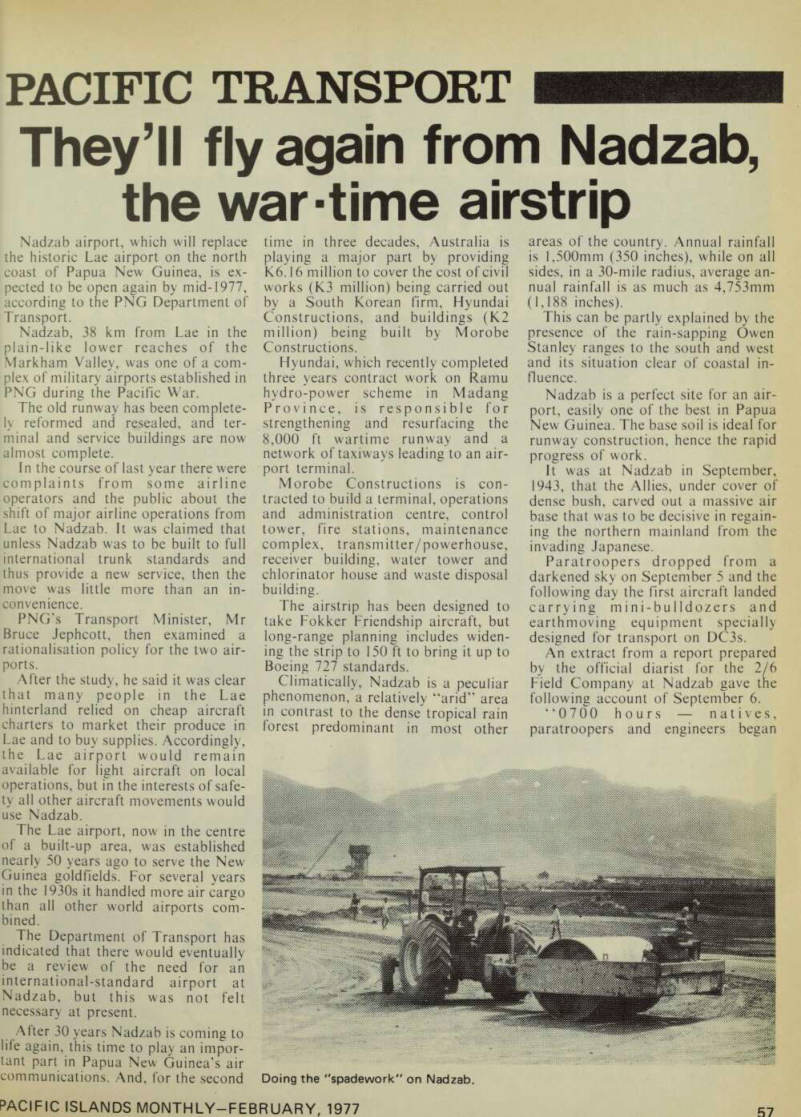
Doing the "spadework" on Nadzab.
work on clearing the airstrip. At 1100 hours, the first plane landed with heavy equipment and in the two hours from 1400 hours 40 planes landed.”
In the following three months con struction of the Nadzab complex, comprising four airstrips, laxiways, loading bays and extensive alert runways, was completed. Largest of the runways was No. I airstrip (7,000 ft) with 1,000 ft of Marsden matting runway added at each end. It provided for 200 fighters and bombers and had an alert runway of 1,000 ft.
These alert strips were an integral part of Nadzab and provided air i:rews with a Le Mans-type start in the event of air raids.
The No. 3 runway was also 7,000 ft with 1,000 ft of matting at each end und had facilities to handle 241 heavy bombers.
Nadzab was an advance air base designed to step up Allied strike power against Japanese strongholds in the north-western area of East Sepik Province. But important as its role was, Nadzab’s usefulness was quickly eroded as the war took its :ourse.
The bigger US Air Force bases iround Popondetta became the centre jf the Allied strike power with the in roduction of the 829 Super Fortress hat could fly non-slop from Manus o Japan and back with a full bomb oad.
Nadzab became an important ransport and supply base in the final hrusl against the Japanese. —PNG Office of Information
10-Year-Old Apia
Vharf Is Unsafe
A nudge at the right place at the ight time could bring Apia wharf own says the Western Samoa Direc- Dr of Public Works, Mr George Jeredith, reporting that the wharf /as unsafe. A recent survey showed orner piles were giving the wharf no upporl at all, and that part of the /harf was suspended. Mr Meredith aid it was important to start soon on he proposed wharf at Vaiusu, in case he Apia wharf “gave in”.
However, the Prime Minister, Mr 'upuola Efi, wants to see the comple ion or development of a deep sea /harf on Savaii before another wharf > considered for Apia.
The first in a series of investigations nto the proposed wharf at Vaiusu tarted in December. The Vaiusu site /as suggested in a 1975 report. The ikely impact of container ships will e considered before actual plans for
the wharf are prepared. Provision will probably be made for future expan sion.
The Biggest Ever
Sets Sail
The largest ship ever built at Carpenters Industrial, Suva, Fiji, has been completed.
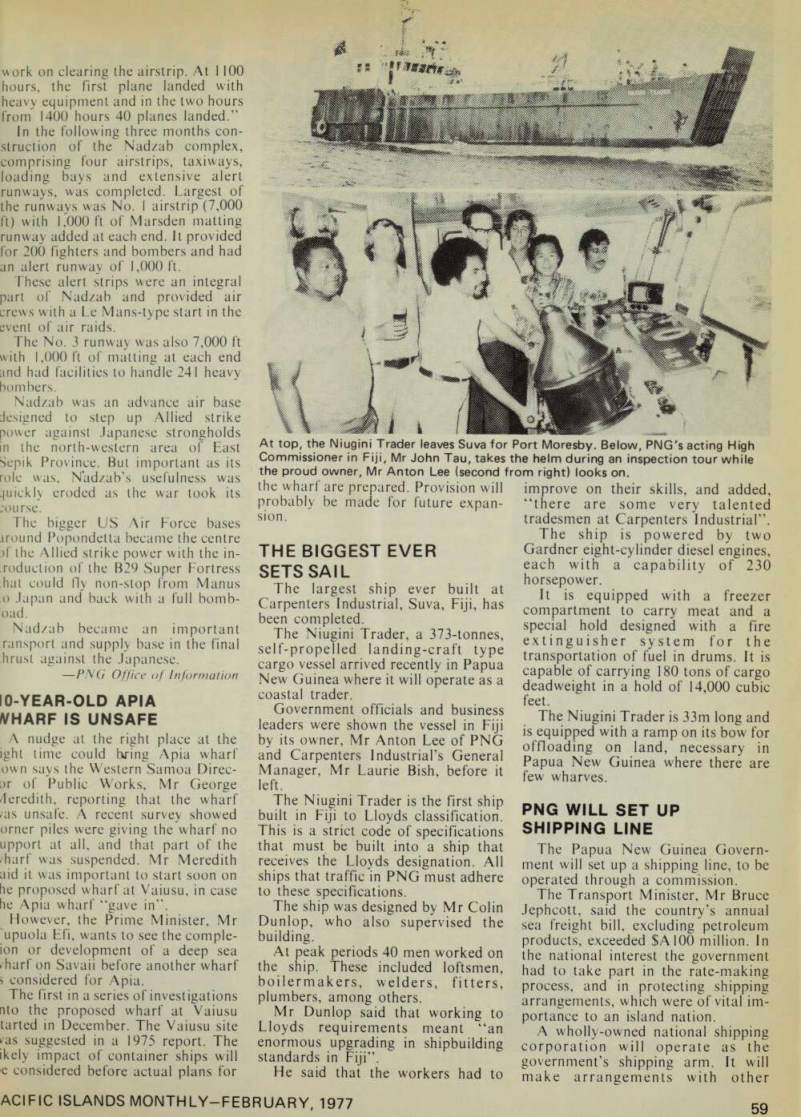
The Niugini Trader, a 373-tonnes, self-propelled landing-craft type cargo vessel arrived recently in Papua New Guinea where it will operate as a coastal trader.
Government officials and business leaders were shown the vessel in Fiji by its owner, Mr Anton Lee of PNG and Carpenters Industrial’s General Manager, Mr Laurie Bish, before it left.
The Niugini Trader is the first ship built in Fiji to Lloyds classification.
This is a strict code of specifications that must be built into a ship that receives the Lloyds designation. All ships that traffic in PNG must adhere to these specifications.
The ship was designed by Mr Colin Dunlop, who also supervised the building.
At peak periods 40 men worked on the ship. These included loftsmen, boilermakers, welders, fitters, plumbers, among others.
Mr Dunlop said that working to Lloyds requirements meant “an enormous upgrading in shipbuilding standards in Fiji”.
He said that the workers had to
improve on their skills, and added, “there are some very talented tradesmen at Carpenters Industrial”.
The ship is powered by two Gardner eight-cylinder diesel engines, each with a capability of 230 horsepower.
It is equipped with a freezer compartment to carry meat and a special hold designed with a fire extinguisher system for the transportation of fuel in drums. It is capable of carrying 180 tons of cargo deadweight in a hold of 14,000 cubic feet.
The Niugini Trader is 33m long and is equipped with a ramp on its bow for offloading on land, necessary in Papua New Guinea where there are few wharves.
Png Will Set Up
Shipping Line
The Papua New Guinea Govern ment will set up a shipping line, to be operated through a commission.
The Transport Minister, Mr Bruce Jephcott, said the country’s annual sea freight bill, excluding petroleum products, exceeded SAIOO million. In the national interest the government had to take part in the rate-making process, and in protecting shipping arrangements, which were of vital im portance to an island nation.
A wholly-owned national shipping corporation will operate as the government’s shipping arm. It will make arrangements with other
At top, the Niugini Trader leaves Suva for Port Moresby. Below, PNG's acting High Commissioner in Fiji, Mr John Tau, takes the helm during an inspection tour while the proud owner, Mr Anton Lee (second from right) looks on.
operators which appear viable, and which would tend to stimulate the shipping industry as a whole.
Mr Jephcott said he was well aware of the number of unsuccessful attempts to set up shipping lines which had been set up by governments in other countries. But PNG was prepared to walk before it could run, and would initially operate in joint ventures with established operators.
Initially it will charter rather than buy a Heel.
The new line will progressively enter PNG’s major trade routes, in cluding those to Australia, New Zealand and Asia.
Mr Jephcott said the project had been evaluated by commercial con sultants and international agencies, including the Commonwealth Fund for Technical Co-operation, and the United Nations Committee on Trade and Development.
Forty-six shipping companies had been approached in tentative planning for the proposed joint ventures. Of that number, 37 showed interest or stated a wish to negotiate further.
More advanced discussions would start soon.
Port Moresby Plans
For Containers
Papua New Guinea will begin a major expansion of its waterfront facilities in Port Moresby, mainly for the large-scale introduction of con tainer shipping facilities. The project is being carried out by the PNG Har bours Board, with assistance from the World Bank.
A foreshore reclamation contact has already been let as the initial move in the expansion. As part of the project, stevedoring companies alone will spend more than SA6 million in container handling equipment. The Transport Minister, Mr Bruce Jephcott, believes that the entire trade between Australian ports and Port Moresby will be containerised within a few years. #The Markwarth Shipping Co in the Solomons recently took delivery of a new passenger/cargo ship, the Walter Funk, which will be renamed Elizabeth Anne. The new ship replaces another Elizabeth Anne which was wrecked off Point Cruz reef. The ship, built in Germany, is of steel, 36 metres long, and can carry 152 tonnes of general cargo. She is powered by a single engine and is capable of seven knots.