The Best Way To
pp. 51-55 · Read in the full issue
Trade With Islands
Australian exporters to the Pacific Islands received some good advice from Mr Philip Best, group general manager of Burns Philp and Co Ltd at the Christmas luncheon of the Sydney Chamber of Commerce Export Development Group in December.
He was particularly qualified to advise exporters after about 25 years with Burns Philp (SS) Ltd, including five years as general manager, for he knows at first hand what is required in the Islands.
He said Australia enjoyed the major portion of exports to a number of countries in the Pacific, with NZ a close second.
The pricing structure of goods sold thus had a significant effect on internal costs and inflation. Australia enjoyed its position because it was close to the Islands, there were good shipping services, and there was a demand for Australian goods. He warned, however, that rising costs in Australia at all levels would eventu ally force Islands importers to look elsewhere. Even with the recent Australian devaluation of currency, retention of the Pacific Islands market would be increasingly difficult.
Mr Best said that as Pacific countries became independent they also became selective. There was a growing awareness of what was available in other countries.
Increasing pressure was therefore placed on Island merchants and importers to prove they were supplying Islands communities goods at the best possible price.
In the middle of 1976, PNG revalued the kina by 5%. After that merchants were asked to show how
the revaluation had helped to reduce the cost to the public of goods sold, and were asked to quote actual figures. Exporters who used the opportunity to increase their fob prices at the same time would be looked at more closely in the future. A similar policy followed in relation to reductions in duty to see that the exporter and local merchant, in collusion, did not take up the difference at the expense of the consumer.
Mr Best said the larger import houses in the Islands had been asked many times whether the merchandise they were carrying was, in fact, being bought from the cheapest source, rather than the traditional. If Australia was to retain the Pacific Islands market exporters would need
to continually appraise their price
structures.
Mr Best also asked exporters to give greater attention to the quality of packages, to help avoid damage and
pilfering.
He said the late receipt of invoices by the importer was an area which had caused concern for many years. With reasonably adequate airline schedules there was no real excuse for delays.
Unfortunately, co-ordination be tween warehouse despatch and ex porters’ customs agents was not always as close as it might be. But importers, to avoid high demurrage charges, needed to clear their goods
quickly.
There was also a need for exporters away from the main shipping port of Sydney to get their goods to the ship in time. Too often, once a ship was
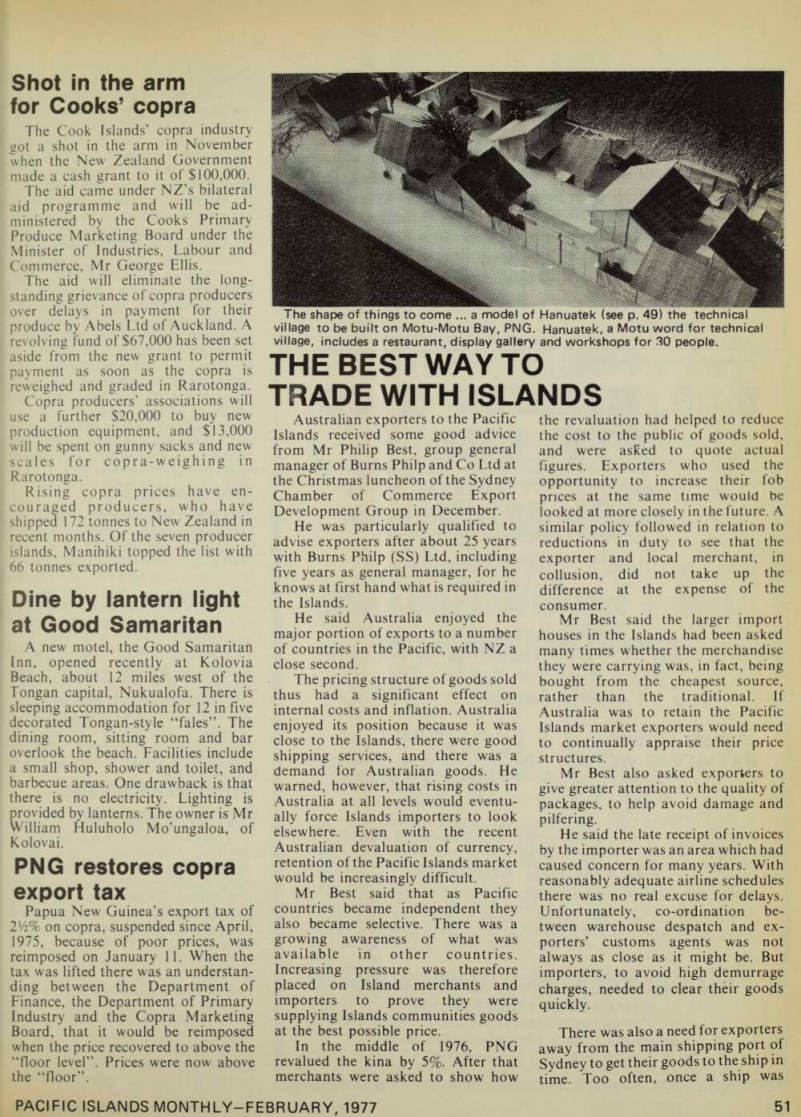
The shape of things to come ... a model of Hanuatek (see p. 49) the technical village to be built on Motu-Motu Bay, PNG. Hanuatek, a Motu word for technical village, includes a restaurant, display gallery and workshops for 30 people.
missed, three to five weeks passed before another was available.
He suggested that exporters do as much as possible to promote container cargoes, from warehouse to warehouse. There were problems to be overcome, and he believed they could be if there was a concerted effort.
Mr Best emphasised that Islands governments were encouraging their nationals to go into commercial trade.
Many of those people were inexpe rienced and did not know all ramifications of international trade and pricing structures. It could be said they should not go into business unless they were fully equipped to do so. Untortunately, not many of them realised that, and exporters in Australia would be doing their country and those people a tremend ous service by watching and safe guarding against pitfalls.
“I make this special plea because of the very dominant role that Australian export does play in the South Pacific market place”, Mr Best said.
Bank of NSW
bows out on Nauru
The Bank of New South Wales will soon close its Nauru branch. This follows an undertaking it gave about nine years ago, when Nauru became independent, that when the govern ment set up its own bank it would pul out. It is now in the closing-dowr process.
The Bank of Nauru, which startec business on October 1, 1976, is full) owned by the Nauru Government and its obligations to depositors an guaranteed by the government. It is it the same premises as the Bank o NSW, which is providing the staff til the Bank of Nauru is able to recrui its own staff.
Finnish ideas for
Tonga’s industry
There are four major areas of in dustrial development which mak sense for Tonga, says a Finnish ex pert, Mr Pekka Mannio, who visitei the country recently as a represen tative of the Asian Development Banl to study industrial possibilities. Th areas referred to were: • Processing agricultura products; • Substituting imports with loca products; • Handicraft development, main ly for export; • Inducing foreign companies t set up subsidiaries in Tonga.
Mr Mannio noted that man
Tongans sought work in New Zealand, and that many NZ employers actively sought island employees. He expressed the view that it would be more humane, and more efficient, to take work to the people, rather than the people to work.
Therefore, New Zealand companies should set up subsidiaries in Tonga to provide work on the spot for Tongans.
W. Samoa to have
its own brew
The Western Samoa Government will hold a 51% interest in a brewery, at Apia, which it hopes will be profitable in two years. West German interests will have a 25.5% equity. The remaining shares will be offered to Nauru, Tonga, Niue and the Cook Islands.
The acting Attorney-General, Mr Neroni Slade, went to West Germany recently to complete details for the project. He said then he expected the brewery would be in operation in about 18 months (about mid-1978).
Initial capital will be T 1 million, but ultimately it will rise to T 3.5 million.
The Chamber of Commerce raised objections, saying the amount of water required would be more than 10 gallons for each gallon of beer brew ed. But the official view was that preliminary studies showed there was enough water available.
A brewery would practically eliminate the need to import beer.
US plans to defuse
Ebeye ‘time-bomb’
The Trust Territory Government has taken the first step to try to lift the standard of living on the tiny islet of Ebeye in the Marshall Islands. Ebeye is over-populated and congested.
About 700 Micronesians, who work on the Kwajalein missile range, and their families, numbering about 7,000, live on Ebeye which covers 76 acres.
A planning committee, a rather high-powered body, has been ap pointed consisting of representatives of all concerned interests, including the High Commissioner, Congress of Micronesia, Marshallese traditional leaders, the District Administrator, the District Legislature, the Defence Department, the Interior Depart ment, Redstone Arsenal, the US Commander-in-Chief, Pacific and Kwajalein missile range officials.
The acting High Commissioner, Mr Peter T. Coleman, recently wrote to the Director of Territorial Affairs, Mr Fred M. Zeder, saying Ebeye
needed upgrading of its “deteriorated public and private facilities to cope with its high population density”. The most “prominent” problems were on Ebeye because of international im plications.
They were problems caused by programmes conducted in the interest of the national security of the US and perhaps the free world. The nuclear tests on Enewetak and Bikini for which the people of Ujelang and Kili had to be moved, the fallout that affected the people of Rongelap and to some extent the people of Utirik, and the anti-missile tests on Kwa jalein Atoll affecting all the people on
that atoll, gave rise to the problems.
An article in PIM last June, which described Ebeye as a “ghetto-islet”, reported that the Congress of Micronesia had declared the islet to be a “disaster area ... a biological time-bomb which could go off at any moment”.
Solomons budget
shows dependence
Just how heavily the Solomons Government relies on overseas assistance to meet budgetary requirements was revealed by the Finance Minister, Mr Kinika, when he introduced the 1977 budget to the
Legislative Assembly. The government requires $21,920,440 to meet commitments $11,681,000 in the recurrent budget and $10,239,490 in the capital budget.
Mr Ki.nika said that to meet the recurrent budget the government expected to raise $9,668,000 locally, with the shortfall of about $2 million coming from a British grant-in-aid.
Mr Kinika expects the whole of the capital budget to be financed by grants or soft loans from overseas. He thought about two-thirds would come from British aid, about a quarter from the Australian aid programme, and the rest from a number of sources, including New Zealand and the United Nations Development Programme.
Mr Kinika said the budget was aimed at fostering economic growth.
The theme was to consolidate the public service and expand the private commercial sector. He wanted to achieve that through a grand partnership between overseas investors with know-how and Solomon Islanders.
Tax concessions would be offered to encourage more local industries, particularly those owned by Solomon Islanders.
Big fish catch
off Ponape
A Ponape-owned fishing ship, the Kacho, with a Ponape captain, fishing in Ponape waters, recently landed about 2Vi tonnes of yellowfin and skipjack tuna in two days. The Kacho is one of seven fibreglass reinforced plastic fishing vessels built in Japan under the US-Japan war claims agreement.
The Kacho will not compete with local fishermen who supply the Ponape markets. All tuna it catches will go to overseas markets, unless the local demand exceeds what local fishermen can supply.
The ship is owned by the Ponape District Administration, and Is operated under contract by the Ponape District Fishing Authority.
The policy in operating the Kacho is to see if a skipjack fishing boat can operate successfully in Ponape District, and to show the people and potential investors that a large joint fishing venture is possible. The Kacho is also being used to survey the availability of bait fish for commer cial use, to train Ponapean fishermen to operate and maintain such a ship, and in proper handling and processing techniques.