New Hebrides Assembly
pp. 17-18 · Read in the full issue
meets —but what's new?
From a Vila correspondent
The Phantom has at last materialis ed. More than a year after the first general elections in the New Hebrides, the Representative Assembly opened for its first official “working” session on November 29, 1976. But the 10 days of debate that then followed left the hardened observer with some doubt as to the real nature of this materialisation.
It was not until three days before the convening of the assembly that the final seat of the 42-member body was elected. The election for the chiefly seat of the Northern District was delayed because Na-Griamel chiefs complained that other members of the college were not wearing custom dres:>. Elections finally took place without the offended chiefs, and Moli Liu Tamata President of the Natui-Tanno movement or Santo was chosen.
Natui-Tanno being pro-National Party indeed an integral part of it this gave the National Party 21
seats of the 42, providing a key factor in the rest of the proceedings.
The main items on the agenda were procedural: the adoption of standing orders, rights and privileges of members, and their allowances.
Practically all proposed amendments were passed with little effective op position. However, a National Party motion empowering the 'assembly to dismiss the Clerk “if he is not proper ly discharging his duties” led to the in dignant resignation of ex-Colonel Blanchet from the post at lunchtime on the first day. Deemed a mis understanding, it was only after diplomatic re-wording of the motion that he agreed to return two days later.
The only other excitement was a debate over which language assembly proceedings should be published in, the National Party having proposed that bislama (pidgin) be used in addi tion to French and English. Regarded almost as an outrageous suggestion by
the white faces inside the assembly, British Resident Commissioner Champion questioned it on the grounds of further staff costs, while manager of Burns Philp, John Staegler of the Chamber of Commerce, maintained that to inspire commercial confidence overseas the country could not afford to take what would be seen as a regressive step.
Most members of the assembly representing an electorate disagreed with such a view, and eventually a compromise was agreed that proceedings should be recorded in a “summarised form" in the three languages.
The essence of the meeting, however, came with the discussion on the composition of the assembly’s committees. Designed, according to colonial sources, as the basis for future ministries, provision was made for four standing committees respon sible for natural resources, industry and commerce, social services, and public works and communications.
Each was to have a membership of seven, the chairman together with up to 10 others then forming a general purposes committee.
Standing orders required that all members declare their affiliation to “political parties or groupings’’, and on the basis of such declarations, seats on the committees would be allocated proportionally. A meeting between Jimmy Stevens of Na-Griamel and Barak Sope and George Kalkoa of the National Party just the week before the assembly opened had aroused speculation that the two parties might form some kind of alliance, thereby emerging as a definite majority.
However, either the time is not yet ripe, or the two parties’ differences exacerbated no doubt by Stevens’
Santo secession movement early in 1976 are still too great for this to happen yet. For statements released after their short conference on Malekula spoke only of “initial dialogues ... to come to a greater un derstanding’’. The affiliations finally worked out to 21 for the National Party, 12 for UCNH, with the
remaining nine including the three MANH/Na-Griamel members —, declaring themselves “independents”.
For the National Party, the com position of the committees was a question of principle. As George Kalkoa pointed out, elections for the assembly had included seats for special interest groups of chiefs and economic interests.
The two administrations were now forcing these representatives to align themselves politically . . . “We wish to record our strongest dissatisfaction with the governments of France and Fngland for their construction of a system of elections and a system of political representation with the assembly, both of which are blatantly undemocratic and are further attempts by the colonial powers to destroy the strength of New Hebri dean representation in the assembly.”
A motion calling for revision of the electoral regulations ensuring that all seals at the next elections would be chosen by universal suffrage was later passed unanimously.
The reason for the National Party's anger was plain; having won almost 60% of the universal suffrage vote, and being represented in three of the four chiefly seals and two of the three co-operative seals, they were to be allowed only 50% representation on the committees. And 50% of seven on each committee produces three and a half people . . . Arguing that in terms of representation of the electorate, they were entitled to a majority on each committee of four members, the National Party tried all ways to argue their case, but to no avail. The Resi dent Commissioners’ offer of a National Parly majority on just two committees was finally accepted, the party choosing Natural Resources and Commerce and Industry as their strongholds.
Debate on the regulations es tablishing the chiefly council then fairly painlessly decided that con sultation with the chiefs would be compulsory on all matters relating to land, custom, hunting and fishing, and judicial and legislative matters relating to New Hebrideans. The council of 20 chiefs would relate directly to the assembly through the four chiefly representatives to the assembly who would also sit on the counci, effectively, therefore, making it a council of 24.
While on the subject of 24, the United Nations General Assembly had the previous month adopted a
Committee of 24 resolution calling on the British and French governments “to expedite the process of decolonisation in the New Hebrides” and to “consider permitting access by a UN-visiting mission”. The vote on a National Party motion condemning the “unworkable system of government” and moving that the assembly request such a mission was perhaps the most interesting of all. It was carried by 21 votes to 21 absten tions: a clear indication of how firmly the assembly is split down party lines (despite “economic interests” and all that), and perhaps revealing the extent to which the UN is regarded as National Party territory, in spite of the two visits there of Na-Griamel and the one of UCNH this year.
Two other motions passed almost unanimously reflected the across-the board discontent with the absurd ob solescence of the condominium. One called for a single legal system for all races in the islands, and the other for the creation of a new administration.
Change in both areas is much over due, there being three adminstrations and more than three legal systems in the country facts which to out siders may be a joke, but which cause untold strain on psychological, as well as financial, resources.
It was at this point that the assembly somewhat mysteriously end ed with the National Party withdraw ing two motions, one calling for the creation of a commission to recom mend a single, unified land-tenure system, and the other demanding “a
programme for the independence on the New Hebrides”. Neither issue could be more controversial, nor nearer to the heart of the nationalists.
But no reasons were given, and so with some relief, and more than a lit tle puzzlement, the two Resident Commissioners jointly closed up shop until February when the Budget is due *to be debated and a single New Hebri dean President of the assembly elected.
Sorting through the mass of ver biage to come to some sort of overall conclusions on the session, one thing alone is clear. That is that, despite colonial attempts to create the con trary impression in the consciousness of the nation, little in reality has changed. Words have been spoken, and the ritual played out. And motions have been passed which mostly give just an official stamp to processes of gradual change which were under way in any case after the usual snail’s-pace fashion of the Joint Administration.
But the power structure of deadlock remains firmly intact, the only difference being that it is now in stitutionalised in the form of the Representative Assembly, which provides its new focus. Initiatives for radical change from the National Par ty can now be counted upon to be squashed by “the Opposition”, thus very conveniently letting the British and French off the hook.
How long the National Party will stand for this version of democracy is anyone’s guess . . .
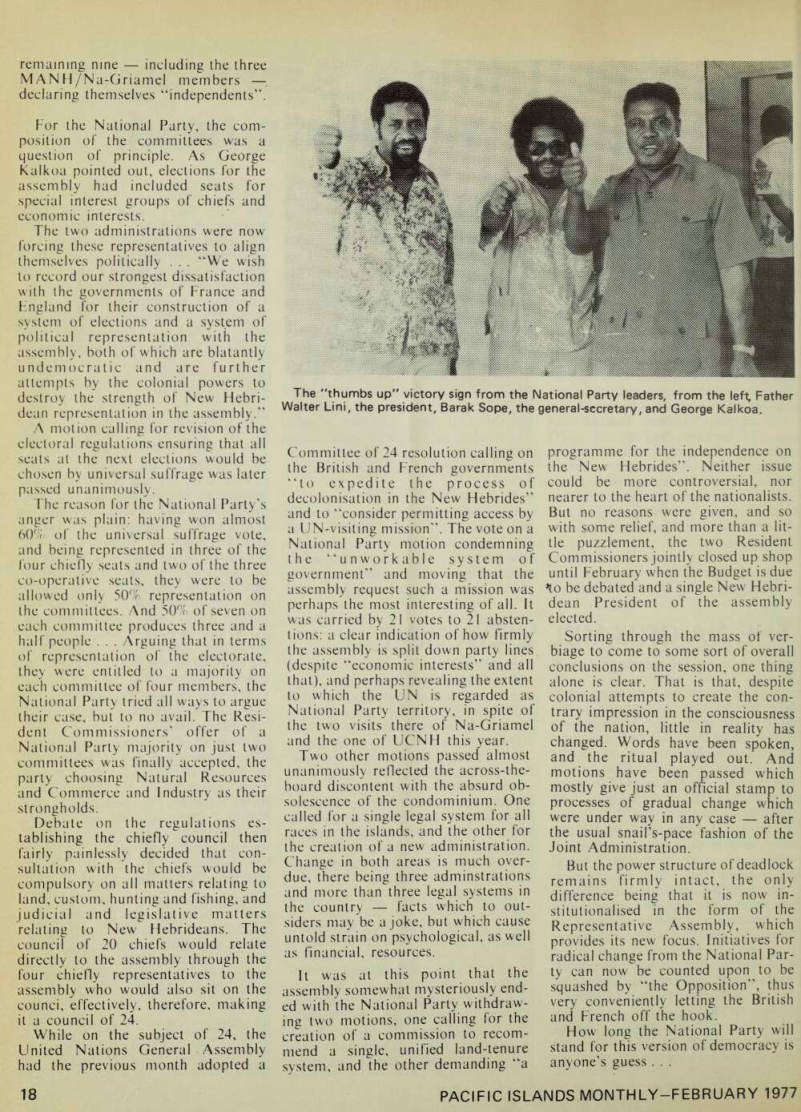
The "thumbs up" victory sign from the National Party leaders, from the left. Father Walter Lini, the president, Barak Sope, the general-secretary, and George Kalkoa.