“Because we’re different why
pp. 12-69 · Read in the full issue
Norfolk Island Reply
“Because we’re different why should we be punished?”
The Nimmo Report on the future constitutional position of Norfolk Island has caused the greatest controversy on the island since it was first occupied in 1856 by the descendants of the mutineers of the "Bounty”, who moved to Norfolk because Pitcairn was overcrowded. If adopted, the Nimmo report will mean great changes to their island lifestyle. William Blucher, president-of-committees of the elected Norfolk Island Council, at a special council meeting, has defended this life-style in an impassioned appeal to the Australian Government not to act hastily over the report. He asks for a referendum of islanders and says that if, in the meantime, any of Sir John Nimmo's recommendations are put into effect it should be regarded as "an indefensible intrusion against human rights". In this and the following pages, PIM publishes the main points of this Norfolk Islander's defence of Norfolk Island.
The Norfolk Island Council, who are the only elected representatives of the people of Norfolk Island, have been asked to comment on a very complicated set of proposals that would radically change the way of life on the Island.
This set of proposals is made in the Report of the Royal Commission into Matters Relating to Norfolk Island.
The Royal Commission was ap pointed because the Australian Government of the day believed that Norfolk Island’s present form of ad ministration had become outmoded and inappropriate.
In urging the council to state its views quickly, the Administrator has several times said, “The place to begin is at the beginning.”
I agree that we should begin at the beginning, but with respect I do not accept the idea that the Royal Com mission Report is the beginning. The true beginning is the Norfolk Island way of life.
Since 1856, when our ancestors the Pitcairn families were re-settled on Norfolk and the Island was set apart for them, a most unusual and distinc tive way of life has grown here and taken shape.
The Norfolk Island way of life is the result of many forces.
It is based partly on the fact that we are an island, three miles by five miles in size, a thousand miles out in the Pacific Ocean from Sydney, with a population now of about 1600 people.
Our way of life is partly based on the fact that this is a very beautiful island, with a semi-tropical climate and good soil.
It is also an important part of our
way of life that since 1856 we have been a territory under the protection and guidance of, first, England, and since 1913, of Australia.
We have for generations been an almost fully self-supporting territory. 1 say “almost” because the island needs help and guidance mostly guidance from people who have ex perience that we lack.
It would be wasteful for us to make and support our own currency, for ex ample, and it is a help to us to be able to use Australian currency. It would be foolish for us to try to have our own foreign affairs representation in other countries, and Australia provides that for us. It is reassuring to us to have the protection of a large country with defence forces, because we could not defend ourselves.
We need good educational curricula, and we need teachers who have been well trained. We need good health regulations to follow. We need guidance in the form of laws that have been written and used elsewhere, which we can examine and learn from in working out laws that are suitable to Norfolk Island.
We need an international standard of air and shipping safety regulations.
We need higher courts where decisions made in the Norfolk Island Court can be appealed to.
We need many such kinds of guidance Australia kindly provides them, although Norfolk Island pays most of the actual costs involved.
We pay for our own school for ex ample, and for our own hospital.
But some services are provided free, and we hope these would continue to be provided free: as an example,
foreign affairs representation. We are glad to have Australia represent us in many countries of the world without asking us to pay, just as England represented Australia in many coun tries of the world without asking Australia to pay.
It has been charged that Norfolk Island is a serious economic burden to Australia.
This charge is made by Sir John Nimmo, the Royal Commissioner, who stales that there were $2,500,000 of annual outgoings from Australia to Norfolk Island in the last financial year. This sum was worked out by the Department of the Capital Territory in a submission made to the Royal Commission.
The calculation is false. It was refuted at the lime by the Norfolk Island Council, and I will be glad to refute it again for anyone who is in terested. In these remarks I will men tion only three examples of the falseness of the calculation. 1. The Norfolk Island Meteorological Station is included as a $67,000 annual outgoing from Australia to Norfolk Island. This sta tion makes no forecasts for Norfolk.
It exists purely as a reporting station required by the Australian meteorological system. It is not a cost of Norfolk Island, but of Australia. 2. Losses of $750,000 a year by Qantas on the Sydney-to-Norfolk route are included as an annual outgo ing from Australia to Norfolk Island.
This sum was the result of an Australian policy that Qantas should operate the route. East-West Airlines has just been appointed to take over the route, and it expects to earn
money on the run. It will need no Australian subsidy. There is no $750,- 000 annual outgoing from Australia to Norfolk Island. 3. The cost of services provided to Norfolk Island by the Australian Department of Labour and Immigra tion, and the Australian Department of Education, is included as being $435,700. These two departments submitted no cost estimates whatsoever, and they provided no significant services whatsoever. The figure of $435,700 is sheer fantasy. It was invented because a grand total of $2,500,000 sounded like a nice, round number. $435,700 more was needed to reach that number, and those two departments were the only ones not heard from.
In all, there are 28 items of sup posed “annual outgoings from Australia to Norfolk Island” in the calculation presented by the Depart ment of the Capital Territory. At least 21 of these items, in the opinion of the Norfolk Island Council, are either seriously overstated or are totally inapplicable to the true costs of the island.
I have mentioned only three of those items. Those three total $1,252,- 700, which is more than half of the imagined total of $2Vi million a year.
Any calculation that includes a few false items, amounting to over half the total, is a false calculation that should not be relied on until it has been completely re-examined and corrected.
Sir John Nimmo accepted that false calculation without examining it closely for accuracy. He then used it as a foundation on which to build his entire report and his recommen dations for the island.
After spending a year on his en quiry, Sir John concluded that the most important and vital decision, from which all other decisions must flow, is whether Australia should abandon Norfolk Island or continue to accept responsibility for main taining it.
In weighing that all-important deci sion, he says: “If the Government chooses to stay in the island, it should set out clearly the conditions and policies under which it will continue to treat the island as part of Australia. As the net overall financial burden is clearly be ing borne by mainland Australia and no one else, it is proper that the Com monwealth Government should have this choice.
“If Norfolk Island residents were
meeting this cost then they would have a case for exercising the choice themselves via a referendum. It would be nonsensical for a minuscule group of 1600 people, who have never con tributed anything to Australia by way of taxes and from whom Australia can be expected to receive minimal or no economic benefit, to claim the right to demand that Australia con tinue to support them on their own terms.
“It is Australia’s choice, not theirs, and it is for Australia to set down the terms under which it may be willing to continue to pay for the sustenance of Norfolk Island.”
Sir John Nimmo has accepted a false calculation, and his major con clusion is false as a result.
The net overall financial burden of Norfolk Island is not being borne by mainland Australia, but by the people and the economy of Norfolk Island itself.
The people of Norfolk Island are not, as Sir John assumes, claiming any right to demand that Australia continue to support them.
Australia is not paying for the sustenance of Norfolk Island. The island very largely pays for its own sustenance, and the people of Norfolk Island should, as a matter of fairness, have a voice in shaping the future of the island.
Many nations have many territories that must be heavily subsidised. The Royal Commission figures give a false and, 1 feel, degrading impres sion that Norfolk Island is such a territory. It is not.
Norfolk Island virtually supports itself. It has done so for 120 years. It has no public debt, but actually has a small surplus in reserve. 1 would think Australia would find this a source of pleasure and satisfac tion, rather than trying to pretend that we are a serious burden.
The good way of life on Norfolk Island comes from the earth, the sun,
the rain, the sea, the hard work and co-operation of the people who live here, and from the beauty and peacefulness of the island, which at tract a growing number of tourists here. It does not come from Canberra or from the Australian budget.
Sir John Nimmo says that perhaps Australia should abandon Norfolk Island, on the grounds that it is a great expense. I hope this notion will be recognised as being exactly what it is preposterous! But if it should for some strange reason be taken serious ly, and Australia should abandon us, we could certainly want to find another large power that would be ac commodating enough to provide the kind of support we do need, at very little cost to itself . . .
If you ask people on Norfolk Island whether they like the Norfolk Island way of life, the answer is an overwhelming “yes”. People here prefer it to the way of life they may have known anywhere else in the world.
But now a Royal Commission report has recommended that our way of life be almost completely changed.
I will speak about twelve of these recommended changes. Many others are recommended as well. 1. Self reliance. Norfolk Island is largely self-supporting. People who live here know that we have to get along pretty well on our own. We do not look to the outside world for hand-outs.
The Nimmo Report recommends that we be meshed into the Australian Government financial system, and that we be encouraged to rely on economic support from Canberra. 2. Our laws. Norfolk Island has its own set of fairly simple and clear laws, most of them made to suit the needs of the island. In general, it is possible for an ordinary citizen to get a copy of the law on some subject, read it, understand it, and know what he can do. In the past several years the
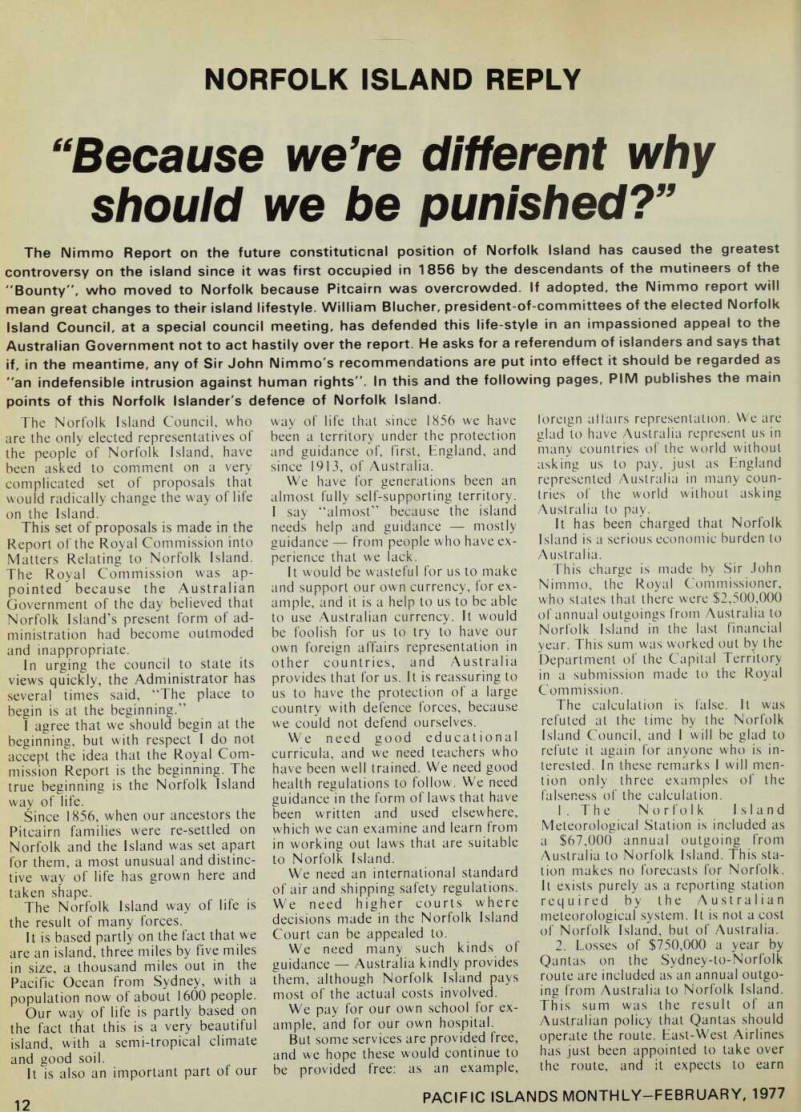
About 400 Norfolk Island residents attended this meeting in the Rawson Hall to discuss the Nimmo report, which got a mixed reception.
Photo: Tim Wood
council has been increasingly concern ed about the number of new laws that have been imposed on the island from Canberra, not because they were needed or wanted here, but because Australia wanted them.
The Nimmo Report recommends that our own set of laws should have superimposed on it the entire tangled range of Australian laws. 3. Taxation. It has been thought by some that Norfolk Island is tax-free.
This is not so. There is a considerable Norfolk Island tax system but it is a Norfolk Island kind of system.
We pay customs duties on all goods that are shipped into the island, and that is a great deal, because we produce no manufactured goods ourselves. We pay extremely heavy freight charges to bring these goods in, and this is a form of tax that affects every one of us in a real way.
We pay an annual works call levy.
Some years ago the works call system was more typical of Norfolk Island than it is now; each man was expected to work a certain number of days per year on the roads, or on other com munity jobs. He could pay money in stead of working, if he preferred. That system was abolished by Australia because it felt it was a violation of some United Nations agreement against “forced labour”. I thought the change was a shame. Now everyone just pays the money.
We pay a kind of tax through a local Norfolk Island Administration monopoly on the sale of beer, wines and spirits. These are sold at prices far below mainland prices, but there is still a very large margin of profit that helps pay local government expenses.
We pay a wide range of small fees for registration of cars, dogs, guns and other such matters.
We pay a Norfolk Island form of tax for transport that is, do it yourself! There is no government transport of any kind on the island, and every individual expects to pay for and maintain his own transport.
The same thing applies to water and sewerage. There is none provided by government. Every home must catch, or dig for, its own water supply, and provide its own sewerage, which must meet proper health re quirements.
City people may think that water is free if you catch it from the rain, but catching it, storing it and pumping it are very expensive and uncertain operations, which government does on the mainland, but which Norfolk Islanders do for themselves.
We on Norfolk Island pay another kind of tax every day, although we scarcely think of it that way. On Nor folk Island we care for our own.
When someone is ill, or in need, or requires a hand, family and friends and neighbours make the effort to help. We do not pay taxes to a govern ment and say, “here you look after these hardship cases for us”. We do it ourselves.
Norfolk Island is not tax free. We pay substantial taxes, in a Norfolk Island manner.
The Nimmo Report recommends that the full range of Australian taxes should be added on top of the Norfolk Island taxes that seem to be adequate for our needs.
I would not question the need for heavy income taxes in Australia.
There are many mainland jobs that have to be done by the Com monwealth Government.
It must finance vast Government offices and wages and expenses; a defence force; tremendous transport
systems; a postal system; universities; research; foreign affairs representa tion overseas; agricultural services; it must provide heavy support for the States; it must pay heavy interest on the national debt; and it must pay for very extensive social welfare benefits; it must pay its share of developing countries to develop themselves. But these have very little to do with Nor folk Island.
Taking a general economic view, there is no question that the addition of heavy new Australian taxes would considerably increase the costs, and therefore the prices, of our tourist in dustry. The tourist industry is our only significant way of bringing new, outside income into Norfolk Island.
We are keenly aware of the need to keep the growth of tourism under con trol, so that it does not spoil the island, but the entire island needs the income that the industry yields. I do not think there is any question but that heavy added taxes would make Norfolk Island much less competitive in the tourist industry.
It might hurl the island only moderately; it might hurt it very greatly; but I do not believe Norfolk can risk a gamble with its only real in dustry.
It is in competition with New Caledonia, Singapore, Fiji, Flonolulu, and Australian and New Zealand resorts and the competition is very close indeed. Our tourist industry should be nurtured and encouraged. It must not be made less competitive. 4. Hospital. Part of the Norfolk Island way of life is that we have our own 17-bed hospital, with a full-time doctor, a part-time doctor, and various consulting doctors that call in to the island from time to time. The hospital is regularly inspected by
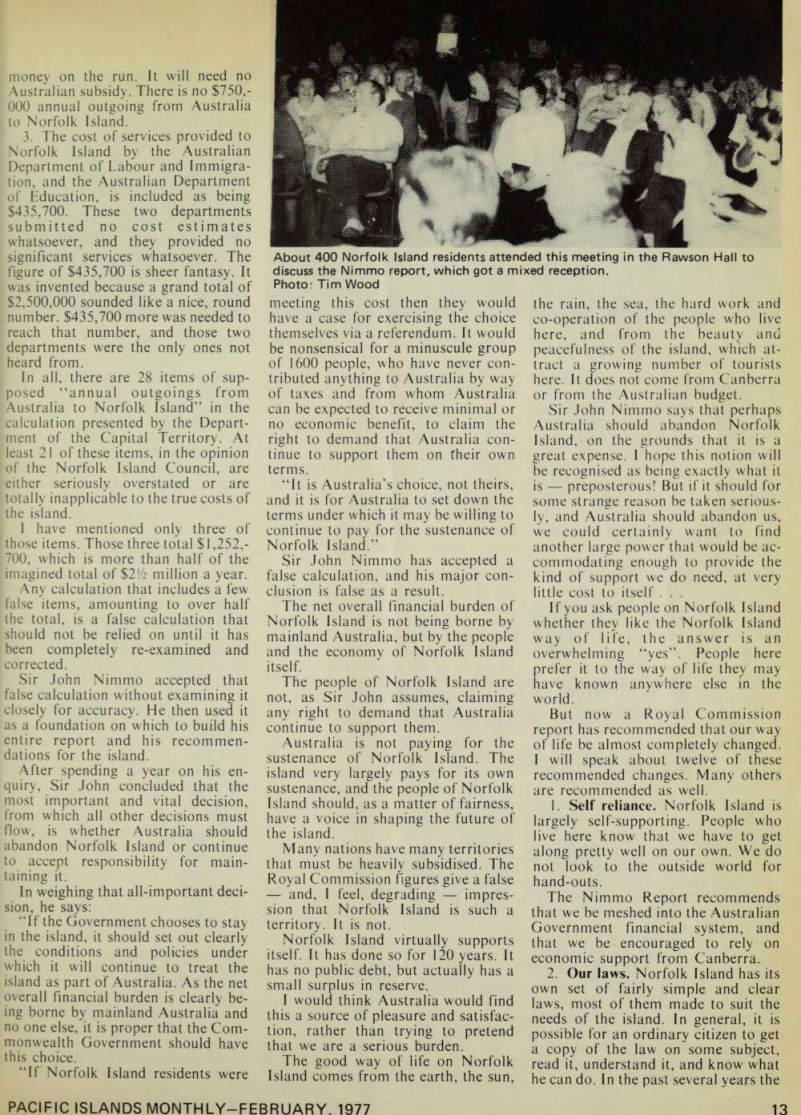
The peace of Norfolk Island in contrast to the turmoil created by the Nimmo Report. Left, Bloody Bridge; centra rear view of St. Barnabas Church and, right, Kingston.
Photo: Qantas
mainland authorities, and they give it very high ratings. More important than ratings, the hospital gives a kind [of patient care that is personal and neighbourly.
The Nimmo Report recommends that the hospital should be taken out of our hands, and become a Com monwealth Government Hospital.
Presumably it would then be run ac cording to Commonwealth Govern ment procedure manuals governing procedures, duties, rights, hours, reporting, and a great array of other details.
These may be necessary in large jnainland hospital systems. I believe that on Norfolk Island they would lead to a work-10-regulations attitude, and would lessen the wonderful degree of genuine concern for patients that exists now. \ School. An important part oflhe Norfolk Island way of life is our school, which goes up through to fourth' form. It is a great source of
pride and of community involvement.
It is staffed with teachers on leave from the NSW school system, and follows the. NSW Department of Education curricula. Norfolk Island youngsters who go on for further schooling almost always go to Sydney, and they fit right into the school system in NSW. For some years now, every single student in the senior class at our school has passed the NSW examinations for that educational level.
Incidentally, Norfolk pays for the teachers' salaries and their transport to and from Norfolk.
The Nimmo Report recommends that this good relationship with the NSW education system be continued but with one new addition, namely that the school would be placed under the supervision of the Commonwealth Department of Education.
That department made a submis sion to the Royal Commission that was, in many ways, seriously critical of our school. We on the island believ ed, and I think with good reason, that the criticism was unjust and reflected a lack of familiarity with the facts.
Thai is the department which it is proposed would take charge of the NSW people who actually run the school.
NSW seems to be happy to help Norfolk on the present basis. But if they are required to accept Com monwealth supervision, I am quite sure that very soon they would say, “We can't work this way. If the Com monwealth wants to run it, let them run it. We are withdrawing.” 6. Social benefits. An important part of the Norfolk Island way of life, as I have said before, is that we take care of our own. To mention just one example, a comparison between a typical elderly person on Norfolk and a typical old-age pensioner in Sydney or Melbourne would show a remarkable contrast.
The Norfolk Island way of life provides an older person with a kind of affection and support and accep tance that make the mainland pension system look almost degrading by comparison this support includes weekly payments of cash, financed by Norfolk Island, which are set from time to time at levels that we believe
Continued on p. 69
are reasonable for island conditions.
The Nimmo Report recommends that all Australian Social Service benefits be applied on Norfolk. Yet Sir John Nimmo said that he could find no hardship on Norfolk. That is quite a rare and fine state of affairs, in this day and age.
The Norfolk Island way of life works, on Norfolk Island. It does not need to be changed over for some other system, however “modern” that new system is supposed to be. 7. Voting. Part of the Norfolk Island way of life is that we vote for a local council to represent us. There is great interest in the council’s ac tivities, and the regularly monthly meetings are broadcast in full once “live” and again the following even ing, for people who could not listen to the first broadcast.
There has been serious concern on the island for some years that our council has no executive authority, but can only advise an Administrator sent from Australia. We would like to elect people who could manage island affairs themselves.
We do not, frankly, maintain regular interest or awareness of mainland politics, and certainly don’t feel we should have any say in them.
The Nimmo Report recommends that Norfolk Island be put into the electorate of Canberra. This is simply ridiculous. It would not give us representation except in a meaningless, legal way. Among other things, it would be an intrusion on our part into Canberra affairs, which could not be welcomed and which we would not want. 8. Land Ownership and Land Use.
One of the 'most important parts of the Norfolk Island way of life is our attachment to the land. It is probably our dearest possession. We feel a very deep need to control it ourselves.
The Nimmo Report recommends that the Commonwealth Government should have all control of all land matters, including zoning and town planning. This would be a basic change in one of the cornerstones of the Norfolk Island way of life. 9. Workers Regulations. A part of the Norfolk Island way of life is that many people have several jobs, perhaps none of them full-time.
Wherever one works on Norfolk, or
whatever the job is, it is Norfolk prac tice to lend a hand where a hand is needed.
The Nimmo Report recommends that worker’s compensation rules, International Labor Organisation conventions, and much of the machinery needed for union demarca tion regulations and dispute handling, be extended into Norfolk Island. We don’t have strikes and tie-ups and dis putes. There are often disagreements and sometimes dissatisfactions, but the Norfolk system works very well on the island. As one example the island’s lighterage and stevedore crews handle cargo from ship to the shore for far less than the same opera tion would cost in the port of Sydney using the marvellous power equip ment they have at their disposal. 10. The right to return to the island.
It has been a tradition for generations on Norfolk that this was our homeland. People often have had to move away, but many of them, now living in Australia or in New Zealand, hold in their minds and hearts the thought that some day, when they can, they will move back to Norfolk Island. Because they were born here, at present they have the right to do so.
The Nimmo Report recommends that this right be abolished and im migration to the island would be on a first-come, first-served basis, and peo ple who now dream of “returning home” would have to take their place in the queue without any rights to residency. 11. Transport. An important part of the Norfolk Island way of life is that we have small-scale but good
links with Australia and New Zealand. For air transport, we have relied for many years on the fine reliable old DC4s operated by Qantas.
They will be retired in March, and small F-27s will replace them. The Norfolk Island airport may have to be upgraded to some extent if we should later shift to small F-28 jet aircraft, but we would like to keep airport ex tensions as small as possible. Big air ports are damaging for the environ ment, and Norfolk Island’s peaceful environment is worth preserving.
The Nimmo Report recommends not that our airport be upgraded for F-27 aircraft; not that it be upgraded for F-28 aircraft; but that it be made into a full-blown international airport capable of handling Boeing 747 jumbo jets.
There are many puzzling ideas in the Nimmo Report, but this one is among the most puzzling of all. So far as I know, no evidence given to the Royal Commission even suggested a super-jet airport. Our tourist industry does not need it, and never will, if we are to have any control over tourism. I know of only one real purpose that would require such an airport; and that is if Norfolk Island should be turned into Australia’s Offshore High Security Animal Quarantine Station. 12. Crime and punishment. An im portant part of the Norfolk Island way of life is that we have no major crime. We do not even have a proper gaol. We seem to get along very well without one.
I he Nimmo Report recommends that a big new police station and gaol
Some of the 400 Norfolk residents who sat in on the "inquest” on the Nimmo report.
Photo: Tim Wood
should be built, and that perhaps a correctional institution for young criminals should be built. Sir John Nimmo says that our attitudes toward crime and punishment are not as sophisticated as on the mainland, and he apparently wants us to get in step with these mainland ideas.
Now, those are not all the recommendations of the Nimmo Report, but those twelve represent massive changes in a way of life we have treasured for generations.
We do not want our way of life replaced by another way of life.
By all that is fair and decent in modern civilisation, I believe Norfolk Island is entitled to retain and preserve its way of life unless one of three causes can be shown.
First Australia might have the right to change our way of life if it could be shown that, by being different, we are causing harm to others particularly Australia.
For a numoer of years, Australia might have argued that this was in deed the case. During those years, outsiders discovered that Norfolk Island’s relatively simple laws could be used to their advantage. The island became a tax haven that apparently cost the Australia n Government many millions of dollars in taxes that otherwise may have been payable.
But the tax haven is over dead and gone.
Sir John Nimmo is, among other things, a tax expert, and the longest section of the Royal Commission Report is the one discussing Norfolk’s history as a tax haven. Having in vestigated in very, very great detail, Sir John concluded as follows and I quote from the report: “In so far as income tax avoidance is concerned the overwhelming body of abuses has now been stopped. Taxation Office in vestigators will be able ... to take any necessary steps to curb or eliminate whatever tax avoidance activities remain’’.
In the summary of recommen dations in the report, there are 74 recommendations for Norfolk Island.
Under the heading of Guideline (g), “The extent to which Norfolk Island has been and is being used to provide a base for activities (e.g. income tax, gift duty and death duty avoidance or evasion) which are harmful to the in terests of Australia or of other coun tries,’’ Sir John Nimmo did not feel it was necessary to make one single recommendation.
Second, Australia might have the right to change our way of life if we
vere harming ourselves, and should )e stopped from doing so.
Sir John Nimmo searched and bund no way in which this is so he bund no activity which could be said .o be harmful to ourselves.
Third, Australia might have the right to change our way of life if we nad in some way offended against the world, or Australia, and were behav ing in some way that called for punishment.
Sir John Nimmo in various parts of lis report expresses a personal dis able for people on Norfolk Island, ml I think we are simply different fom some others. I do not really iclieve he would say that it is for Australia to punish us.
If we are not harming others, if we ire not harming ourselves, and if we ire not deserving of punishment, I iclieve it is morally wrong for Australia to destroy a way of life that las been followed for generations on Norfolk Island and is treasured by all he people.
There is one other possible ground >n which great changes might be im )osed on our way of life. That would >c if Australia believed the changes would actually improve our way of ifc, and that we ought to be forced to ry them for a few years and see whether we liked them, with the un- Jerslanding that if the changes proved o be harmful, they would be undone.
That is not what the Nimmo Report proposes.
If Australia reduced our need to support ourselves; if Australia Abolishes our simple laws and imposes implicated new ones; if Australia in :reases our costs by requiring us to ■>ay full Australian taxes as well as our own indirect taxes and levies perhaps wrecking our tourist in iuslry in the process; it Australia akes our hospital out of our hands; if
Australia disrupts our good
"dationship with the NSW Depart ment of Education; if Australia gets js accustomed to receiving benefit cheques; if Australia forces us to vote in Canberra; if Australia takes over oil powers over our land; if Australia allows and introduces mainlandstyle strife in our work force; if Australia removes the right of our people to come home; if Australia builds a Boe ing 747 airport in the middle of the island, and gives us a big concrete gaol and police station Australia will have permanently ruined our pre sent way of life.
It could not conceivably be an ex periment that could be undone.