No Fun And Games When Party
pp. 8-10 · Read in the full issue
Politics Creep Up On Nauru
The news that President Hammer Deßoburt had lost his job as President of the Republic of Nauru was one of the
most surprising political develop
ments to have taken place in the South Pacific in years.
Certainly the political understate ment of 1976 was the official announcement made in Nauru on December 22 that “the unexpected election of a new President has aroused keen interest among Nauruans.”
The election of 30-year-old Bernard Dowiyogo as Nauru’s second Presi dent had in fact stunned Nauru.
Nauruans were unable to talk of anything else over the Christmas and New Year holidays. Interest intensified when within a few days, it became obvious that Nauru was undergoing not merely a change of President but a constitutional crisis.
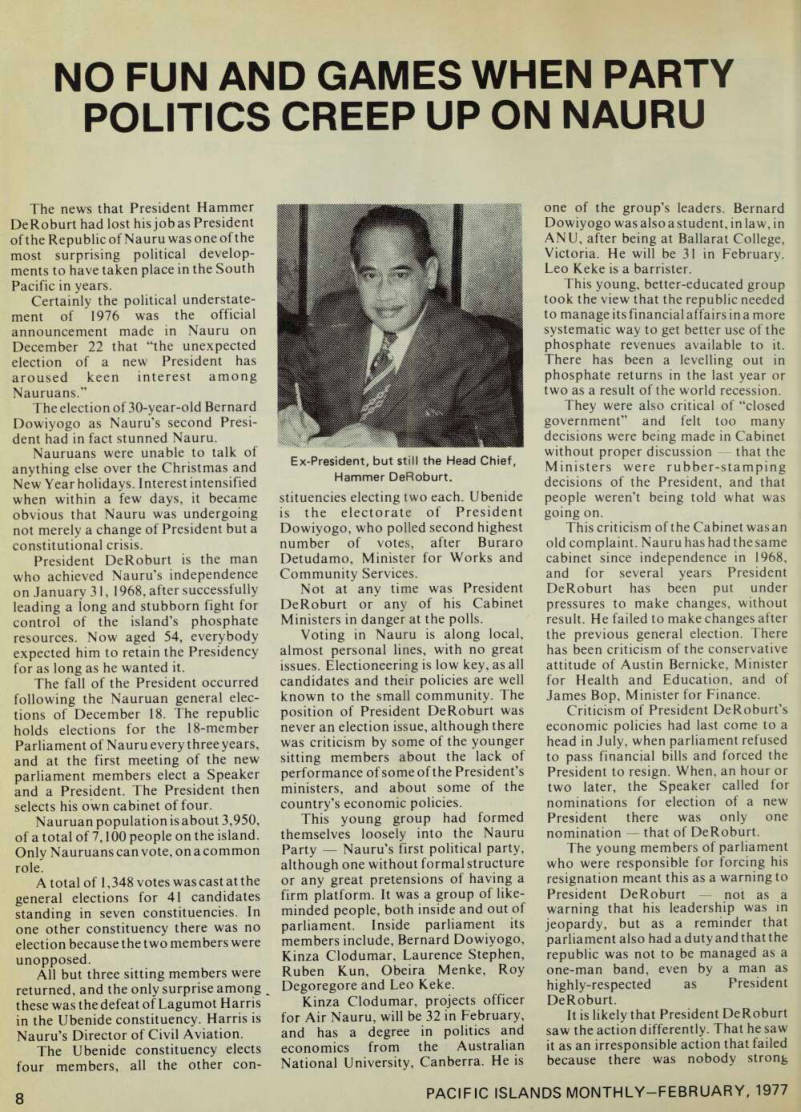
President Deßoburt is the man who achieved Nauru’s independence on January 31,1968, after successfully leading a long and stubborn fight for control of the island’s phosphate resources. Now aged 54, everybody expected him to retain the Presidency for as long as he wanted it.
The fall of the President occurred following the Nauruan general elec tions of December 18. The republic holds elections for the 18-member Parliament of Nauru every three years, and at the first meeting of the new parliament members elect a Speaker and a President. The President then selects his own cabinet of four.
Nauruan population is about 3,950, of a total of 7,100 people on the island.
Only Nauruans can vote, on acommon role.
A total of 1,348 votes was cast at the general elections for 41 candidates standing in seven constituencies. In one other constituency there was no election because the two members were
unopposed.
All but three sitting members were returned, and the only surprise among these was the defeat of Lagumot Harris in the Übenide constituency. Harris is Nauru’s Director of Civil Aviation.
The Übenide constituency elects four members, all the other con-
stituencies electing two each. Übenide is the electorate of President Dowiyogo, who polled second highest number of votes, after Buraro Detudamo, Minister for Works and Community Services.
Not at any time was President Deßoburt or any of his Cabinet Ministers in danger at the polls.
Voting in Nauru is along local, almost personal lines, with no great issues. Electioneering is low key, as all candidates and their policies are well known to the small community. The position of President Deßoburt was never an election issue, although there was criticism by some of the younger sitting members about the lack of performance of some of the President’s ministers, and about some of the country’s economic policies.
This young group had formed themselves loosely into the Nauru Party Nauru’s first political party, although one without formal structure or any great pretensions of having a firm platform. It was a group of like minded people, both inside and out of
parliament. Inside parliament its
members include, Bernard Dowiyogo, Kinza Clodumar, Laurence Stephen, Ruben Kun, Obeira Menke, Roy Degoregore and Leo Keke.
Kinza Clodumar, projects officer for Air Nauru, will be 32 in February, and has a degree in politics and economics from the Australian National University, Canberra. He is
one of the group’s leaders. Bernard Dowiyogo was also a student, in law, in ANU, after being at Ballarat College, Victoria. He will be 31 in February.
Leo Keke is a barrister.
This young, better-educated group took the view that the republic needed to manage its financial affairs in a more systematic way to get better use of the phosphate revenues available to it.
There has been a levelling out in phosphate returns in the last year or two as a result of the world recession.
They were also critical of “closed government” and felt too many decisions were being made in Cabinet without proper discussion that the Ministers were rubber-stamping decisions of the President, and that people weren’t being told what was going on.
This criticism of the Cabinet was an old complaint. Nauru has had thesame cabinet since independence in 1968, and for several years President Deßoburt has been put under pressures to make changes, without result. He failed to make changes after the previous general election. There has been criticism of the conservative attitude of Austin Bernicke, Minister for Health and Education, and of James Bop, Minister for Finance.
Criticism of President Deßoburt’s economic policies had last come to a head in July, when parliament refused to pass financial bills and forced the President to resign. When, an hour or two later, the Speaker called for nominations for election of a new President there was only one nomination that of Deßoburt.
The young members of parliament who were responsible for forcing his resignation meant this as a warning to President Deßoburt not as a warning that his leadership was in jeopardy, but as a reminder that
parliament also had adutyandthatthe
republic was not to be managed as a one-man band, even by a man as highly-respected as President Deßoburt.
It is likely that President Deßoburt saw the action differently. That he saw it as an irresponsible action that failed because there was nobody strong
Ex-President, but still the Head Chief, Hammer Deroburt.
enough to effectively oppose his leadership even when the opportunity presented itself.
In any case, hedidn’theedthestorm warnings on December 21 when the new parliament met to elect a Speaker and a President of the small republic Before the actual sitting began, the new parliament met behind closed doors for a general unofficial discussion on attitudes and procedures. At this meeting the “ginger group” made it clear that this time they definitely wanted some Cabinet changes, and they sought to get an undertaking from Deßoburt.
Although the election for President was still to be held, there was no question in anybody’s mind that Deßoburt would not be re-elected.
President Deßoburt was unexpec tedly unco-operative. He stressed that it was the President’s prerogative to select his own Cabinet and he would give no undertakings beforehand. He was further pressed, but remained adamant that the principle was not to be interfered with.
He indicated at the last moment that if his opponents disagreed, the remedy was in their own hands they would oppose his leadership. This is something the young group did not want to do, but after being challenged they were left with no choice.
Even then, when election timecame they nominated in turn various members of the former Cabinet for the position of Speaker, knowing that if anyone of them accepted nomination it would indicate they knew their Cabinet post was insecure. Each man declined nomination.
The former Speaker, Kenas Aroi, was re-elected.
For the post of President, there were two nominations those of Hammer Deßoburt and Bernard
Dowiyogo. Kenas Aroi chose not to vote and one of the four members for Übenide, Victor Eoaeo, was missing from the chamber at the crucial time.
The ballot was 9 to 7 for Dowiyogo.
The young members had expected
to count on eight votes, and this result was unexpected and stunning. The baby had been thrown out with the bathwater.
Immediately after the ballot, the Speaker adjourned the House for several hours during which time behind scenes, the Nauru Part} assured Deßoburt that the new President would resign and make way for Deßoburt’s re-election, if he now recognised the strength of their feelings and agreed to cabinet changes.
Hammer Deßoburt is a stubborn, resolute man, a strong believer in principle. He made it clear that the principle as he saw it was that the President chose his own Cabinet. No amount of pressure could get him to change his mind, even after he held a long private meeting with members of his former Cabinet Austin Bernicke, Buraro Detudamo, James Bop and Joseph Detismea.
The Nauru Party was left with no alternative but to get on with the business of governing.
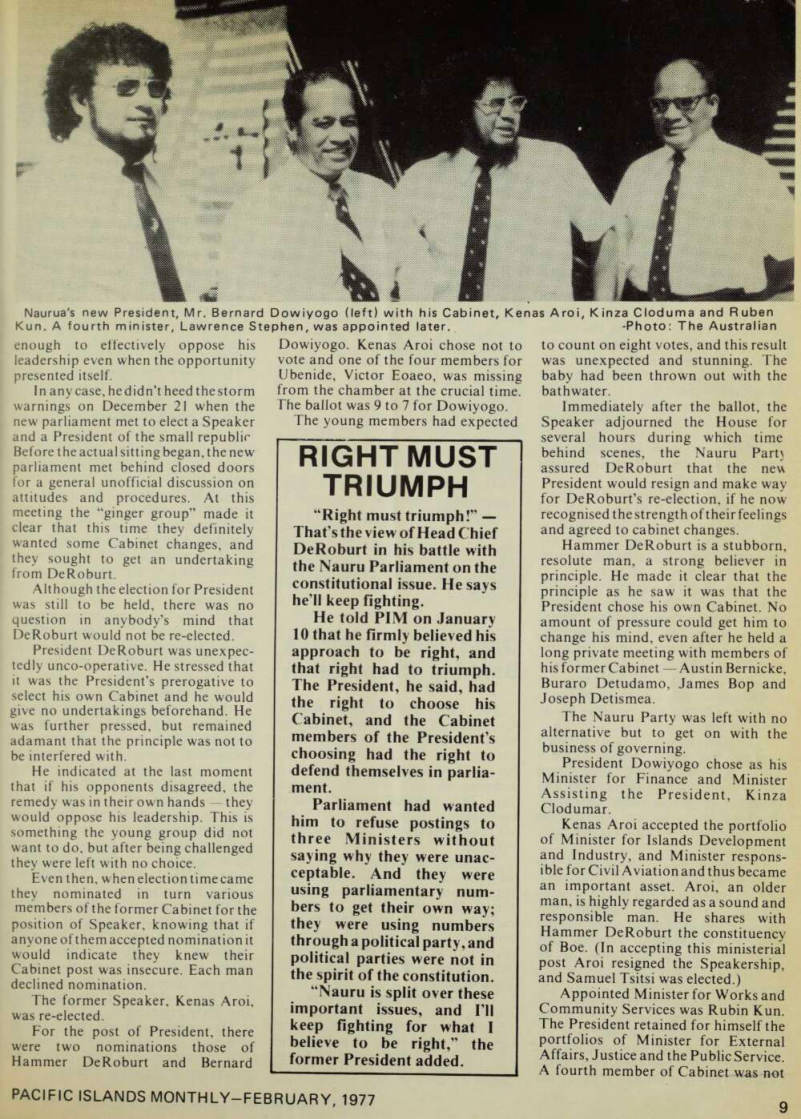
President Dowiyogo chose as his Minister for Finance and Minister Assisting the President, Kinza Clodumar.
Kenas Aroi accepted the portfolio of Minister for Islands Development and Industry, and Minister respons ible for Civil Aviation and thus became an important asset. Aroi, an older man, is highly regarded as a sound and responsible man. He shares with Hammer Deßoburt the constituency of Boe. (In accepting this ministerial post Aroi resigned the Speakership, and Samuel Tsitsi was elected.) Appointed Minister for Works and Community Services was Rubin Kun.
The President retained for himself the portfolios of Minister for External Affairs, Justice and the Public Service.
A fourth member of Cabinet was not
Naurua's new President. Mr Bernard Dowiyogo (left) with his Cabinet. Kenas Aroi. Kinza Cloduma and Ruben Kun. a fourth minister, lawrence Stephen, was appointed later.
selected tor a few days Lawrence Stephen, who took over the portfolio of Health and Education. He has been Nauru’s Assistant Director of Educa tion.
The new President issued a statement paying great tribute to former President Deßoburt, stating that his name “will take an imperishable place in Nauru’s history as the founding father of independ ence.”
He said he was confident that as Head Chief of the island (a post which Deßoburt holds separately under the powerful Nauru Local Government Council) his “contribution to the prosperity of the island in the future will be more than comparable to his great achievements as President.”
Head Chief Deßoburt moved immediately from State House on the hill to his own home which he has always retained neartheciviccentreon the waterfront.
For the next week, the new Cabinet met into the night, takingoverthereins of government.
By Christmas eve, Deßoburt fought back by calling a special meeting of parliament for that day, which can be done under the constitution if any six members want it.
He proposed in a motion that the House should agreeMhat the recent changes were outside the constitution, because they involved party politics, and there was no provision for party politics in the constitution. Nor was party politics in the spirit of the views expressed at the constitutional con vention which had agreed to the constitution.
The debate was not concluded because the new Speaker, Edwin Tsitsi, who is Nauru’s Government Printer, was unable to keep order and resigned, not merely from the Speaker ship but from parliament, thus forcing a by-election (to be held on February 5.) Not until the following week was a new Speaker, David Gadaraoa, appointed, with Derog Gioura elected Deputy Speaker, but despite pro longed debate the motion was still not resolved, although it certainly gave every opportunity for views to be ventilated. The public gallery was crowded.
Meantime, President Dowiyogo’s new government found itself under great social pressure on Nauru.
Head Chief Deßoburt argued that for the sake of the republic they should resign. The new leaders replied that
they had worked within the democratic framework and that Head Chief Deßoburt should accept the will of parliament or else be labelled a dictator. It was also argued during parliamentary debate that the crisis might be resolved by those former ministers to whom the new govern ment objected declaring that they would not be available for Cabinet reappointment, thus clearing the way for Deßoburt’s re-election.
The crisis soon became as much a test of the Nauruans. If they wanted Deßoburt returned, whose principles should be sacrificed? It was a demo cratci coup, and should democratic principles be sacrificed to please the former President? And it soon became obvious that after the first shock of finding itself in office, the new government began to settle into the role that it had unexpectedly won for itself. Minister in charge of Civil Aviation Kenas Aroi represented Nauru at an inaugural flight of the government-owned Air Nauru to Tonga, and was well received by King Taufa’ahau, who said he planned to call briefly at Nauru on January 15 en route to Guam. The Cabinet also started to examine in detail some of the decisions of the former President and evaluate their effect on the Nauruan economy.
Good year for PNG’s
Banking Corporation
The Papua New Guinea Banking Corporation overcame depressed economic activity and periods of un certainty about liquidity to turn in a net profit of K 760,000 for 1975-76, an increase of 24% over the previous year. The improved result allowed the corporation to double, to K 100,000, its contribution to consolidated revenue.
The corporation, in 1975-76, open ed four new sub-branches, to bring the total number to 13. Its total represen tation throughout the country by banking outlets is now 223. The cor poration, in intensified education programmes, made extensive use of audio-visual aids to spread banking knowledge.
The corporation approved new
loans of almost K 1 million, which suggested a depth of demand for credit for worthwhile purposes, which had yet to be fully satisfied by the country’s banking institutions.
Aircraft factory
planned for PNG
Douglas Airways Pty Ltd, a PNG company, is to assemble Australian Nomad aircraft at a plant in Port Moresby.
The deal between Douglas Airways and the Australian government air craft factory in Melbourne was an nounced late in December by the managing director of Douglas Airways, Mr Denis Douglas, as a “partial assembly” operation and in itially it will amount to the installa tion of internal equipment and finishing work.
However, the content of local assembly is expected to increase as the operation develops.
About $55,000 is being spent on the Port Moresby assembly plant, and a technical team from Australia was to arrive in January to advise on the project.
Initially the assembly scheme will be used to provide Nomads sold in PNG, including a fleet which is being established by Douglas Airways itself.
Later, however, if the operation proves economically sound, Douglas Airways could make export sales un der licence.
There are two Nomads operating in PNG at present one with a small charter operator on the north coast of mainland PNG, and the other with Douglas Airways.
Mr Douglas said he had embarked on the assembly deal for two reasons.
One was that he believed the Nomad with its basic engineering and short-field performance appeared to be one of the most suitable aircraft in the world today for PNG operations.
The other reason was that politically-independent PNG had already proved itself economically stable, providing a sound launching base for an aircraft assembly project.
The PNG-assembled Nomads will have a higher seating density than the Australian units, giving them capacity for 15 passengers instead of 12.
Meanwhile, the PNG Transport Minister, Mr Bruce Jephcott, has given tentative details of a ship building project to be established at Madang on the central north coast of the PNG mainland.
Mr Jephcott did not reveal the in vestment interests involved, but said the government had given an assurance of initial contracts.