Nauru Pacific
pp. 63-66 · Read in the full issue
Cuts Its Services
The Nauru Pacific Line has withdrawn from the Australia-Papua New Guinea-Micronesia run with the November sailing from Melbourne, but has caused hardly a ripple among Australian shippers. There was some initial consternation, but several new services were available, or soon became available, to fill the gap.
Nauru Pacific advised that losses, which the Nauru Local Government Council was no longer able to sustain, was the reason for the abrupt withdrawal of the service.
The Daiwa Line service from Australia to the Solomons, Micronesia and Tarawa operated every 35 days with the Palau, 6,393 tonnes, which started several months ago, fills the gap left by the withdrawal of the Nauru Pacific Line.
The Palau sails from Sydney for Honiara, Koror, Guam, Saipan, Truk, Ponape and Tarawa. Its cargoes have been increasing steadily.
Nauru Pacific Line will continue the Australia-Nauru service with the Figamoiya, and the Australia-Fiji- Weslern Samoa service with the Weser Despatcher.
New Png Ships
Fail Stability Tests
Stability problems are delaying the commissioning of four trawler-type coastal ships delivered to the PNG Government.
The four 20-metre ships were built by Pan Asia Shipbuilders of Singapore under a contract worth more than three quarters of a million dollars. But they have failed their seaworthiness tests in PNG, and ad ditional ballasting will have to be carried out. The expense of the extra ballasting will be borne by the
builders following extensive legal negotiations with the PNG Depart ment of Transport.
The ships, of steel and aluminium, were expected to be commissioned in December four months behind schedule. They will replace older trawler-type ships used by the Government for general purpose cargo and passenger operations, mainly to remote coastal outstations.
Tt Ship
Springs A Leak
A Trust Territory ship, the Fen tress, recently sprang a leak while on the way to Koror only a few days after it left dry dock in Japan. She was carrying about 915 tonnes of cement for the new Koror-Babelthaup bridge, and about 810 tonnes of other cargo for other districts in the Trust Territory.
The crew used 55-gallon drums to discharge water which flooded one of the hatches. The ship arrived at Malakal Harbour where an inspection was made and cracks were found in her hull. It was reported later that the cracks were minor and could be repaired in Palau. All cargo in the lower section of one hatch was wet, but there was no damage elsewhere.
Some of the damage was to about 305 tonnes of cement, but it was not expected that that loss would affect the completion date of the bridge, set for March, 1977.
Forum Line Is
On The Stocks
A South Pacific shipping line, the Pacific Forum Line, owned by Islands governments, is on the way. The South Pacific Regional Shipping Council, which met at Suva in November, decided to set up head quarters in Apia and start an active
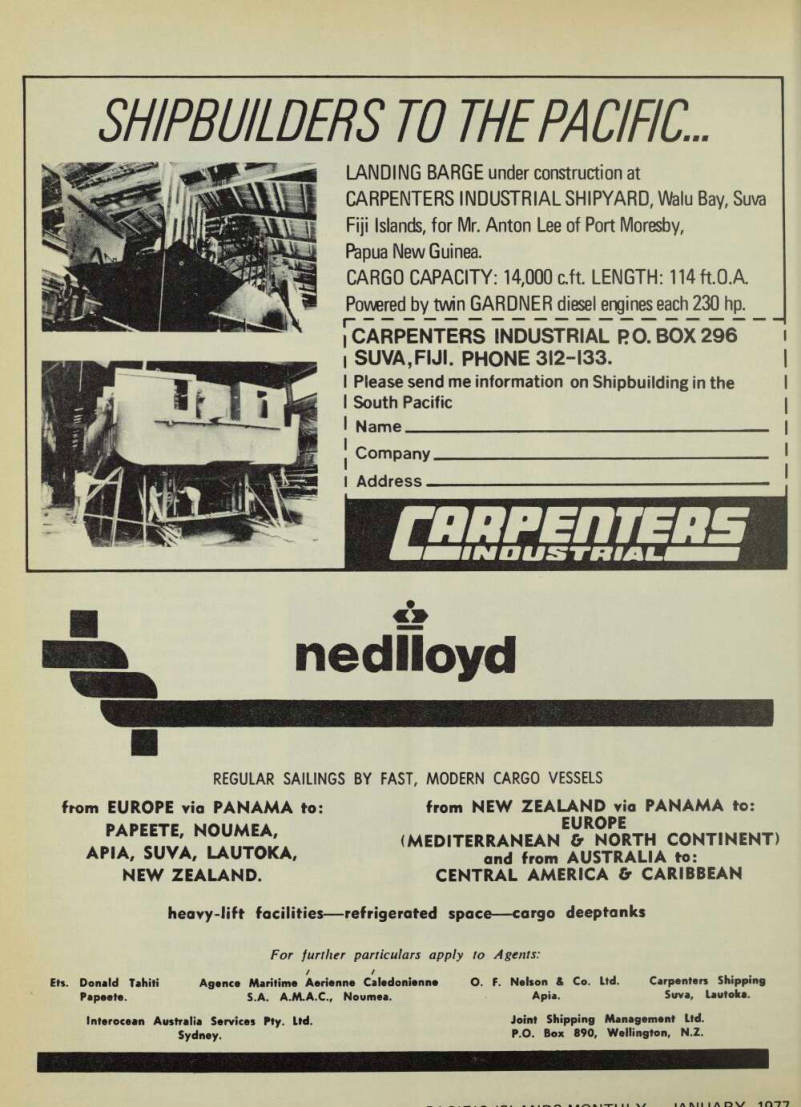
Soon to be a familiar sight in Papua New Guinea waters-the 15.3m ferrocement craft Josephine Sali, a gift from the New Zealand Government to PNG for use as a fisheries patrol vessel. She has a range of 1,200 nautical miles, will have a crew of four with ac commodation for seven people,and is fitted with radar and echo-sounders and a deep freeze for fish specimens. Another craft which is being acquired by the PNG Government is a floating patrol post and cargo-carrying barge to be named Abisaka, the local name for the Sepik River along which the barge will operate, making regular runs for 300 miles between Pagui patrol post and the Green River patrol post. Abisaka will cost K70,000 to be paid for out of a K78,000 independence gift from Canada.
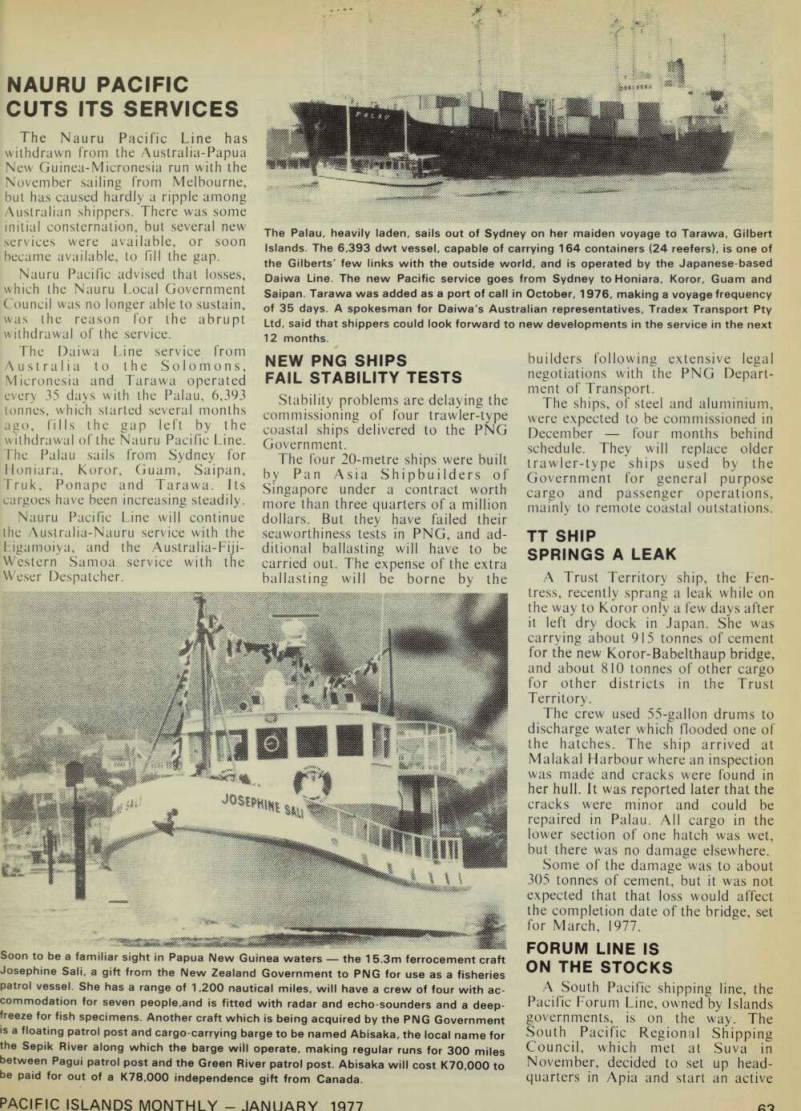
The Palau, heavily laden, sails out of Sydney on her maiden voyage to Tarawa, Gilbert Islands. The 6,393 dwt vessel, capable of carrying 164 containers (24 reefers), is one of the Gilberts' few links with the outside world, and is operated by the Japanese-based Daiwa Line. The new Pacific service goes from Sydney to Honiara, Koror, Guam and Saipan. Tarawa was added as a port of call in October, 1976, making a voyage frequency of 35 days. A spokesman for Daiwa's Australian representatives, Tradex Transport Pty Ltd, said that shippers could look forward to new developments in the service in the next 12 months.
marketing policy to obtain cargo.
The council’s hope is that the ship ping line will be operating the main trunk routes covering Australia, New Zealand and the Islands by the second half of 1977. However, there are still many matters to be attended to before the first ship sails.
Where will the ships come from?
The council said that Nauru, New Zealand and Western Samoa had “in dicated an interest” in supplying ships. The council also reported that the Cook Islands, Fiji, Papua New Guinea and Tonga were willing to take part in the line, and the Gilbert Islands might come in.
A constitution still has to be agreed. There is agreement on a draft constitution, to be considered by the countries taking part, and ratified. An interim board of directors will be ap pointed to establish the line under the council’s guidance.
It was not stated what the eventual powers of the board would be, but if it is to be under the guidance of the council the line is doomed. No managing director or board will be able to operate efficiently when sub ject to the whim of individual governments. The line will only succeed if the board is given its brief and then left to carry it out without in leference.
East-West Gets
Norfolk Service
The Tamworth (NSW) based East- West Airlines has been granted a licence to operate the Sydney-Norfolk Island service, and expects to take over from Qantas on March 1. The Minister for Transport, Mr Nixon, announcing the grant of the licence, said it was in line with a recom mendation in the Nimmo report.
Sir John Nimmo recommended that Qantas be relieved of the responsibility of operating the service to the island, a recommendation which, no doubt, was received with a sigh of relief at Qantas. The ageing DC4s (Skymasters) with which Qantas operate the service, have been a losing proposition for years.
East-West Airlines recently took delivery of two F 27-5009 turbo-prop aircraft, the most modern turbo-prop aircraft in the world. They are fitted with special long-range tanks, and have all the necessary equipment to enable them to fly over water.
East-West expects to take part in phase-in phase-out operation with Qantas. Frequencies have yet to be worked out, but it is likdy East-West
services will fly more frequently as the seating capacity, because of the amount of fuel to be carried, will be 40, compared with up to 58 in the DC4s.
Transport Briefs
• Air Hibiscus may not get off the ground in its bid to operate cheap charter flights from Fiji, initially to the Bahamas and later to Europe. The Fiji Government granted the com pany a permit to operate in July. The first flight was scheduled for October 12, but did not eventuate. The com pany was then informed that unless it began flights by January 1, the licence would be withdrawn. • A new charter service for fishing and sailing enthusiasts visiting Wewak in Papua New Guinea’s East Sepik province has been announced by Mr John Barry of Barry Enter prises. His 26-ft trimaran, licensed to carry eight passengers, may be hired for an eight-hour day for K5O. Motor craft fans may hire his 24-ft cruiser, equipped with two 150-hp motors, for K 75 a day, plus cost of fuel. The cruiser’s flat-out speed is 50 mph. • Melanesian Tourist Services, nation-wide tour operator in Papua New Guinea, has taken over the Sepik River pleasure craft Sepik Explorer, and the Ambunti guesthouse. The move follows the temporary closure of Karawari Lodge in August. • The Micronesian Princess, a container/conventional cargo ship, is for sale at SUSI. 6 million. The ship was charted to the Palau Shipping Co by its owner, the Trust Territory Government. There were no initial bids, but one company submitted a proposal, which was under considera tion in November. The TT Govern ment bought the Micronesian Princess in 1974 from the Dae Sun shipbuilding and Engineering Co, South Korea. It is now offered for sale as it does not fit present operational procedures of the TT fleet. • Nauru Pacific Line is building a new ship in Japan. It will be known as Rosie D. Delivery date is expected to be sometime in July or August, 1977.
The Rosie D, which will be a little smaller than the Kolle D, will be a ser vice ship on trips to Nauru and will carry phosphate on outward trips. She is designed to carry a large quantity of bulk fuel, which will cancel the needs for tankers to call at Nauru. The Rosie D will be equipped to carry general cargo and containers.