The Gilt Is Rubbing Off
pp. 53-54 · Read in the full issue
Business
The City Of Nickel
From PAUL STERLING in Noumea
New Caledonia is a very special island, one aptly named “France’s showcase of the Pacific”. The visitor in search of a tropical paradise is shocked to find himself in the middle of a hustling French community, in a town where modern department stores and glittering shopping arcades overflow with a wide variety of luxury goods.
France, eager to maintain her con trol on the world's second largest reserve of nickel ore, has created a consumer’s paradise, at great expense to the French taxpayers. Television covers the whole island, roads are probably the best in the Southwest Pacific, and the Town Hall would make most New Zealand mayors go green with envy.
The territory enjoys the lion’s share of medals in the South Pacific Games, its representatives prepared by official coaches flown out from Paris, its best athletes trained in France. Sports facilities are far better than any other island could afford.
Since 1968, the inhabitants have prepared themselves for an economic revolution which was to place the territory among the world’s wealthiest communities. Since 1972, economic expansion has been an undefined horizon, somewhere in the middle of “next year”.
The numerous foreign companies who were candidates for the construc tion of a second, or even a third nickel smeller have slowly withdrawn, dis couraged by years of negotiation deliberately delayed by administrative formalities.
Meanwhile, the French State has taken over nearly 50% of the equity of the Societe le Nickel, becoming at the same lime the indirect owner of a generous slice of the nickel reserves.
The population, which was to increase substantially, is actually diminishing, some 2500 people having returned to France during the last 18 months.
Official statistics show close to 1000 unemployed in the capital, but the banks consider that more than 2000 of their clients are without in come. Emigration, and the return of the Melanesians to the refuge of their tribal communities have prevented the unemployment figures from reaching alarming levels.
There are, in Noumea, large blocks of modern flats only half occupied,
and more than 2000 dwellings are empty. The public housing finance company, SICNC, having built hun dreds of flats to accommodate the ex pected inflow of workers, was on the verge of bankruptcy last year, saved by an injection of public funds which doubled its capital. Modern commer cial premises are offering reduced ren tal terms to attract the rare tenant, and the owners of modern boutiques despondently await the rare customer on the doorstep. Fixtures and stocks are heavily mortgaged.
Bankruptcies are numerous, and in proportion to the importance of the disaster. Some are due to imprudence, others to a lack of commercial ex perience, a few deliberate. Several businesses have closed down, leaving hundreds of millions of Pacific francs in debts.
New Caledonia’s economic struc ture is extremely simple. The smelter produces nickel and ferro-nickel matts exported to France and Japan.
At present, there is one year’s stock of
ferro-nickel awaiting the eventual buyer. Ore is also exported to Japan, but quantities sold diminish from year to year.
New Caledonia is basically a corn munity of shop-keepers and public servants. The former sell imported goods for the highest profit possible, the latter preferring high salaries and relative security. Profits and savings are frequently transferred overseas, draining the territory’s reserves, With high, tax-free salaries paid to migrant employees from France, Tahiti, Wallis and Futuna, money is rarely spent locally on more than the minimum necessity. A left-wing group of the Territorial Assembly has suggested the creation of an exchange tax, applicable even on transfer of funds to France and French territories, a project considered un acceptable to the authorities, If the chaos of private enterprise is a major problem for the territory, the situation of public finance is dis astrous. A recent proposition by
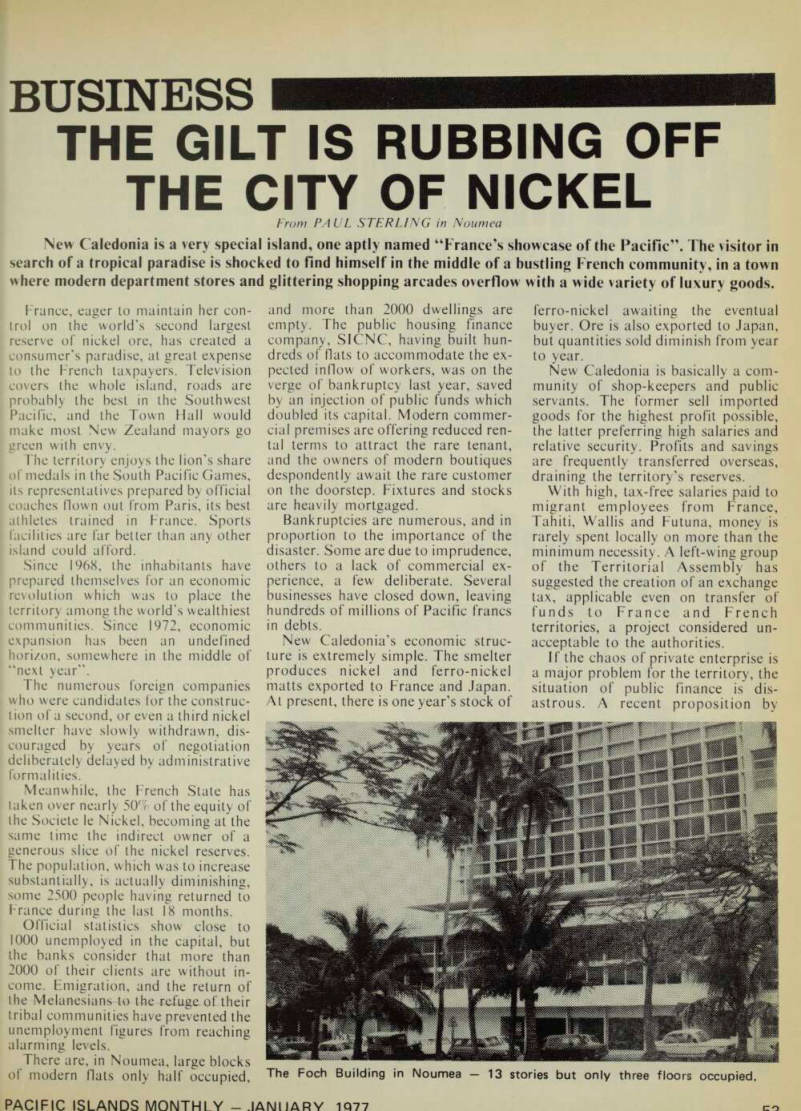
The Foch Building in Noumea-13 stories but only three floors occupied.
France to take over the cost of private education was accepted by a one-vote majority of the Assembly, those in favour being motivated by budgetary problems. A month later, a deficit of 1.5 billion francs had been acknowledged on the current budget, while a modest forecast of 800 million francs shortage has been announced for next year.
In November, the Assembly was to examine the 1977 Budget and in par ticular a project to introduce direct taxation. It seems likely that the ma jority will refuse to accept new taxes, leaving France the responsibility of the final decisions. Import tax has not provided the revenue expected, due to the substantial decrease in overseas trade.
France’s Prime Minister, Raymond Barre, while introducing measures to fight inflation and restrict public ex penditure, is hardly expected to provide further subsidies to the territory.
The old policy of signing the bill and asking France to write out the cheque is wearing thin. The owners of 40ft yachts, air-conditioned Mercedes and bank accounts in Geneva, Nice, Sydney and Honolulu can feel the menace of direct taxation putting an end to their financial paradise.
Yet the territory has resources that are deliberately ignored. Tourism is becoming a new source of revenue, the only activity that improves steadily through the present crisis. Virgin land awaits the plough, while fruit, vegetables and cereals are still im ported from Australia, New Zealand and the United States.
When mining, agriculture and tourism finally play the role of partners in the economic development of the territory, then, and only then will New Caledonia merit its claim to economic leadership in the South- West Pacific.
Two million dollar
causeway for Gilberts
After years of talking about it, the Gilbertese Government has finally decided to build a causeway between Betio and Bairiki, the two main islets on Tarawa Atoll.
The two-mile long, sealed causeway will cost at least $2 million.
A British engineering company has been called in to do design work and supervise the letting of a contract for the job. Work is expected to start late in 1977 and to take about 18 months.