Easy Guide
p. 52 · Read in the full issue
To South Seas
Handicrafts
In September 1964 the South Pacific Commission published Angus Mcßean’s Handicrafts of the South Seas : An Illustrated Guide for Buyers, and it was a book which filled a very definite role.
It gave a straight-forward account of the basic handicraft styles and artifacts of the Pacific Islands and it set out to make the potential buyer more discerning in appraising the intrinsic worth of some pieces of carving, pottery, tapa or other Islands
handicraft products.
The book also described the handicrafts which the Pacific countries and territories each specialised in and gave a realistic price guide for articles which were well produced.
That 1964 book was reprinted in 1966, and a second edition has just been published. The book now deals with the handicrafts of all the countries in the South Pacific Commission’s area with the exception of French Polynesia and Norfolk Island. The latter of course has a somewhat different status.
The book in its second edition is a rather strange mixture. It is as if the
publishing generations have somehow
or other become entangled. In some cases entirely new material has been added and much of this has been assembled with a considerable amount of flair and imagination.
This is particularly noticeable in the sections dealing with the Solomon Islands and Papua New Guinea. Here the use of photographs of quality to support the text is excellent, and I must presume that the input into the sections of the book must be a measure of the importance the individual government departments place upon the pro moton of sales by their cottage industries.
In other cases the book carries on some of the weaker features of the earlier edition, in particular, use has been made of some photographs which must only be described as crude in their reproduction. I am sure, for instance, that the Fiji Government has much
better graphic material than the photograph used to display tapa making.
The book obviously is designed to suit the needs of two groups of users: the tourist, and the vendor who is going to make substantial purchases of Island handicrafts.
Perhaps the most valuable section of the book is the Handicrafts of the South Seas Price List, which appears at the end. It is a comprehensive listing and should be of much assistance to the discerning buyer. It is to the credit of the South Pacific Commission that it is now recognising the dynamic nature of the handicraft market and that it will produce annually an updated price list, in order to provide prospective buyers with accurate information on which to
base their orders.
W. G. Coppell.
(Handicrafts Of The South Seas
Published by the South Pacific Commission. $3.50 in SPC area, $4 elsewhere.)
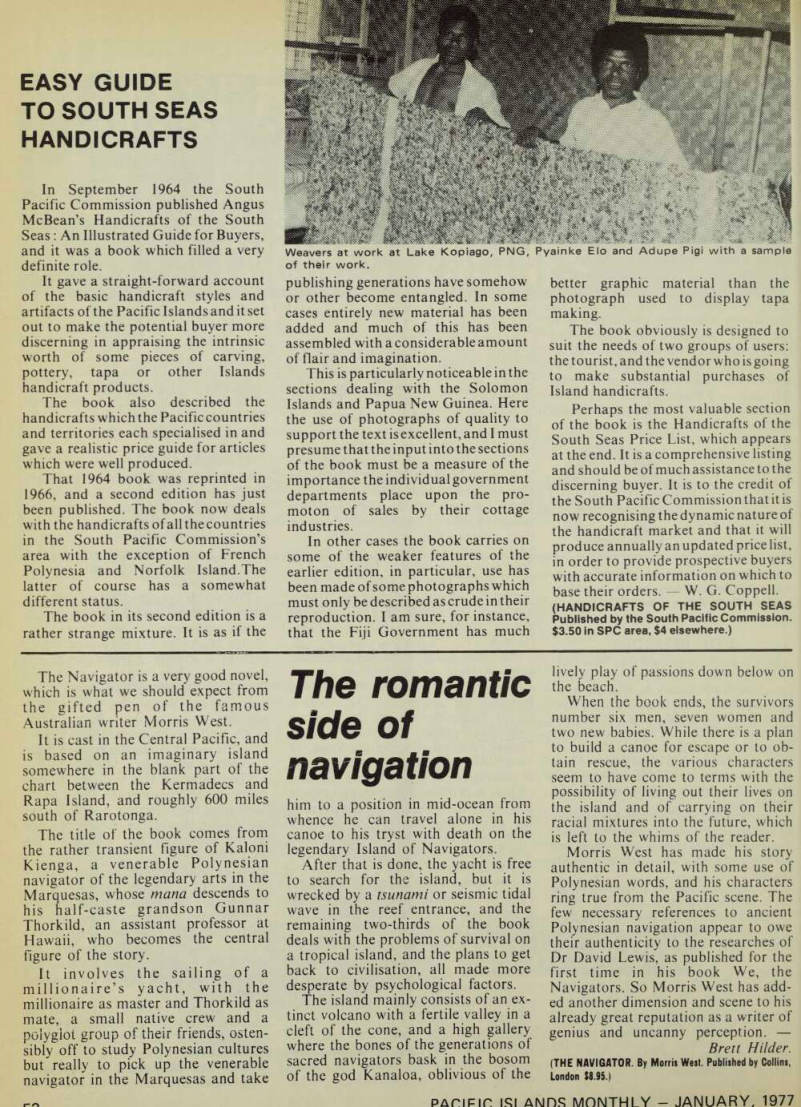
Weavers at work at Lake Kopiago, PNG, Pyainke Elo and Adupe Pigi with a sample of their work.