A Pacific Paradise
pp. 33-35 · Read in the full issue

The Perils Of Living In
From ROBERT KEITH-REID in Suva
Pacific Islanders who think they are immune from gigantic earthquakes like the one which devasted a whole Chinese city recently are in for a shock; they are not.
Nor should they count on their cor al reefs to protect them from tsunamis the huge killer waves stirred up by earthquakes that have battered coun tries in the North Pacific.
And when you add up the number and toll of destructive hurricanes, count how many sleeping bomb volcanoes there are, and throw in floods and drought, it all goes to show that South Seas life is not so som nolent as it seems.
There are all sorts of perils to blast people rudely awake. They were brought out for examination at the first South Pacific disaster preparedness relief seminar held in Suva.
Organised by the Red Cross, Com monwealth Fund for Technical Co operation and the United Nations Disaster Relief Organisation (UNDRO), its aim was to find out how Pacific Island countries stood ready to cope with handling major disasters.
Experts and delegates from 22 countries and 10 international organisations discovered that in most cases the answer was that they are not really ready at all.
The definition of a disaster came from Mr James Lewis, of the Disaster Research Unit of the University of Bradford, in England.
“Without people there cannot be a disaster’’ he said. “No matter how big the ’quake or the hurricane if people are not affected there’s no disaster situation”.
According to Mr Lewis disasters in the 10-year period 1966 to 1975 cost the 10 members of the South Pacific Bureau for Economic Co-operation (SPEC) a total of sA37.s~miiHon.
This is about $1 each for each man, woman and child in the region or 11.5% of the average gross national product at 1973 prices.
Mr Lewis said this figure didn’t in clude the cost of secondary losses caused by evacuation and migration.
Hurricanes are the type of natural
disaster most frequently associated with the Pacific Islands.
Looking at the record for a 30season period from 1939/40 to 1968/69, Dr John Gabites, of the Fiji Meteorological Service, said the region’s hurricane season was generally regarded as being November to April. But 1972’s Hurricane Bebe had arrived on Oc tober 20 and in 1968 one had been ac tive on May 4.
Of 194 hurricanes, nine had oc curred in November, 29 in December, 54 in January, 61 in February, 50 in March and 20 in April.
Frequencies ranged from three in 1944/45 to 12 in 1955/56. The region’s busiest hurricane playground, said Dr Gabites, was the 18-21 deg lat, 150-170 deg long area across the north of New Caledonia to the Loyal ty Group.
Inside this area any one place had been battered at least four times in a decade.
In the area from the Coral Sea to Fiji, people could expect to experience at least three hurricanes a decade; and places in the New Hebrides, Samoa, Tonga and the southern Cooks could count on one or two visitations.
In the 30-year period New Caledonia has recorded 36 hurricanes (eight severe); the New Hebrides 25 (five severe); Fiji 35 (eight severe); northern Tonga 10, southern Tonga 16 (two severe); Samoa 11 (three
severe); Niue 11 (three severe); the northern Cooks four and Southern Cooks 15 (five severe).
Mr Ronald Richmond, director of the Fiji Mineral Development Depart ment, had some alarming information to impart about earthquakes and tsunamis.
Since 1900, 18’quakes greater than the Richter magnitude eight very strong seismic events had occurred in the PNG-Solomons-New Hebrides-Tonga areas, he reported.
Recent research has shown that no less than 70% of the world’s deep focus earthquakes are recorded from the Fiji area, but fortunately for Fiji they are so deep they do not cause land surface damage.
An 8.4 ’quake in the Tonga Trench shook all Tonga and caused landslides as far away as Samoa; and an 8,7 shock in the same area in 1917 up lifted and dried out a whole lagoon.
Mr Richmond warned that only the New Hebrides, French Polynesia, New Caledonia and possibly Papua New Guinea had adequate seismograph stations to discover areas of possible seismic danger.
Recent studies from a three-station network operated in Fiji showed the 110,000 people of Suva to be settled on a major seismic zone running from Suva to Beqa Island and possibly towards Taveuni.
Shocks in 1953, 1961, 1970 and 1975 were all located in this zone, and
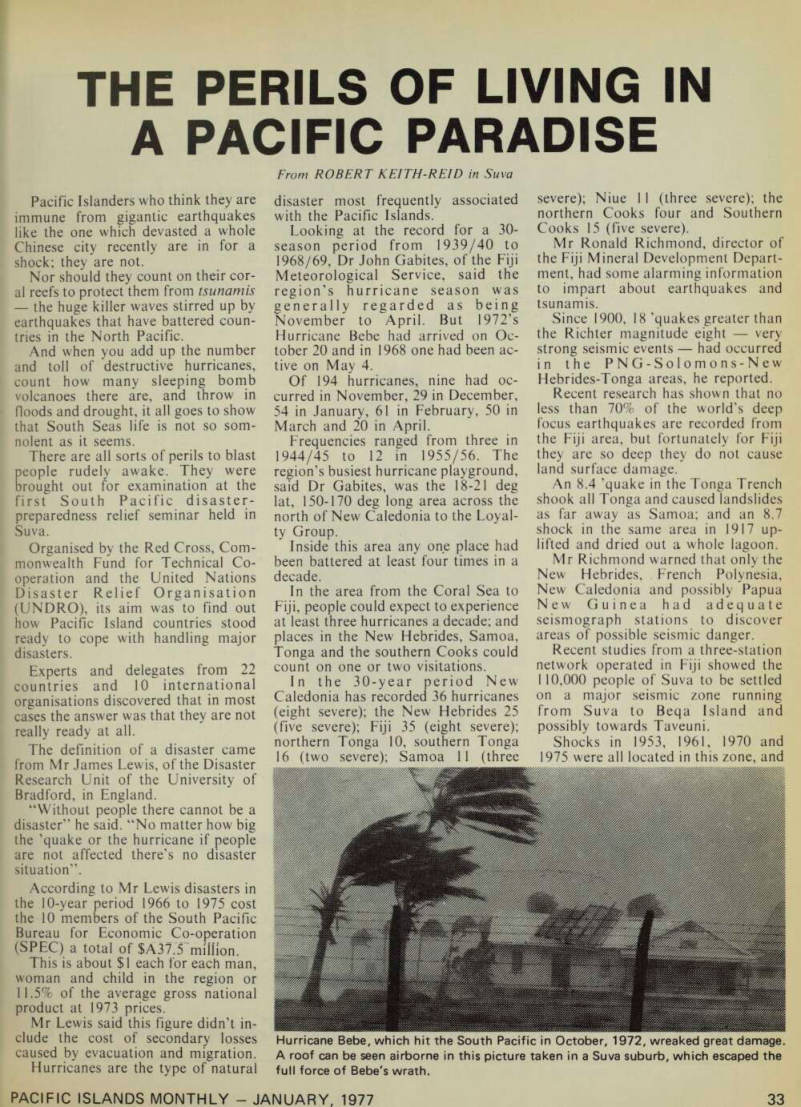
Hurricane Bebe, which hit the South Pacific in October, 1972, wreaked great damage.
A roof can be seen airborne in this picture taken in a Suva suburb, which escaped the full force of Bebe's wrath.
the Suva seismograph had recorded about 30 minor shocks in the past two months before the seminar.
“The discovery of this active zone so near the densely-populated city of Suva has many implications for building codes, town planning and communications” Mr Richmond pointed out. He said the area needed urgent detailed study to decide just what level of risk the city faced.
Turning to tsunamis, Mr Rich mond had some equally chilling news.
In special circumstances the largest wave could be well over 80ft high, he said. Most Pacific Islands had well developed fringe or barrier reefs which were good protection against the waves.
But in 1953, a 30ft to 50ft tsunami had hit the Suva barrier reef at low tide and reached the city as a 6ft wave which inflicted considerable damage.
Bougainville had been hit by three waves in 1974/75, and tsunamis had been generated by the big Tonga Trench earthquakes of May, June and November 1917, and April 1919.
“The lesson from this is that in spite of our protective reefs we may be quite vulnerable to tsunamis of local origin and perhaps also to tsunamis from other parts of the Pacific”, Mr Richmond said.
Noting that the waves can travel at “jet speed” Mr Richmond said the in ternational tsunami warning centre at Honolulu had serious limitations as far as the South West Pacific was con cerned.
On December 26 last year a 7.2 magnitude earthquake occurred near Samoa at about 4 am. At 6 am, Suva had a warning from Honolulu that a wave might arrive at Suva at 6.10 am.
If a large one had occurred it would already by then have swept through the Lau Group and there would have been no time to effectively warn Suva’s population.
On January 14 this year, a 7.7 shock had occurred in the Kermadecs, south of Fiji, at 6.47 am. Suva had got a warning from Honolulu that a killer wave might arrive at 7.12 am.
“The fault was not entirely with Honolulu as it does take a good two hours to communicate with other seismograph stations to locate the magnitude,” Mr Richmond said.
“What it does show is that for regional earthquakes in the south west Pacific we may have to organise our own regional network for im mediate warning in the event of strong earthquakes within the region.”
Apart from being in one of the
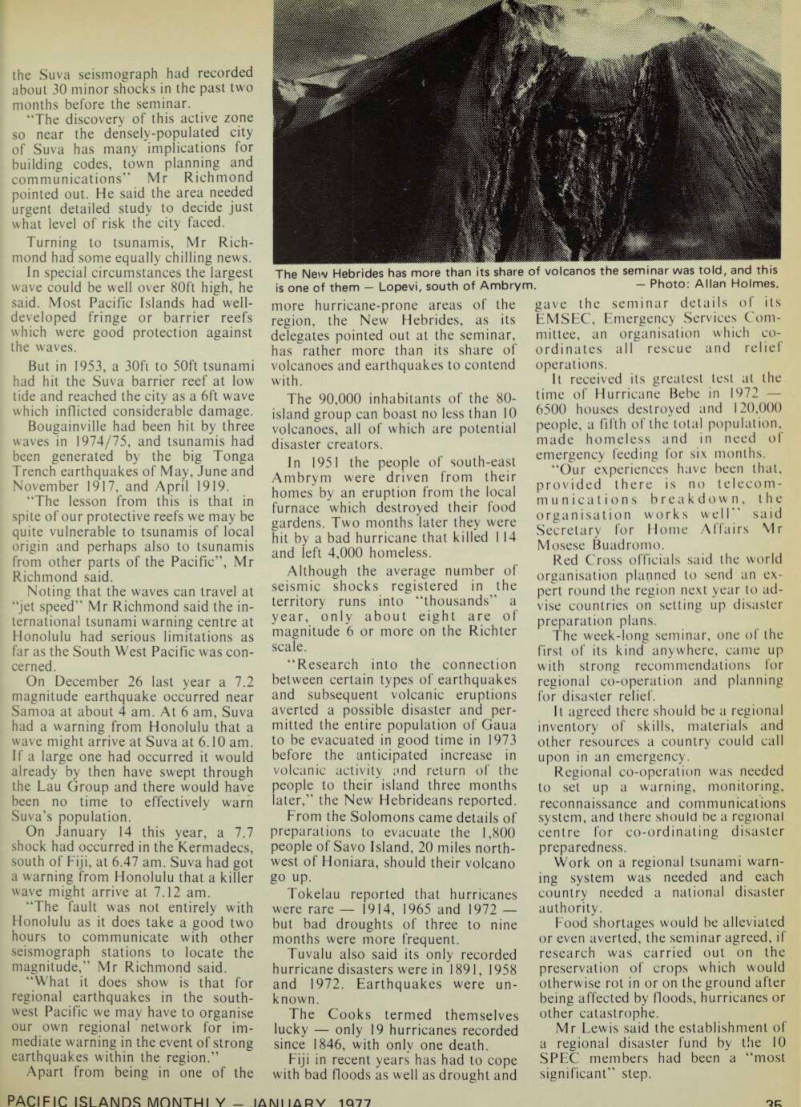
more hurricane-prone areas of the region, the New Hebrides, as its delegates pointed out at the seminar, has rather more than its share of volcanoes and earthquakes to contend with.
The 90,000 inhabitants of the 80island group can boast no less than 10 volcanoes, all of which are potential disaster creators.
In 1951 the people of south-east Ambrym were driven from their homes by an eruption from the local furnace which destroyed their food gardens. Two months later they were hit by a bad hurricane that killed 114 and left 4,000 homeless.
Although the average number of seismic shocks registered in the territory runs into “thousands” a year, only about eight are of magnitude 6 or more on the Richter scale.
“Research into the connection between certain types of earthquakes and subsequent volcanic eruptions averted a possible disaster and per mitted the entire population of Gaua to be evacuated in good time in 1973 before the anticipated increase in volcanic activity and return of the people to their island three months later,” the New Hebrideans reported.
From the Solomons came details of preparations to evacuate the 1,800 people of Savo Island, 20 miles north west of Honiara, should their volcano go up.
Tokelau reported that hurricanes were rare 1914, 1965 and 1972 but bad droughts of three to nine months were more frequent.
Tuvalu also said its only recorded hurricane disasters were in 1891, 1958 and 1972. Earthquakes were un known.
The Cooks termed themselves lucky only 19 hurricanes recorded since 1846, with only one death.
Fiji in recent years has had to cope with bad floods as well as drought and
gave the seminar details of its EMSEC, Emergency Services Com mittee, an organisation which co ordinates all rescue and relief
operations.
It received its greatest lest at the time of Hurricane Bebe in 1972 6500 houses destroyed and 120,000 people, a fifth of the total population, made homeless and in need of emergency feeding for six months.
“Our experiences have been that, provided there is no telecom munications breakdown, the organisation works well” said Secretary for Home Affairs Mr Mosese Buadromo.
Red Cross officials said the world organisation planned to send an ex pert round the region next year to ad vise countries on setting up disaster preparation plans.
The week-long seminar, one of the first of its kind anywhere, came up with strong recommendations for regional co-operation and planning for disaster relief.
It agreed there should be a regional inventory of skills, materials and other resources a country could call upon in an emergency.
Regional co-operation was needed to set up a warning, monitoring, reconnaissance and communications system, and there should be a regional centre for co-ordinating disaster preparedness.
Work on a regional tsunami warn ing system was needed and each country needed a national disaster authority.
Food shortages would be alleviated or even averted, the seminar agreed, if research was carried out on the preservation of crops which would otherwise rot in or on the ground after being affected by floods, hurricanes or other catastrophe.
Mr Lewis said the establishment of a regional disaster fund by the 10 SPEC members had been a “most significant” step.
The New Hebrides has more than its share of volcanos the seminar was told, and this is one of them -Lopevi, south of Ambrym. -Photo: Allan Holmes.