Tropicalities
pp. 23-28 · Read in the full issue


Sex, sport and scandal
Anyone visiting New Caledonia these days could well imagine that the island is overrun with French police and gendarmes feverishly hunting out robbers, vengeful lovers, victims of passionate crimes and family gun feuds.
At least this is the impression a visitor would gel just by reading the front pages of the territory’s main newspapers. Indeed, if newspaper headlines are any clue to the variety of local exotica, Noumea certainly has everything, and writers seem to have really excelled in providing sensation for the New Caledonians.
From one day to the next in November readers were confronted with “Attempted Suicide at Camp Fsl prison”, while a remote west town reported “Kicked in the stomach by his brother, he lies in agony and dies 8 days later”, and in a Noumea slum “Asphyxiated in the mud A drunk man had fallen head-first into a road side drain”.
For the student of life in the South Seas a la franca ise, the French papers paint a vivid picture “Series of Robberies in Noumea 150,000 francs booty”. An even more colour ful reaction to the economic crisis tells how “His boss was taking off aboard the Galileo He attacks him with splashes of paint”. This is over alleged unpaid wages and results m the depar ting family being treated at hospital before finally sailing for Europe leav ing the locals to worry about reported debts.
The news of Caledonians in France is no less comforting “Paris: The Caledonian students in revolt” (at their Paris hostel) and “Two young (Melanesian) military trainees killed in France their bodies are flown back”.
Then there are the affairs of pas sion. Up bush there is “Passionate violence at La Foa She chides her lover with a tommyhawk”, while at the hideous tall blocks of apartments at the Cite de St Quentin outside Noumea there is drama for a young
Melanesian from Ouvea Island “Her boyfriend leaves her She jumps from the third floor” and, for tunately, suffers only fractured limbs.
Family disputes, often among the poorest folk desperately trying to make a living, also help to sell newspapers “In the X family at La Foa, they talk with guns” leaving mother and son with gunshot wounds in the legs. Then comes a shock from Tahiti “To make her obey, they burnt her with an iron”.
This was the constant front-page diet served up during two weeks in November by Noumea’s two dailies, one owned mainly by the SLN nickel company and the other closely identified with the French administra tion. The third pro-administration paper, a weekly, entertained its readers with an impressive picture of the guillotine and posed the question, “Death Sentence new dilemma of conscience for (President) Giscard”.
Noumea for some years had a third daily newspaper the Bulletin du Commerce Noumea Soir, but this was bought out four years ago by the SLN and closed down some time ago.
About seven years back, an Australian journalist writing for Radio Australia and others was ex pelled from Noumea for writing reports claimed to be damaging to the Noumea tourist industry.
However, today, the French press is presenting a far more dazzling array of sensation. If one happens to look for news other than in the voluminous pages of sex, sport and scandal, one may notice that a lot of people are be ing hastily flown off to talk with the central government in Paris where the most important action of all is taking place to integrate New Caledonia more completely with France.
But, by the time the Caledonians have read all their dramatic daily diet of newspaper headlines, they just may be distracted enough not to notice that anything else is happening.
Mount Hagen that entertainment opportunities in the villages were limited. She said, “as far as women and children are concerned, their main entertainment is to watch the men coming home drunk and performing like idiots”.
Mrs Watts suggested that music ians and instruments from overseas could be brought to the villages to extend the cultural interests of the people. Music lesson could be provided for the younger people who could then provide entertainment in their villages. Finance for the scheme should come from part of the government tax on beer.
She believed that entertainment and social life were important in a developing society, and were not receiving sufficient attention from the PNG Government.
Anyone heard
about this?
Dick Hosking, Director of Broadcasting in the Solomons, is seeking information on a little-known incident which involved his uncle, the late Aubrey Hosking, around some South Pacific Islands about 1919.
Aubrey Hosking, late general
manager of Amalgamated Wireless Valve Manufacturers of Australia, who died in Sydney in 1968, made the first radio valve in Australia. At one lime he was radio operator on the SS Nauru and on one voyage, believed to be in 1919, he made the first ship-to shore radio contact in the South Pacific Islands.
He set up apparatus and linked two islands. Then he demonstrated the magic box to the chiefs and was able to gel the warring chiefs of two islands to talk to each other over the air. One of them promptly tried to take possession of Aubrey and his box believing him to be some kind of a god, but Aubrey was able to get back to his ship with his radio apparatus.
Dick Hosking is wondering if anyone has knowledge of the incident and the islands concerned.
He has been in the Solomons for a year before which lime he was 9Vi years in Papua New Guinea with government radio and the NBC. He's had several years in Africa, a year with Radio Luxembourg in London and two or three years in Australia.
He has a home at Buderim in Queensland.
His title of Director of
Broadcasting is a new one in the Solomons where the government is now' setting up a Solomons Broadcasting Corporation which will have a statutory board and, so it’s hoped, will be able to operate more or less free of government control. mo • Tnma.
IScblgn bdyS> lumd;
"Thanks" says Oscar
n f Papua New Guineas Minister for Provincigi Affairs and Local Governmem, Mr Oscar Tammur, said in Rabaul late last year he appreciated the call by Toma Community Government on the Gazelle Peninsula for him to give up his portfolio.
He said he was also grateful that his own Tolai people had reminded him to do something for the province.
“However, being their member and a minister for the whole country, I cannot just give up my portfolio. The decision has to come from both the people and the national government," he said.
Mr Tammur reminded the people
of Toma Community Government that it was not he alone who made decisions on the process of handing over powers to the provincial governments. The process of decen tralising powers must go through the cabinet and the national parliament, and then, at the end of the line, it was his job to hand powers over to provin dai government.
Mr Tammur said the people’s high eX p ec tations of receiving too many things at the same tim cou|d 0 „Z resu t in a bad provincia government structure mti c
I H 6 Samoans
• coming . ♦ .
“Are Samoans going to do for American football what oil did for Oklahoma?" asks the New York magazine Sports Illustrated in a re cent issue The magazine comments on the “swarm of Polynesian warriors" entering American college football from American Samoa. It lists Samoans playing for the Univer
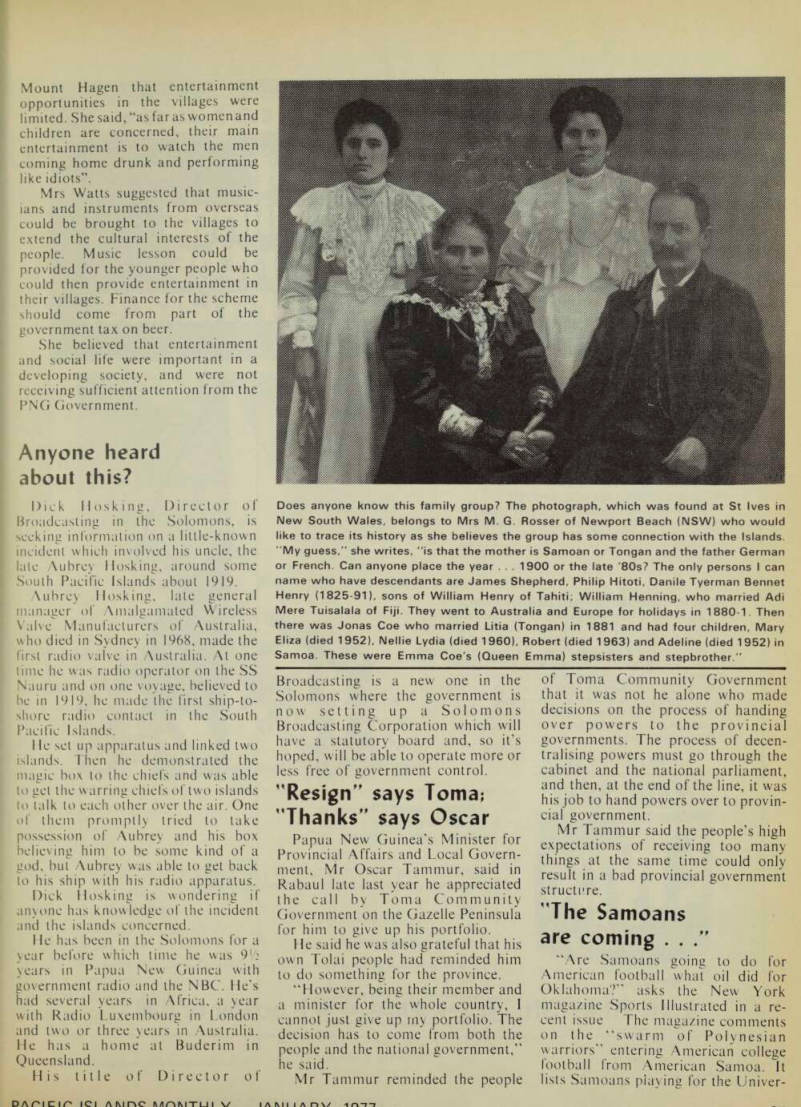
Does anyone know this family group? The photograph, which was found at St Ives in New South Wales, belongs to Mrs M. G. Rosser of Newport Beach (NSW) who would like to trace its history as she believes the group has some connection with the Islands.
"My guess,” she writes, "is that the mother is Samoan or Tongan and the father German or French. Can anyone place the year...1900 or the late '80s? The only persons I can name who have descendants are James Shepherd, Philip Hitoti, Danile Tyerman Bennet Henry (1825-91), sons of William Henry of Tahiti; William Henning, who married Adi Mere Tuisalala of Fiji. They went to Australia and Europe for holidays in 1880-1. Then there was Jonas Coe who married Litia (Tongan) in 1881 and had four children, Mary Eliza (died 1952), Nellie Lydia (died 1960), Robert (died 1963) and Adeline (died 1952) in Samoa. These were Emma Coe's (Queen Emma) stepsisters and stepbrother."
sity of Southern California, Universi ty of California (Los Angeles), Brigham Young, San Jose State, San Diego Stale, Long Beach City College, and lots more.
It says that the new wave started after President Kennedy’s nominee, former Governor of American Samoa, Rex Lee, introduced educational TV to American Samoa in 1961 and screened football training films. From that time on, American football “looked like the rainbow’s end to many Samoan teenagers”, the magazine says.
The wave of northward migration shows no sign of tapering off. Sports Illustrated says the idea is gaining ground in American college football circles that “if the way to catch a thief is to be one, the way to stop a Samoan may be to put another Samoan, or better yet, two Samoans against him”.
Pumpkin leaves
or the cemetery!
Modern Papua New Guinea treats its troublemakers too kindly, the Prisons Minister, Mr Pita Lus, said towards November’s end.
“Under tribal law, troublemakers ended up in the cemetery now we just lock them up for a while,” Mr Lus said.
He was answering questions in the National Parliament about food given to prisoners.
Mr Ninkama Bomai (Gumine elec torate) had suggested the food was un suitable, and could have been a factor in the recent death of four prisoners.
Prisoners were fed Pumpkin leaves for breakfast, Mr Bomai alleged.
Mr Lus said, “Well what’s wrong with that? There’s plenty of protein in pumpkin leaves”.
He added that so far as he knew, prisoners were being properly fed three times a day, and many were growing fat and healthy on the diet they received.
He undertook to investigate Mr Bomai’s report that four prisoners had died.
'Sorry, sergeant’,
says the minister
A two-year-long Cook Islands legal drama ended in November in an em barrassing climb-down by Tupui Ariki Henry, Minister-in-Charge of the Broadcasting and Newspaper Corporation, and Mr M. Drollet, the Corporation’s manager.
Both men signed a public apology
to Sergeant Norman George, a Cook Islander who had previously been a policeman in the Cook Islands before joining the New Zealand force.
The drama centred on an article published under banner headlines in the Cook Islands News on November 22, 1974, which described Sergeant George and another man as “agitators” and “disturbing elements in a public place”.
The article was subsequently broad cast over Radio Cook Islands.
Sergeant George instituted civil proceedings against the Corporation, the responsible Minister and the Cor poration’s manager.
At a hearing of the Cook Islands High Court on November 29, 1976, it was ruled that a public apology was to be made to Sergeant George and that the question of damages and costs in his favour had been settled in private.
The apology said: “You were reported as an agitator and a distur bing element in a public place. It was inferred that you had created a distur bance in a public place, and that as a result of your behaviour the Chair man of the Island Council had to close the meeting (on the island of Aitu on November 21, 1974).
Although you participated in the meeting and asked repeated questions concerning the Audit Report which caused some concern to the guest speakers at the meeting, we have found that it was not correct that you were the cause of a disturbance and that the meeting had to be closed because of your behaviour. Accor dingly, each of us apologises and regrets any improper reflections on your personal reputation, or your reputation as a policeman.”
Still looking
for lost caravel
The Australian National Universi ty has awarded a two-year research fellowship to Robert Langdon, who was PI M’s assistant editor for several years in the 1960 s and is the author of two books published by Pacific Publications.
The fellowship is in the Department of Pacific and South-East History of the Research School of Pacific Studies and begins in February. It recognises the contribution Bob made to Pacific studies with his book The Lost Caravel, which concerns the in fluence in the Pacific Islands of 16th century Spanish castaways.
Bob proposes to devote the period of his fellowship to further in vestigations into the castaway ques
tion, as he believes the 368 pages of The Lost Caravel have only told about half the story.
He is especially interested in pur suing his theory that a goodly number of Spaniards from the caravel San Lesmes reached New Zealand from Raiatea, Society Islands, several years after their ship ran aground in the Tuamotu Archipelago about mid- July, 1526.
Bob believes the Spaniards sailed south-west with the idea of rounding the Cape of Good Hope and returning to Spain; that they were accompanied by Polynesian men, women and children; and that their vessel was the so-called Tainui “canoe” of Maori and Tuamotuan tradition.
Maori tradition says that the Tainui people settled at Kawhia Har bour on the west coast of New Zealand’s North Island. Many Maoris of today trace their descent from them. An announcement of the reasons for his fellowship has already created interest in New Zealand newspapers.
Bob is also interested in seeing what more he can find out about Spanish castaways in other parts of the Pacific, notably the Carolines and Solomons.
He has been delving into Pacific history since the early 19505. His first book, Tahiti: Island of Love, a pop ular history of Tahiti, was first published in 1959 and is now in its fourth edition the last two publish ed by Pacific Publications.
Bob was with Pacpub from 1962 to 1968 when he went to Canberra as ex ecutive officer of the Pacific Manuscripts Bureau at the Australian National University. He has leave of absence from the PMB for the dura tion of his fellowship.
Air strip
A man from the Gilbert Island caused a stir on a recent flight by jum bo jet from Frankfurt to London. Fin ding the cabin temperature a little bit too high, he divested himself of his clothing, and even when the pilot lowered the temperature he did not re dress. He just sat in his seat, in his birthday suit, all the way to London.
The pilot radioed London. The police met the aircraft and took the man,aged about 30, into their care, handcuffing him as a precaution. Said one passenger, “It was better than a movie”.