For The Banabans
p. 16 · Read in the full issue
Something Each Way
The British High Court in December found against the Bana bans in their claims for £2l million sterling in back royalties for phos phate mined on their native Ocean Island, and for Britain to replant devastated mining areas with coconut palms and other crop-bearing trees.
The court said that although legally nothing could be done to force Britain to pay the royalties or rehabilitate the land, the Banabans were entitled to compensation for the damage to the land, and he ordered that the British Phosphate Commis sioners make payments that were “neither nominal nor very large”.
But if the major legal decision in the marathon, 221-day case went against them, the Banabans came out of it clear moral victors.
The presiding judge. Sir Robert Megarry, was sharply critical of past British treatment of the islanders, and broadly hinted that Britain should also make some financial recompense to the islanders for its treatment.
Sir Robert said he could not grant the £2l million claim because no “true trust” had been created with the Banabans in a legal sense. The Crown’s obligation was govern mental, and although there had been grave breaches,of that obligation, the court was powerless to do anything about it. Such obligations were not enforceable in the courts, he said.
But he added: “Justice is not confined to what is enforceable in the courts. I shall accordingly leave the Attorney General to make such communications to other persons concerned as he considers proper.”
A London report a few days after the court case said that SA2 million was a figure being suggested, but the true figure will be set in an out-of court settlement between the Bana bans and the BPC (which is a partnership of the British, Australian and New Zealand governments).
It’s most likely that the settlement will be financed from the money paid by the Nauruan Government to the BPC when it took over the BPC operations on Nauru.
In the course of his judgment, the longest in British legal history, Sir Robert said that a letter written to
Ocean Islanders by the island’s Resident Commissioner, Sir Arthur Grimble, in 1928 “could not be read without a sense of outrage”.
Sir Arthur had told the islanders in the letter that their refusal to accept an offer of 10.5 pence per ton of phosphate had “shamed the import ant chief’ (King George V). The letter than put to the islanders “points of life and death”.
Sir Arthur had said if they signed the agreement they would have life and their “shaming of the important chief will be forgiven and you will not
be punished.”
The “points of death” were that if they did not sign, the land would be compulsorily acquired, mining would be indiscriminate and their children and grandchildren would have “no land, no money”.
Sir Robert Megarry was also highly critical of British Government action in the negotiation of a major phosphate deal between the GEIC and the BPC in 1947. To negotiate on such a matter as the government had done, without giving the Banabans any guidance or advice, “could not possibly be called good government,” he said.
He said the British Phosphate Commissioners, who have had charge of mining operations on the island since 1920, could not take the benefit of the mining without taking the burden of their obligations.
In reaction to the judgment, Mr Thomas Teai, secretary to the Banabans’ Rabi Council of Leaders, said in Suva that his people had found great satisfaction in the judge’s denunciation of the British Govern ment.
The Banabans had felt that way for a great many years since they became
aware of the way things were manipulated to suit first the private exploiters of the phosphate deposits, then the administering power of the Gilbert and Ellice Islands Colony, and last but not least the BPC.
“The judge said that we did not have the protection we should have got,” he said.
“But, as he also said, his court was not a court of morals, and we lost our claim that legally the British Govern ment had been our trustee and had let us down.
“We have absolutely no complaint to make about the judgment.
“The judge gave the finding he did because there was no law under which he could do otherwise.”
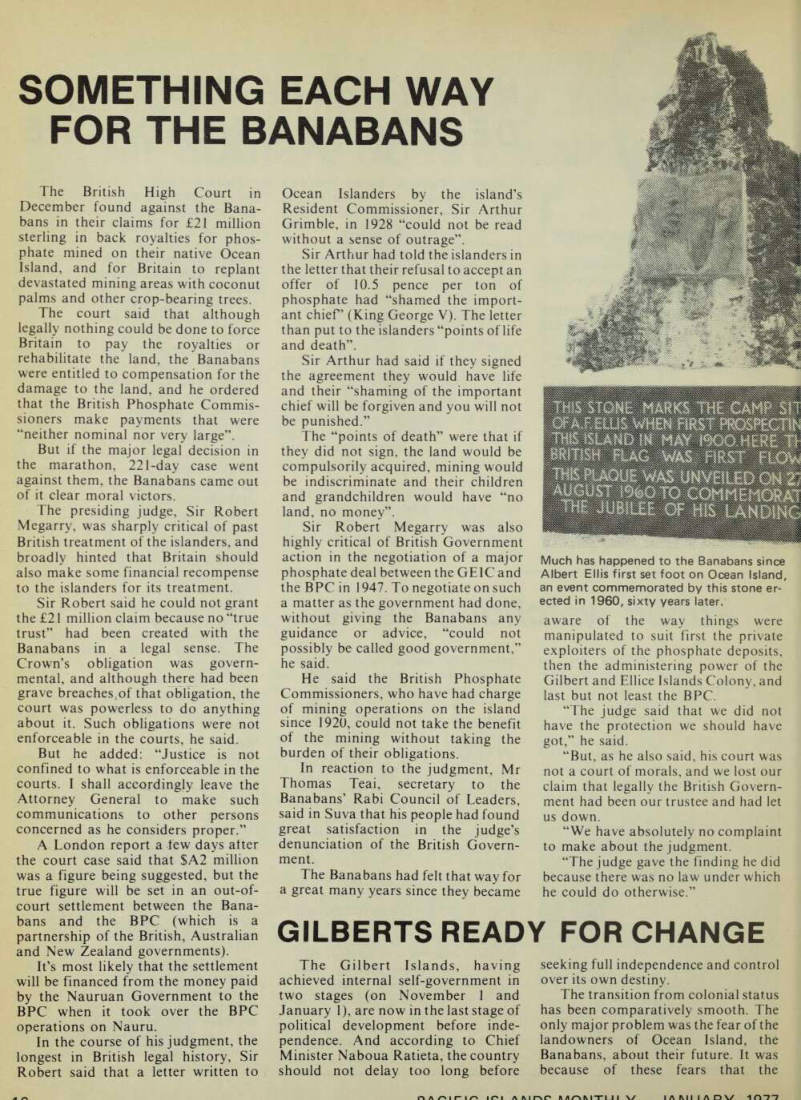
Much has happened to the Banabans since Albert Ellis first set foot on Ocean Island, an event commemorated by this stone er ected in 1960, sixty years later.