'Mickey Mouse calling'- and
pp. 59-65 · Read in the full issue
Pacific Transport
'Mickey Mouse calling'- and another yacht is helped
From lAN Me!NTYRE in Vila
“This is net controller for Pacific Maritime Mobile Net YJBAN . . .
Yankee Juliet Number Fight America November in Vila, New Hebrides . . . the time is 0530 GMT. Would all stations please listen for any emergen cy or priority station checking in . . .
Now.”
So intones the voice of Robby Beets from hundreds of short-wave radio sets operated by amateur radio enthusiasts and cruising yachtsmen throughout the South Pacific and the world. For Robby, his “Mickey Mouse" (MM for Maritime Mobile) radio schedule at 1630 hours (Vila time) every day, 365 days a year, is a labour of love for him and a keenly awaited event for the hundreds of cruising yachts who rely on the MM net for a chance to communicate with someone be it friends, relatives, other boats or to get advice on medical problems perhaps, weather or immigration information or a radio fault-finding session for a faulty engine, generator or radio aboard their vessel many leagues from land fall or habitation.
“Would any station wishing to check in ... do it now." This call from Robby brings forth a babble of voices as dozens of stations reply together. His keen ears pick up a call sign and he replies, calling, “HP9XMK Hotel Papa Nine Xray Mike Kilo . . . good evening, Muriel and Heinz aboard the Manu Ote Miti." Heinz replies giving his posi tion, heading and the weather. They have recently left Vila after a stay of several months and are sailing to Port Moresby. Robby advises them that he has been to the Vila post office and picked up some mail for them and readdressed it to their next port of call.
A land station in the Marquesas Islands calls asking for information
on the yacht Tyele. The operator is worried as there have been strong winds and poor conditions in the area since the yacht left Nukuhiva.
While he calls for Tyele, Robby thumbs back through his log and finds that she checked in three nights ago with him. His repeated call brings no immediate response from the yacht but he is able to pacify the inquiring station with the last-known position which was well away from the storm area.
By far the majority of messages or “traffic" from cruising yachts are positions and headings which Robby takes down and logs. Many request that these be passed on to relatives or friends and he draws on his worldwide radio friends and contacts to pass these on.
A very weak station, unreadable in Vila, calls in and he asks for any other station who can hear it clearly to relay
its message for him. Bob, VK3SK in Melbourne, immediately replies and a message is passed via him to Robby from a yacht moored in the sheltered confines of Neiafu harbour, Vavau, Tonga. Bob in Victoria and Bruce, W6VX.I in Paradise, California are Robby's right and left ears and they, along with shore stations in Japan, Nauru, Hawaii, Auckland and Seattle and Portland in USA assist him with the net, taking messages and positions and acting as relay stations should the signal be 100 weak for YJBAN to pick up.
All are radio amateurs or Hams md give their lime and energy freely n maintaining the Maritime Mobile net. Robby, as SWIAN, Western Samoa, originated the link “by ac cident" in September, 1973. A Swedish yacht, Vagabond, then sail ing in the Galapagos Islands, called him up one night while he was work-
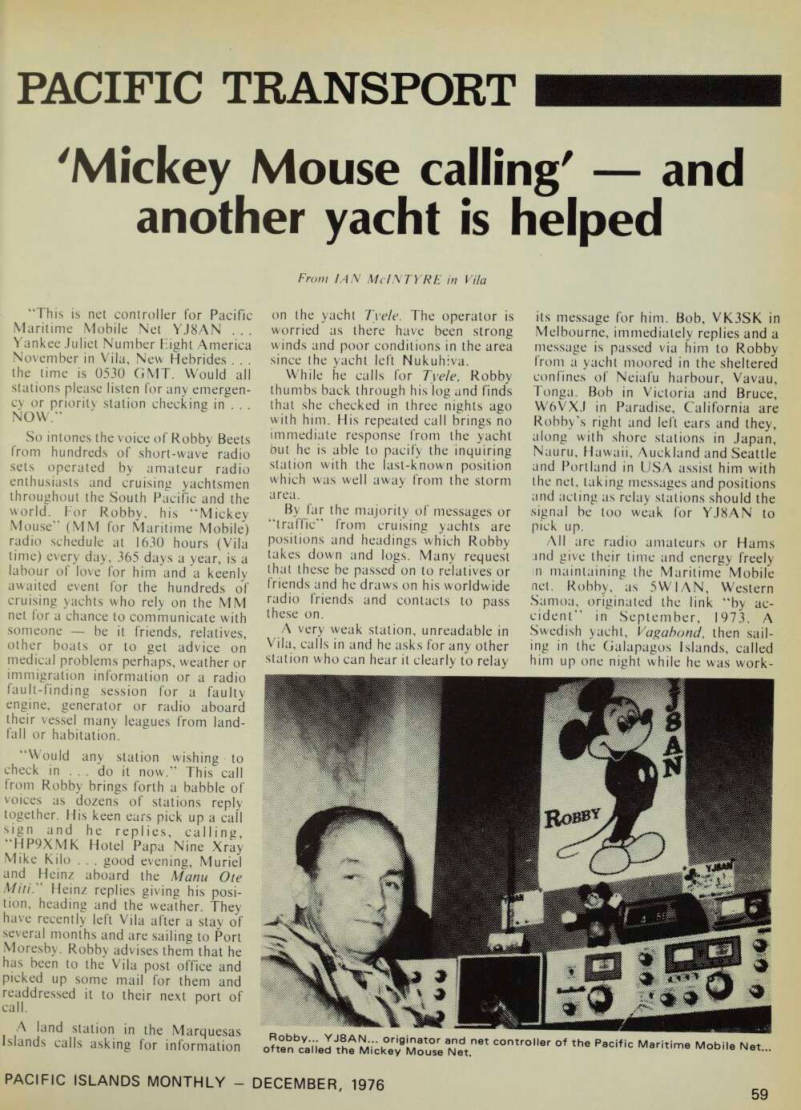
Robby... YJ8AN...originator and net controller of the Pacific Maritime Mobile Net.. often called the Mickey Mouse Net
ing on the amateur band and asked him for information on weather, im migration and customs formalities in Samoa.
Robby obtained this information and passed it on the following night.
They kept in touch nightly and gradually more yachts joined in, glad for some land-contact and so the net grew. In fact it grew so rapidly and so big that it has now had to be divided into three regions. Region 1 covers the Atlantic Ocean from the Americas to Africa: Region 2 East from the dateline, 10 degrees north to 140 degrees west and Region 3 all east of 2 to the coast of Africa.
A touch of a switch and Robby’s 40 ft high three-element, three-band beam aerial swings around and he’s talking to Japan and several vessels in the South China Sea. His Japanese manufactured Vaesumusen Ftd X 401 transceiver driving a linear amplifier is powerful enough to draw comment from his Japanese contact that he is “driving him out of the room", Robby replies to him with greetings in Japanese, a language he was forced to learn as a prisoner of war in Japan.
Born in Soerabaya. Indonesia in the 1920 s of Dutch parents, he was mobilised in June, 1941, for the Netherland East Indies Army and trained with them until he was intern ed by the invading Japanese in Ban dung and transported to Singapore.
From there he was sent to Thailand to work on the Burma-Thailand railway and later returned to Singapore where, by way of Manila, he was shipped to Japan and the prison-camp on Kyushu.
There he stayed until liberated by the American forces in September, 1945. In 1950, he migrated to New' Zealand where he met and married his wife Nancy, worked as an electrical engineer and helped raise a family of four children. In 1965, he went to the Gilbert and Ellice Islands as an elec trical supervisor for the British ad ministration on Tarawa. It was there that he became a radio amateur with the call sign VRIV. Then, 1973 Rob by and Nancy moved to Savaii, Western Samoa. That brought a new call sign SWI AN and the start of the MM net. He has been in Vila since 1975 and is now managing a private
power project.
Wife Nancy acts “unpaid" as his “manager and secretary" for the
Mickey Mouse net, answering correspondence, arranging mailforwarding, taking grocery orders, spare-parts supplies and sharpening the numerous pencils Robby gets through in an evening. She also keeps the logs tabulated and edits the rather large scrapbook of the net’s activities.
She is very proud of the ARRL (American Radio Relay League) Public Service Award certificates that fiave been awarded to Robby.
A very recent one acknowledges the part YJBAN played in the rescue from the yacht Mandorla of an American girl, Kaarin Schwabe, stricken with hepatitis. (PIM, July p 65). As net controller, Robby coor dinated the rescue through a widespread group of stations needed because of weak signals from the Mandorla. Because of his favourable sea position in relation to the yacht, New Zealander Ken McCormack, C2l KM, wireless operator aboard the Nauru Shipping Lines MV Enna G, became the relay station and with the co-operation of the master maintained a continuous watch for four With stations in Seattle (Washington) Honolulu and Johnson Atoll-and medical advice from a doctor on board the Yankee Trader, a French Navy tug, Hyppototame, made a rendezvous with the and look Kaarin to Rangaroa from where she was airlifted to hospital in Tahiti.
To Robby this was just a reflection of the dedication shown by amateur radio enthusiasts and the Pacific Maritime Mobile Net.
A call comes over from Bob in Melbourne. He has handled the
Medical Traffic call and is back on frequency. He reports to Robby that the father of a crew member on a yacht is seriously ill in a Texas hospital and a daily report schedule has, now been set up between the obliging Texan and the now-worried son on board the yacht cruising hun dreds of miles from any telephone communication, Robby thanks him for his assistance and remarks, aside, that this is what the net is all about. Since its inception in 1973 he has handled many urgent situations and a few comical ones as well.
One of his most amusing was the plight of a woman passenger aboard a cruising yacht who developed a par ticular female problem. Robby secured the services of a doctor aboard another boat and, at the woman’s insistence, had the two stations go to a different frequency to “talk privately over the air”.
On calling the net to continue he found that no one was there. They had all shifted to the medical frequen cy to listen in. For months afterwards the woman was being asked by strangers in many ports how her problem was. She was most mystified and no doubt mortified wondering how they knew. She had not realised that the whole world could listen in and that much of it had! • For those who would like to monitor the Pacific Maritime Mobile Net and for those cruising yachts who would like to report in, YJ8AN can be found on 14310 megacycles in the 20 metre band at 0530 GMT every night of the year.
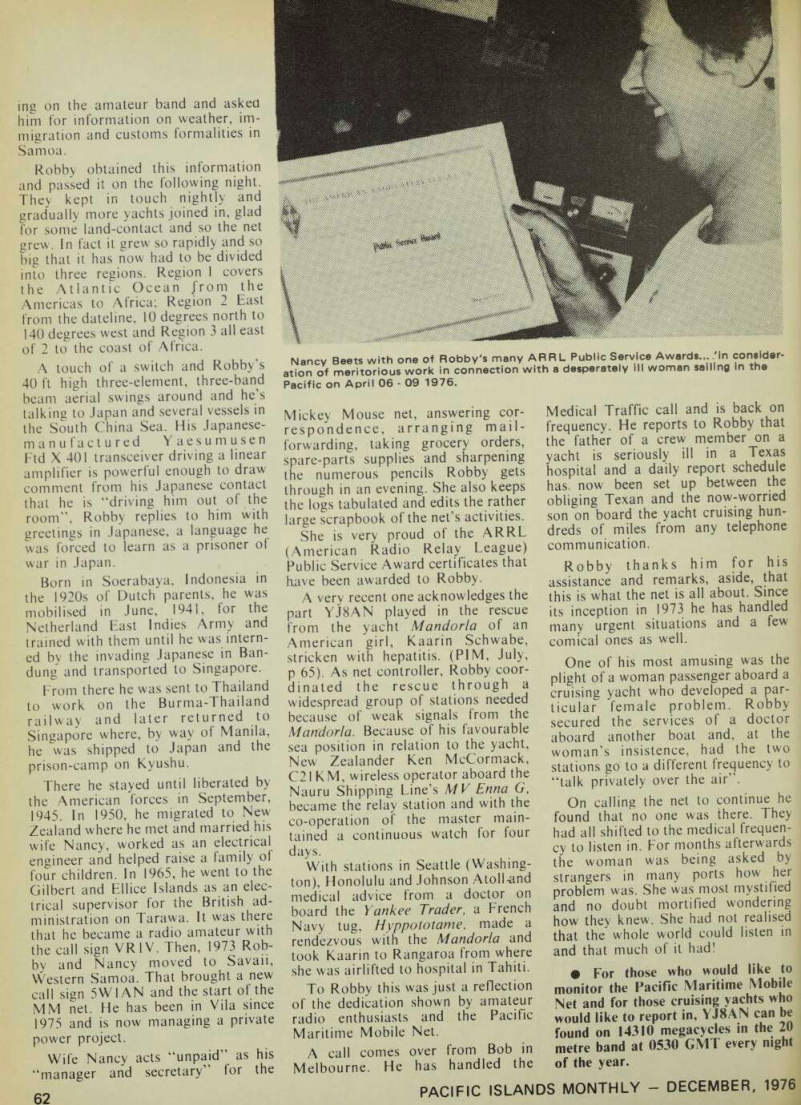
Nancy Beets with one of Robby's many ARRL Public Service Awards... .'in consider ation of meritorious work in connection with a desperately ill woman sailing in the Pacific on April 06 - 09 1976.
An Airline For
The Gilberts
The Gilbert Islands plans to be the next small country in the Pacific to own its own airline. Recently it bought a surplus Trislander from Air Pacific, and plans to buy a second Trislander from the same company later. Air Pacific operated a domestic airline within the Gilberts for several years. Mr Bwebwetake Arieta, the Gilberts Minister for Com munications, Works and Utilities, said the local airline would be a sub sidiary of the development authority, either wholly or in partnership with others.
Solomons To
Sell A Ship
The Solomon Islands Government ship, Belama, will be taken out of ser vice soon and offered for sale by tender. The Solomons took delivery of the Belama, then known as the Inikoria, in 1967, after a survey in Fi ji, and put her into service. The ship had been built in Hong Kong in 1958 for the GEIG.
The main functions were to serve the outer islands, take the High Com missioner on tour, and provide
foreign-going transport. The Belama, 285 tons, is made of steel, she is 127 ft long, and has two decks of fully air conditioned cabins. She is powered by Gardner engines and has a maximum speed of nine knots. There is enough room in the hatch to carry 3000 bags of copra.
The Belama is now getting old and needs a complete overhaul. It would be an expensive proposition to put her on the slip for re-servicing.
Whatever the Solomons Govern ment gels for her will be a bonus, as Britain made a grant to buy the Regina M as a replacement.
Png Lifts Ban On
Mission Flights
The bans applied by Papua New Guinea Transport Minister Bruce Jephcott to the Missionary Aviation Fellowship in September were lifted early in October. MAF aircraft were grounded after a series of mishaps over four months in which eight peo ple were killed and four aircraft were destroyed or damaged.
Mr Jephcott grounded the aircraft till aviation authorities were satisfied MAF had undertaken certain “operational remedies”. Changes made included the appointment and
approval of a new chief pilot and two check and training captains, together with a review of operating practices.
Strikes Paralyse
Fiji’S Air Services
Fiji air services were in turmoil early in November as an industrial dispute over pay between Qantas and the Qantas Salaried Staff Association spilled over and involved Air Pacific.
Air Pacific employees walked off the job after seven of that airline’s employees were suspended for refusing to handle Qantas flight reservations.
Air Pacific, claiming that the employees’ walk-off was in contravention of the Trades Disputes Act, inserted an advertisement in the Fiji Times, advising employees “who abandoned their work on Tuesday, November 2, and Wednesday, November 3, are hereby dismissed from Air Pacific’s employment from the lime of the abandonment’’.
Individual letters would be sent to those employees.
Air Pacific advised that the Trades Disputes Act clearly set out that air transport was an essential service, and those engaged in it were required to
give 28 days’ notice before going on strike. The advertisement appeared over the name of the Air Pacific general manager, Mr S. H. Quigg.
At the same time Air Pacific advised it had immediate vacancies in the engineering, commercial, finance and operations sections.
An immediate result of the strike was cancellation of all Air Pacific’s overseas services, and most internal services. Mails were disrupted. The only way for intending travellers to move in Viti Levu was by hire car or chartered aircraft (from Fiji Air) or by bus.
Who’Ll Do What
In Fiji’S Ports
Fiji could be in for one of those demarcation disputes which plague trade union activities in Australia.
The Fiji Waterside Workers and Seamen’s Union, through its vocal adviser, Mr Taniela Veitata, has told the Ports Authority that it will insist on unpacking and packing all cargo containers handled in Fiji ports. The practice is known in the industry as “unstuffing” and “stuffing”.
In Australia a few months ago a huge backlog of container cargo built up while a transport union and the wharfies bickered oyer whose members should handle it at par ticular points. Mr Veitata says his members have to handle all containers on the wharf to safeguard their work.
At present importers and exporters handle the unpacking and packing, although the waterside workers do handle some containers.
The union has also given the authority eight months notice of a de mand for an increase of 30% in the minimum pay rate of $1.20 an hour.
In Tonga It’S
Never On Sunday
Air Pacific has stepped up its Fiji- New Zealand flights to five a week with the introduction of a Sunday ser vice. The Sunday service will be the first non-stop Nausori-Auckland night. All other nights to and from Auckland are via Nukualofa. But Tonga’s strict observance of the Sun day laws preclude anything but emergency work on Sundays, which effectively rules out handling jet air craft on southbound nights. The air craft will leave Nausori at 4.45 pm on Sundays and arrive at Auckland at 7.45 pm. It will return to Nausori, via Nukualofa, on Mondays.
The Air Pilots’
Strike That Wasn’T
A strike by the Continental Airlines Pilots Association in October turned out to be a non-event in Micronesia after the association authorised pilots to continue to work in the Trust Territory on a voluntary basis. Earlier, the Trust Territory High Court, on the application of the Trust Territory Government, granted a temporary restraining order against the association from striking within Micronesia.
Mr Gary Thomas, chief union of ficial with Continental, said the pilots, intended to give their earnings from voluntary flights to charities within Micronesia, and hoped the airline's management would do the same with earnings from those flights.
More than 1000 Continental pilots operating in other areas went on strike for higher pay and shorter hours. Continental services between the US mainland and Hawaii were cancelled. Micronesia accounts for only a small part of Continental ser vices, but is heavily dependent on them.
Last Of The
Trading Schooners
The only registered trading schooner left in the South Pacific, the 96ft three-masted SOL, arrived at Rarotonga in October from Papeete with Captain de Graaf and 11 crew, all Australians except one Fijian and one Solomon Islander. The steel hulled, steel-decked schooner can carry 100 tons of dry cargo and 15 tons of freezer cargo and is registered in Sydney.
SOL left Papeete in company with MV Moana. Both vessels belong to Rowllem Pty Ltd and both called at Rarotonga to effect repairs to Moana s stern tube and starboard engine. Both ships expected to leave for Suva on October 18, then SOL was to return to Sydney and resume the Lord Howe run.
Moana operated in the Cook Islands in 1973 when owned by Cap tain Hugh Williams who later sold the vessel to an Australian company The new owners took the Moana in 1974 for survey in Tahiti and she stayed in Tahiti until the present voyage. • Groups of 15 travellers can get reductions of 25 per cent on their fares on Air Niugini’s internal services by flying during weekends including Mondays on long weekends.