crossbows
pp. 46-47 · Read in the full issue
Daggers, swords and crossbows in old-time Polynesia
Books
By Robert Lang Don
Dr Kenneth P. Emory, senior ethnologist at the Bishop Museum, Honolulu, has been investigating Polynesia’s past for so long now that it almost seems as if there never was a time when he was not hard at it.
His first published work appeared some 60 years ago, long before most of the present breed of Polynesia specialists were born. Yet still his works appear.
His latest is about the 70-odd little known atolls to the north and eastward of Tahiti, and is entitled Material Culture in the Tuamotu Archipelago. The book was largely completed in 1934. But it could not be published then, due, apparently, to the high cost of reproducing the hundreds of line drawings and photographs that illustrate it. Most of these il lustrations are Emory’s own work.
The new work is the fruit of Emory’s participation in two Bishop Museum expeditions to the Tuamotus in 1929-30 and 1934. His findings on those occasions have been supplemented by an examination of Tuamotuan artefacts in European and American museums, and a close study of the fairly scanty literature on the Tuamotus.
Two earlier monographs, entitled Tuamotuan Stone Structures and Tuamotuan Religious Structures and Ceremonies, were published in 1934 and 1947 respectively. Emory also has a number of papers on the Tuamotus to his credit.
He says in the present work that the Bishop Museum’s pre-war ex peditions to the Tuamotus were, in a sense, a salvage operation. Besides himself, the participants in them were: the late J. Frank Stimson, linguist; Harry L. Shapiro, physical anthropologist; Clifford Gessler, jour nalist; and, briefly, the late Peter Buck, ethnologist.
The five men entered a Polynesian world “still under the sway of an es sential part of their ancient culture,”
although the past was “rapidly losing its hold.”
That link with the past has since been all but completely destroyed by two influences. The first was exposure to daily radio broadcasts from Tahiti from the post-war years onwards.
The second was the French nuclear testing project which began in the
1960 s and brought airfields and
thousands of complete foreigners into the Tuamotuans’ midst.
Emory’s Material Culture in the Tuamotu Archipelago is therefore a book containing information that no one will ever be able to obtain again, and it is naturally of enormous value to anyone interested in unravelling the tangled story of Polynesia’s past.
Emory says in it that although the physical environment of the Tuamotu Archipelago is fairly uniform, the an cient culture of those islands was not that there were striking differences in language, and also in the human physical types.
Some of the remarkable, and as yet unexplained linguistic differences are revealed here and there in the body of his new book, which is
made up of 10 chapters. These are devoted to: food, houses, plaiting, clothing and ornaments, adzes, weapons, canoes, fishing, hunting and trapping, and games, sports and amusements.
Having delved to some extent into the prehistory of the Tuamotus in my book The Lost Caravel. I found Emory’s chapters of absorbing in terest.
Inevitably, I could not but keep a sharp lookout for additional evidence, previously unavailable to me, that might support my theory that castaway Spaniards from the caravel San Lesmes, lost in the eastern Pacific in 1526, had settled in the Tuamotus and had played a part in influen cing the local culture.
A number of items did, indeed, seem to support my contentions. For example, Emory’s pages contain a good deal of new information, often illustrated, about the remarkable, sometimes European-looking sailing craft of the Tuamotus vessels that leave no doubt that seafarers, with un usual expertise, once came to live in those islands.
Writing on this subject generally,
Emory says: “While in all other material possessions the Tuamotuans were inferior to their high-island neighbours, they were superior in ocean-going sailing canoes in spite of poorer resources.” However, he makes no attempt to explain why this should have been so.
Other items in Emory’s compen dium that seemed to me to savour strongly of long-lost Spaniards were swords and daggers, of which he has some interesting sketches. In addi tion, his photographs of islanders “jousting” with wooden staves on Vahitahi Atoll conjured up more visions of doughty dons of long ago.
Of course, anyone can argue that the swords, daggers and staves could have been made by anyone that they are not so distinctive that they must have been derived from Spain.
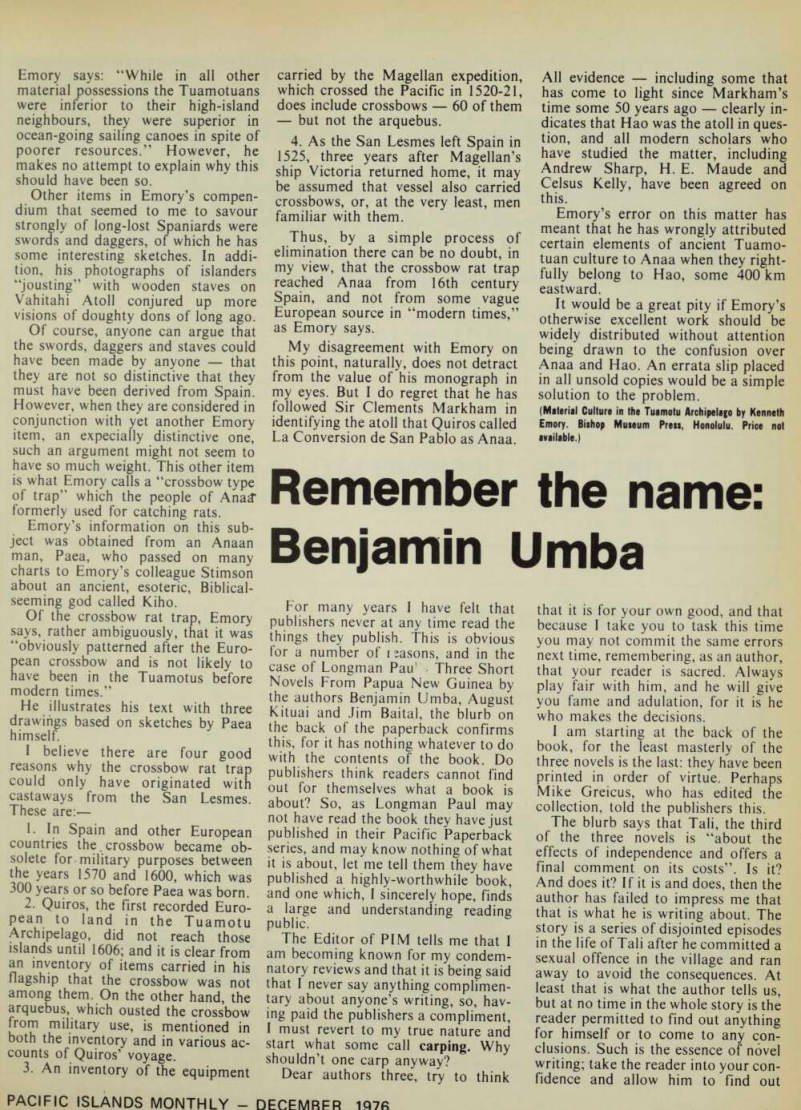
However, when they are considered in conjunction with yet another Emory item, an expecially distinctive one, such an argument might not seem to have so much weight. This other item is what Emory calls a “crossbow type of trap” which the people of formerly used for catching rats.
Emory’s information on this sub ject was obtained from an Anaan man, Paea, who passed on many charts to Emory’s colleague Stimson about an ancient, esoteric, Biblical seeming god called Kiho.
Of the crossbow rat trap, Emory says, rather ambiguously, that it was “obviously patterned after the Euro pean crossbow and is not likely to have been in the Tuamotus before modern times.”
He illustrates his text with three drawings based on sketches by Paea himself.
I believe there are four good reasons why the crossbow rat trap could only have originated with castaways from the San Lesmes.
These are;- 1. In Spain and other European countries the. crossbow became ob solete for military purposes between the years 1570 and 1600, which was 300 years or so before Paea was born. 2. Quiros, the first recorded Euro pean to land in the Tuamotu Archipelago, did not reach those islands until 1606; and it is clear from an inventory of items carried in his flagship that the crossbow was not among them. On the other hand, the arquebus, which ousted the crossbow from military use, is mentioned in both the inventory and in various ac counts of Quiros’ voyage. 3. An inventory of the equipment
carried by the Magellan expedition, which crossed the Pacific in 1520-21, does include crossbows 60 of them but not the arquebus. 4. As the San Lesmes left Spain in 1525, three years after Magellan’s ship Victoria returned home, it may be assumed that vessel also carried crossbows, or, at the very least, men familiar with them.
Thus, by a simple process of elimination there can be no doubt, in my view, that the crossbow rat trap reached Anaa from 16th century Spain, and not from some vague European source in “modern times,” as Emory says.
My disagreement with Emory on this point, naturally, does not detract from the value of his monograph in my eyes. But I do regret that he has followed Sir Clements Markham in identifying the atoll that Quiros called La Conversion de San Pablo as Anaa.
All evidence including some that has come to light since Markham’s time some 50 years ago clearly in dicates that Hao was the atoll in ques tion, and all modern scholars who have studied the matter, including Andrew Sharp, H. E. Maude and Celsus Kelly, have been agreed on this.
Emory’s error on this matter has meant that he has wrongly attributed certain elements of ancient Tuamo tuan culture to Anaa when they right fully belong to Hao, some 400 km eastward.
It would be a great pity if Emory’s otherwise excellent work should be widely distributed without attention being drawn to the confusion over Anaa and Hao. An errata slip placed in all unsold copies would be a simple solution to the problem. (Material Culture in the Tuamotu Archipelago by Kenneth Emory. Bishop Museum Press, Honolulu. Price not available.)