Tropicalities
pp. 25-29 · Read in the full issue


Pacific mystery,
or plain hoax?
Another Pacific maritime mystery . . . or a hoax?
Officials at Canberra’s Marine Operations Centre are asking themselves this question following the picking up in June in the Gulf of Bothnia, Finland of a bottle con taining a message.
It read: “Help. I am on an island with my children 167 degrees east and 13 degrees south. My boat sank near this island. I came here on 17 July, 1972. Please rescue us as soon as possible. Jill Woodall, Mary, Tom, Bill”.
Interpol, Canberra, and the Direc tor of Ports, Vila, New Hebrides, within whose geographic area the co ordinates lie, were soon involved.
Of particular interest to Canberra was the fact that seven people were known to have disappeared in a trimaran in the same general area in September 1968. Known names of the people on board were Bill and Mary Shute and their children Joanne, Rosalind and Richard. The names of other persons aboard were Sallie Scales, Valerie Kuirk and Diane McNeill. Mrs Mary Shute’s maiden name was Widall and she was also known to friends as Joy, Joan or Jill.
Canberra cabled Vila; “In view of similarity of maiden names Jill Widall to signature on letter in bottle Jill Woodall, her brother considers she and children and others survived and landed on island close to 13 degrees South 167 degrees East. Further, brother believes must be out-of-way, isolated or deserted island”.
British Marine Superintendent at Vila, Captain Robin Libby, said the islands near the position given were the Banks and Torres groups. These were mostly inhabited and all were regularly checked by both British and French marine operations supporting their respective district agents, as well as being visited by coastal traders and mission vessels at least once a month.
It was his opinion that it was not
possible for a bottle to drift from this part of the world to the Atlantic on known ocean currents.
Furthermore, the British Resident Commissioner’s cruising vessel, Euphrosyne II had recently visited all islands in the Banks and Torres groups with a geological survey team, and had observed nothing unusual.
The ship’s master, Captain Leith Nasak, said moreover that anyone throwing a bottle from any of these islands would be likely to see it drift west to southwest, as these islands are subject to the South Equatorial current. This ran quite the wrong way for a bottle to end up in Finland.
Another hypothesis that a ship taking in sea water as ballast in Pacific waters could have sucked in the bottle, carried it in its ballast tanks and then discharged it into the Atlantic was discounted as “highly improbable” by Captain Libby. He pointed out that most ships have filter screens across the intakes of their ballast systems to prevent the drawing up of just such objects.
The possibility of the message being a hoax has not been entirely ruled out.
Some odd body knowing the family and their pre-marital history could have written the message, getting the dates confused and misspelling the surname, and throwing it overboard from, say, a passenger liner in Atlan tic waters.
It is not known how long the bottle had been in the water, but it was held that its survival for even something less than four years would be highly unlikely.
But survive it did to commemorate what could be a plain hoax, or yet another Pacific Ocean mystery.
Another Fiji
doggy tale
Wild dogs are making life hell for the people and livestock of the small island of Moturiki, on Ovalau, in Fiji.
In one incident, a woman just escaped from a pack of wild dogs by climbing
up a tree. She had to stay there all night. Parents fear that the dogs will attack their children going to and from school.
A livestock death tally late in September showed that two large cows, nine goats, two pigs and dozens of chickens had fallen prey to the dogs. Men armed with knives failed to nail a single dog. On top of their depredations, the dogs, with their con stant howling, keep the people awake at night.
The dogs are descendants of village dogs which have gone into the bush and bred. Poison bait may end the menace, but perhaps the best ap proach would be engage dog killers like the school principal (PIM, Sept, p 25) or the priest (PIM, Aug, p 23) if the dogs are really to be eradicated.
Franco-Fijian
Fun-around
Fiji has been caught in the popular French game of screaming out like a little boy whose lollipop has been taken away, and he won’t stop yelling till you’ve given him four lollipops as compensation. It will be interesting to see what sort of a bargain these childish French tactics can win from Fiji.
Actually, what Anglo-Saxons might regard as petty, senseless behaviour, is in fact a carefully dis ciplined French sport. And, as in all games, it’s interesting to get to know the rules. In this particular Franco- Fijian contest, play went something like the following. Fiji nominated an ambassador to represent her at the European Common Market (EEC), and although eight EEC members were prepared to grant accreditation, France withheld her consent for seven months. Of course, France has made it clear she would like to be treated as leader in the EEC, acting as spokesman, negotiating, and being generally treated with importance.
The delaying tactics used to emphasise this point were said to be
based on the fact that the Fijian am bassador, Mr Satya Nandan, had been a representative on the political committee of the UN General Assembly, and as such had expressed the Fiji Government’s official opposi tion to French nuclear tests in the Pacific. France managed to keep up the drama and suspense until the end of September, just as the Fiji Prime Minister was about to arrive in Brussels as president of the Council of Ministers of the 50 Africa-Caribbean- Pacific nations, holding talks with the President of the EEC Council of Ministers.
So the Fiji ambassador to the EEC was finally accredited. But by then there had arisen another sticky business, a matter of lollipops, you might say. In the Pacific, French diplomatic relations with Fiji are maintained by the French am bassador in Wellington. When the present ambassador arrived a request for accreditation was made to the Fiji government and this was granted in early June. But somehow, at the end of the month, this request was withdrawn, which meant there was no request pending in late October.
Meanwhile the game suddenly switch ed to London, where the French tried to have approval granted verbally. Of course, to the Fijians this just wasn’t cricket and they would not agree.
Now if any spectators are tempted to think that the French have got themselves into an embarrassing situation, on a sticky wicket say, then they’d better save their laughter for later. Wait till they see the French persecution drama, screaming like a little boy who’s had his lollipop taken away and sulks until you take pity on him and give him four times what he had before. That's the sticky game of the French lollipop. But since the French enjoy finding cultured names for their games, maybe PIM readers could find a sophisticated title for this one.
Kavachi comes
up to breathe
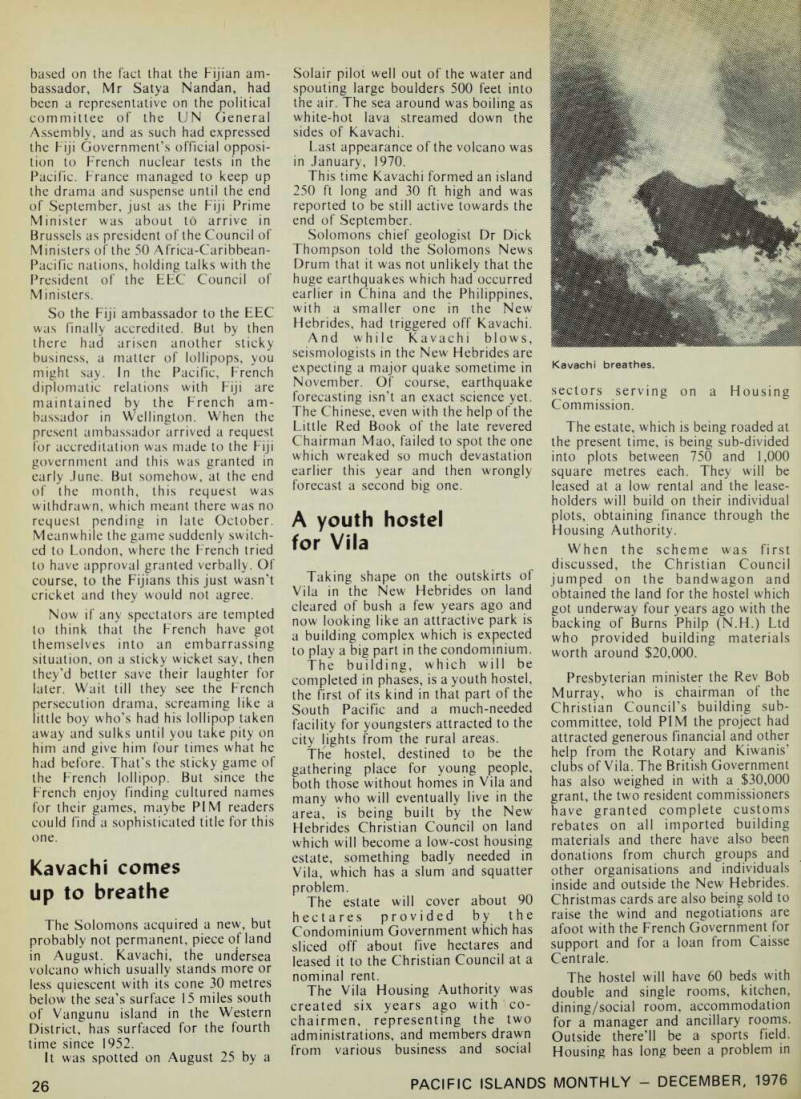
The Solomons acquired a new, but probably not permanent, piece of land in August. Kavachi, the undersea volcano which usually stands more or less quiescent with its cone 30 metres below the sea’s surface 15 miles south of Vangunu island in the Western District, has surfaced for the fourth time since 1952.
It was spotted on August 25 by a
Solair pilot well out of the water and spouting large boulders 500 feet into the air. The sea around was boiling as white-hot lava streamed down the sides of Kavachi.
Last appearance of the volcano was in January, 1970.
This time Kavachi formed an island 250 ft long and 30 ft high and was reported to be still active towards the end of September.
Solomons chief geologist Dr Dick Thompson told the Solomons News Drum that it was not unlikely that the huge earthquakes which had occurred earlier in China and the Philippines, with a smaller one in the New Hebrides, had triggered off Kavachi.
And while Kavachi blows, seismologists in the New Hebrides are expecting a major quake sometime in November. Of course, earthquake forecasting isn’t an exact science yet.
The Chinese, even with the help of the Little Red Book of the late revered Chairman Mao, failed to spot the one which wreaked so much devastation earlier this year and then wrongly forecast a second big one.
A youth hostel
for Vila
Taking shape on the outskirts of Vila in the New Hebrides on land cleared of bush a few years ago and now looking like an attractive park is a building complex which is expected to play a big part in the condominium.
The building, which will be completed in phases, is a youth hostel, the first of its kind in that part of the South Pacific and a much-needed facility for youngsters attracted to the city lights from the rural areas.
The hostel, destined to be the gathering place for young people, both those without homes in Vila and many who will eventually live in the area, is being built by the New Hebrides Christian Council on land which will become a low-cost housing estate, something badly needed in Vila, which has a slum and squatter problem.
The estate will cover about 90 hectares provided by the Condominium Government which has sliced off about five hectares and leased it to the Christian Council at a nominal rent.
The Vila Housing Authority was created six years ago with co chairmen, representing the two administrations, and members drawn from various business and social
sectors serving on a Housing Commission.
The estate, which is being roaded at the present time, is being sub-divided into plots between 750 and 1,000 square metres each. They will be leased at a low rental and the lease holders will build on their individual plots, obtaining finance through the Housing Authority.
When the scheme was first discussed, the Christian Council jumped on the bandwagon and obtained the land for the hostel which got underway four years ago with the backing of Burns Philp (N.H.) Ltd who provided building materials worth around $20,000.
Presbyterian minister the Rev Bob Murray, who is chairman of the Christian Council’s building sub committee, told PIM the project had attracted generous financial and other help from the Rotary and Kiwanis’ clubs of Vila. The British Government has also weighed in with a $30,000 grant, the two resident commissioners have granted complete customs rebates on all imported building materials and there have also been donations from church groups and other organisations and individuals inside and outside the New Hebrides.
Christmas cards are also being sold to raise the wind and negotiations are afoot with the French Government for support and for a loan from Caisse Centrale.
The hostel will have 60 beds with double and single rooms, kitchen, dining/social room, accommodation for a manager and ancillary rooms.
Outside there’ll be a sports field.
Housing has long been a problem in
Kavachi breathes.
Vila. Ten years ago, the labour force was 1,700. Seven years later it had risen to 3,948. The high schools are now turning out large numbers of educated youngsters, the majority of whom stay put in Vila as white collar workers. Up to now, there has been little in the way of accommodation or entertainment for single people.
The bill for the hostel won’t be less than $160,000 so that the New Hebrides Christian Council will welcome support from outside.
"Seize us a
fishing boat, please"
The people of the Fead Islands in Papua New Guinea are after a fishing boat, preferably a Taiwanese fishing boat. They recently asked the Minister for Public Utilities, Mr Donatus Mola, to give them one, preferably the next one confiscated by the government for poaching, or one that has already been forfeited to the government.
They consider such a boat would suit their purposes for fishing and carrying their copra. Mr Mola, after a visit to the Feads, supported their request. As he is going to see what he can do about it, Taiwanese fishing ships, and other foreign fishing ships for that matter, would be well advised to keep clear of PNG waters.
Dr Sarei’s house
on the hill
The North Solomons Premier, Dr Sarei, has sent out the invitations all 200 of them. The Papua New Guinea Governor-General, Sir John Guise, will be guest of honour. There are politicians, business and civic leaders, leading churchmen and senior civil servants on the guest list.
Dr Sarei wants it to be a big occa sion his formal reception to mark the introduction of provincial govern ment to the North Solomons (previously Bougainville). The setting will be something out of the box, too the big house on the hill allocated to Dr Sarei, complete with everything, and once occupied by Australian dis trict commissioners based in Bougain ville.
But when Dr Sarei tried to move into the house and to prepare for the fast-approaching reception he found it was stripped of furniture, curtains, lampshades, the lot. And Bougain
ville’s no place to buy furniture and household fittings in a hurry.
Political and public service friction is building up over what has happen ed. Inquiries showed that the Provin cial Commissioner, Mr Benson Gegeyo the previous occupant took the furniture out when he left. As Provincial Commissioner Mr Gegeyo represents the Central Government of PNG and was the top “official” man in Bougainville until provincial government came along.
Now Dr Sarei as Premier gets the top billing and the top house but no one’s too sure about the furniture and fittings. Mr Gegeyo claimed the fur niture is a public service issue allocated to him for use in govern ment houses he occupied, and not specifically allocated to the house on the hill. Dr Sarei sent a plaintive report to the Central Government in Port Moresby and was counting the days to the planned reception while he waited for an answer.
Pick a peck of
Ponape pepper
Ponape, recently chosen as the future capital of Carolines, could have a profitable new export pepper.
In a letter to Knox McConnell, president of the Micronesia Develop ment Bank, Richard Brosnjak, presi dent of the American Culinary Federation, said in September: “In my professional opinion, Ponape pepper is truly a gourmet product and I can assure you of my utmost co operation in your endeavour to market it in the US”.
The American Culinary Federation is the national organisation of American chefs, and is a member body of the World Association of Cooks Societies.
McConnell said he had first sent the Ponape pepper for evaluation to his friend the restaurateur Federick R. Seity Jr. Seity, in turn, forwarded the pepper to Brosnjak. Both men are considered in county club circles to be leaders in their fields in the US.
Echo of bombing
of Macdhui
Harbour authorities have begun salvaging fuel oil from an Australian ship which was bombed and sunk in Port Moresby harbour more than 30 years ago. The fuel is being recovered from the partly-submerged and badly rusted hulk of the Burns Philp
passenger-cargo ship, Macdhui, destroyed by Japanese bombing on June 18, 1944. Ten of the ship’s crew of 77, and five officers and men of the 39th Battalion AIF, were killed dur ing the bombing.
The AIF men on board were help ing to handle urgently-needed cargo, including supplies for troops based in Port Moresby, when the raiding air craft came over the harbour.
Macdhui’s Master, Captain J.
Campbell, deliberately grounded the ship on a submerged mudbank to save it from sinking in deep water and in the hope that if could be salvaged. But further bombing destroyed the ship on the bank, and since then the partly submerged wreck has become a feature of the harbour.
The ship’s mast stands outside Port Moresby Yacht Club as a memorial to the men killed during the bombing.
Over the years the wreck has been the centre of a number of legal deals in volving salvage rights. Several years ago attempts were being made to locate a salvage operator who had allegedly allowed fuel oil to leak from the hull and cause harbour pollution.
Port Moresby officials said the fuel oil remaining in the ship's bunkers had been examined as a precaution against the possibility of pollution, but the quantity there had prompted further investigations and tests. It was now believed that about 12 tonnes of what is described as light marine diesel or industrial diesel fuel could be recovered from the wreck. The fuel will be offered for sale by public tender.
A culture clash
on betel nuts?
Micronesia's betel nut war with the Health, Education and Welfare Department in Washington hotted up again in October when two prominent Micronesians publicly voiced support lor Guam Congressman Antonio Won Pat in his fight with the depart ment on the issue.
It all began earlier in the year when
a spokesman for the US Food and Drug Administration announed a ban on interstate traffic of betel nuts in the US. He said that investigations had shown a link between prolonged betel nut chewing and oral and throat cancer.
Then HEW announced a ban on the importation of betel nut into the US mainland.
Betel nut enjoys a continuing and growing popularity in Micronesia.
Congressman Won Pat objected to the ban, citing the use of betel nut for centuries without any proven bad side-effects or consequences, and he has asked HEW secretary David Mathews to overturn the ban.
Now Palau District Administrator Thomas O. Remengesau has entered the lists, saying, according to a Micronesian News Service report: “I don't understand it. When the US Surgeon-General warned that ‘cigarette smoking is dangerous to your health’, HEW officials didn’t take notice of the warning, and the cigarette manufacturers continue to ship their deadly commodities over state lines and on to foreign coun tries”.
And Valentine Sengebau, assistant editor of the Micronesian Reporter, a betel nut chewer for 18 of his 36 years, backed up with this comment: “Betel nut chewing is much better than drinking hard liquor. About the only danger involved is that you might get your white shirt stained”.
But perhaps Congressman Won Pat came closest to putting the matter in a betel nutshell when he said earlier on in the fight: “A reasonable person could only conclude that the FDA has banned the betel nut because it is ‘strange’ or ‘different’.
“I guess that we must just face the fact that Western-style thinking finds the betel nut strange and therefore suspicious.”
The fight is far from over. And MNS recalls that an earlier similar FDA-HEW ban was overturned in 1973 when Congressman Won Pat took up the cudgels.
The old Macdhui pictured 10 years ago. There's not that much of her left now.