Does Tonga’S
pp. 23-24 · Read in the full issue
Parliament
Need A Shake-Up?
From a Nukualofa correspondent
Should Tonga’s parliamentary
system be altered? -T-i • . . , , This important question has been poseci time and again both by outsiders and by interested Tongans themselves, and invariably the answer has been in the affirmative There is certainly no doubt that the r f Par ! ia r n r‘ ary e P resenta lion ,n Tonga is far from democratic m the normal sense of the word. Like I°» ther fdC f tS ° f Ton^ 8 n n j oCiet u ’
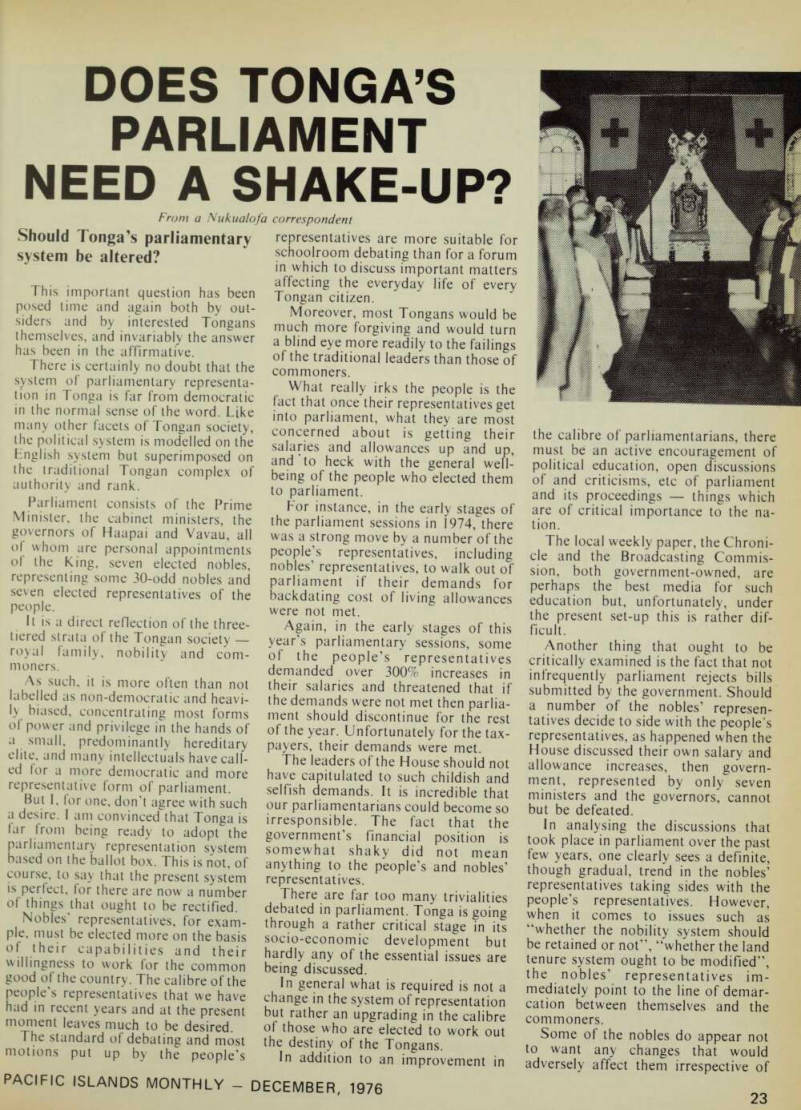
Pn„l hlc ! y r, ' S modelied °" the H ™ but superimposed on ?u!hority , rd al ralk onBan complex of Parliament consists of the Prime Minister, the cabinet ministers, the governors of Haapai and Vavau, all ol whorn are personal appointments of the King, seven elected nobles, representing some 30-odd nobles and seven elected representatives of the P e ®P' e It is a direct reflection of the threeuered strata of the Tongan society royal family, nobility and commoners.
As such, it is more often than not abelled as non-democratic and heavily biased, concentrating most forms ol power and privilege in the hands of
a small, predominantly hereditary
elite and many intellectuals have callnior % democrat lc and more representative form of parliament. ut I, (or one, don t agree with such a desire. I am convinced that Tonga is far from being ready to adopt the parhamentary representation system rnnrl°? the b u° X ‘ Th ' S ,S not ’ ° f course, to say that the present system nf P >h r i„„ et ’.K or , ,her l are 1 0W a namber °f things that ought to be rectified.
Nobles representittives, for exampie must be elected more on the basis i lli?*" C .' pabl , V eS u and their willingness to work for the common good o| the country. The calibre of the hud P in r/-pni eSematlV a S tha i! We have had in recent years and at the present T^rs t land V e rd m f H h i| 0 f be des J red - I he standard of debating and most motions put up by the people's
representatives are more suitable for schoolroom debating than for a forum in which to discuss important matters affecting the everyday life of every Tongan citizen J Moreover, most Tongans would be much more forgiving a * d wou d turn a blind eye more readily to the failings of the traditional leaders than those of commoners What really irks the people is the fact that once their representatives get into parliament, wha? they are most concerned about is getting their salaries and allowance? up Ind up, and to heck with the p era| we ft who eleeted them For instance, in the early stages of the parliament sessions in 1974, there was a strong move by a number of the people’s representatives, including nobles’representatives, to walk out of parliament if their demands for backdating cost of living allowances were not met.
Again, in the early stages of this year’s parliamentary sessions, some of the people’s representatives demanded over 300% increases in their salaries and threatened that if the demands were not met then parlia ment should discontinue for the rest of the year. Unfortunately for the tax payers, their demands were met The leaders of the House should not have capitulated to such childish and selfish demands. It is incredible that our parliamentarians could become so irresponsible. The fact that the government’s financial position is somewhat shaky did not mean an y thm £ to the people’s and nobles’ representatives There are far 100 ma ny trivialities debated in parliament. Tonga is going through a rather critical stage in its socio-economic development but hard| y any of the essential issues are
being discussed.
In general what is required is not a chan ? e in the system of representation but rather an upgrading in the calibre °, f those who are elected to work out the destiny of the Tongans In addition to an improvement in
the calibre of parliamentarians, there must be an active encouragement of political education, open discussions of and criticisms, etc of parliament and its proceedings things which are of critical importance to the na tion.
The local weekly paper, the Chroni cle and the Broadcasting Commis sion, both government-owned, are perhaps the best media for such education but, unfortunately, under the present set-up this is rather dif ficult.
Another thing that ought to be critically examined is the fact that not infrequently parliament rejects bills submitted by the government. Should a number of the nobles’ represen tatives decide to side with the people’s representatives, as happened when the House discussed their own salary and allowance increases, then govern ment, represented by only seven ministers and the governors, cannot but be defeated.
In analysing the discussions that took place in parliament over the past few years, one clearly sees a definite, though gradual, trend in the nobles’ representatives taking sides with the people’s representatives. However, when it comes to issues such as “whether the nobility system should be retained or not’’, “whether the land tenure system ought to be modified’’, the nobles’ representatives im mediately point to the line of demar cation between themselves and the commoners.
Some of the nobles do appear not to want any changes that would adversely affect them irrespective of
whether such changes will be for the overall benefit of the country.
To a certain extent, this is un derstandable. However, the guiding factor in any issue that is of great significance to any nation should be the overall benefit of the whole nation and not just a section of it, no matter how traditionally privileged that sec tion may be.
The question that should be posed, therefore, is not whether the system itself should be changed but rather how to get the best possible people into parliament. This implies, to be sure, that the system itself has to be modified somehow in order to allow more capable people to become parliamentarians, though that is only part of the solution.
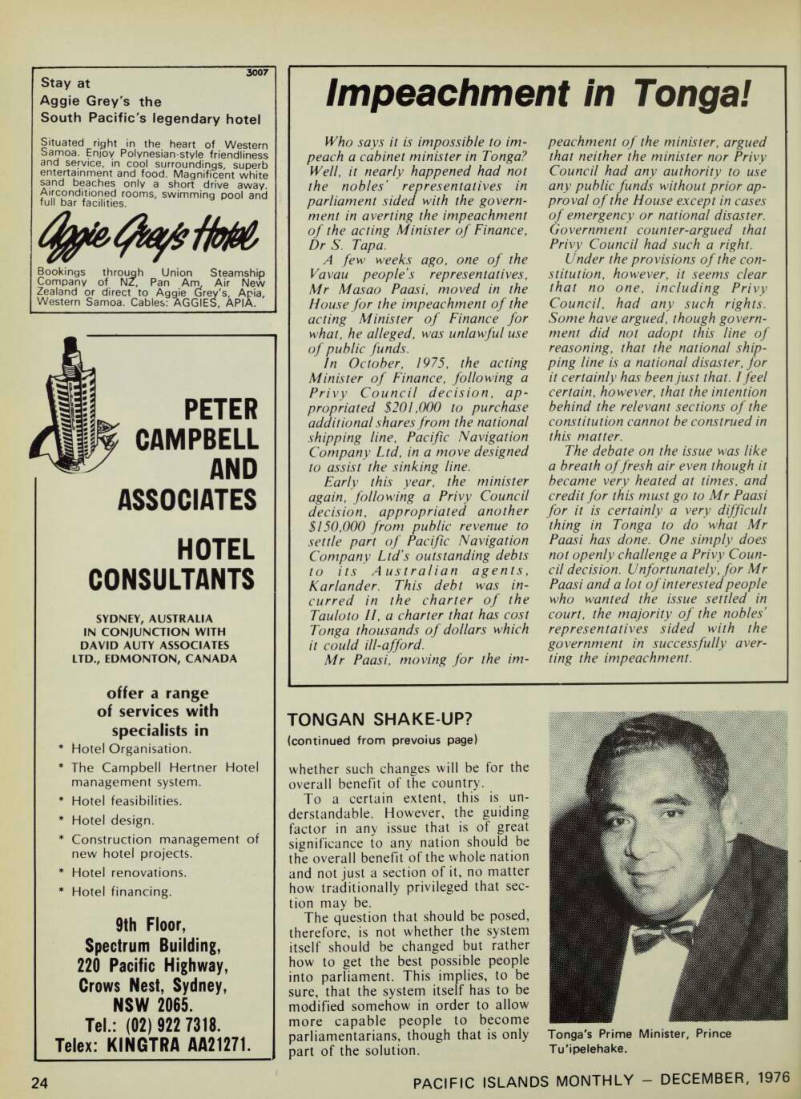
Tonga's Prime Minister, Prince Tu'ipelehake.