News
pp. 18-19 · Read in the full issue
The
In A
Nutshell
Red China In W. Samoa
Red China in October opened an embassy in Apia, operating temporarily from the Tusitula Hotel.
The embassy’s counsellor and charge d’affairs, Mr Wang Tao, was quick to denounce any attempt by Russia to interfere with the internal affairs of Western Samoa, saying China would fully support Western Samoa in resisting such moves.
Eight diplomats arrived in Apia on October 19 to help set up the embassy. Mr Wang said the ambassador had yet to be appointed.
The term of office of those who had arrived had not been fixed. It would depend on the “necessity of the work".
Mr Wang denied that setting up the embassy was a step towards spreading communism in Western Samoa.
There were different social systems, which were decided by the people of each nation. China considered setting up the embassy and diplomatic relations as being fully in line with the wishes of the peoples of each nation, based on the five principles of peaceful co-existence.
Among those principles was agreement that there should be no interference with the internal affairs of other nations. Those who thought China was trying to influence or spread communism in Western Samoa one way or another, did not understand China’s system very much.
“Revolution is never exported", he said. He added that the friendliness of
his country could be seen in the recent warm welcome to the Western Samoa head of state, Malietoa Tanumafili.
China was in Western Samoa to help and develop that friendship and understanding which, he believed, would increase day by day,
Nauru: A Courtly Deal
Legislation was before the Australian Parliament in October to allow appeals to the High Court against certain classes of decision by the Supreme Court of Nauru. The legislation is in line with a wish ex pressed by Nauruan leaders during negotiations which preceded in dependence for Nauru in 1968. The Australian Attorney-General, Mr Bob Ellicott, QC, said the Australian Government was happy to accede to the wish of the Nauruan leaders. He said the enabling bill represented a novel and significant step for it would be the first time the High Court of Australia became the final court of appeal for another independent sovereign country. The Australian Government saw the Nauru move as an expression of confidence in the capacity and impartiality of the High Court.
Status Change
Lautoka, Fiji’s “sugar" capital, is seeking city status. Town councillors reckon there are about 25,000 people living in the town. With census figure due soon, and expected to show more than 20,000, they felt that now was the time to seek government approval to have Lautoka declared a city. The Lautoka Town Council recently accepted a recommendation from the staff and general purposes committee to make the appropriate application for a change in status to the Minister for Local Government, Mr Mohammed Ramzan.
Self-Governing Gilberts
The Gilbert Islands will achieve full internal self-government on January 1, 1977, two months after the earlier target of November 1. Provision was made in the appropriate regulation for the appointment of an elected Minister of Finance from November 1, 1976. This was regarded as an im portant stage on the road to in dependence.
The regulation also contained provisions to safeguard the position of the Banabans. The UK Government agreed to defer full implementation of internal self-government for two months to enable the Banabans to be satisfied beyond any doubt that their interests were fully protected.
Fiji-Png Cricket Date
Sporting contests between Fiji and Papua New Guinea are few and far between. About the only time their sportsmen oppose each other is during the South Pacific Games. In February, 1977, the two countries will meet in a team sport for the first time for several years, when Fiji visits PNG to play a three-day cricket test and a one-day limited overs match.
The PNG visit will follow a four-week tour of New Zealand, by Fiji, in December. PNG might prefer to forget the last time PNG and Fiji met in a team sport. This was in 1969 dur ing the South Pacific Games when the Fiji rugby team twice trounced PNG, 79-0 and and 88-3. PNG, however, is mainly rugby league territory, and their men found the rugby union code a little difficult to follow.
Aitutaki’S Stamps
The Post Office of Aitutaki in the Cook Islands chose a series of sketches of biblical scenes connected with the birth of Christ for its regular issue of stamps for use on Christmas season mails. The artists prepared each design on a solid coloured background with Jhe design sketch in metallic gold to be a cheerful and at tractive representation of the Christ mas spirit, with each design covering two stamps in each denomination.
The denominations are 6c, showing the archangel Gabriel advising Mary she was to become the mother of Jesus; 7c, the angel telling the shepherds to follow the star to Bethlehem where Jesus was born; 15c, the infant Jesus in his cradle; and 20c, the three wise men on their way to Bethlehem to present frankincense and myrrh to the infant Jesus.
Streamlining Jobs
Papua New Guinea has set up a national works authority within the Department of Transport and Works to design, construct and maintain roads, bridges, aerodromes, water supply and sewerage and buildings.
Formation of the authority followed acceptance by the National Executive Council of recommendations made by Australia’s Snowy Mountains Engineering Corporation, which, in 1975, made an ex amination of PNG’s construction resources. The authority has taken over most of the responsibilities of the former Public Works Department and the Plant and Transport Authority. It will provide the government transport services previously provided by the Plant and Transport Authority. Mr Neil Collier, First Assistant Secretary of the Depart ment of Transport, Works and Supply, will act as director of the new organisation.
Eniwetak: Yanks Bow Out
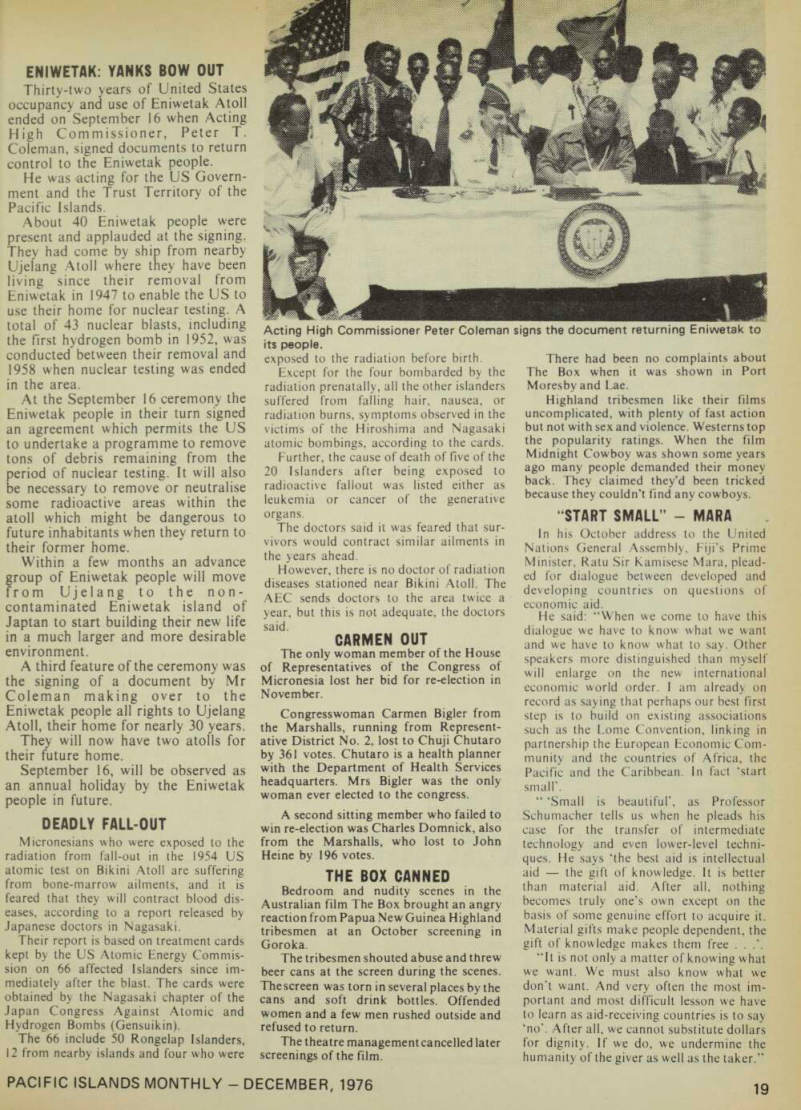
Thirty-two years of United States occupancy and use of Eniwetak Atoll ended on September 16 when Acting High Commissioner, Peter T.
Coleman, signed documents to return control to the Eniwetak people.
He was acting for the US Govern ment and the Trust Territory of the Pacific Islands.
About 40 Eniwetak people were present and applauded at the signing.
They had come by ship from nearby Ujelang Atoll where they have been living since their removal from Eniwetak in 1947 to enable the US to use their home for nuclear testing. A total of 43 nuclear blasts, including the first hydrogen bomb in 1952, was conducted between their removal and 1958 when nuclear testing was ended in the area.
At the September 16 ceremony the Eniwetak people in their turn signed an agreement which permits the US to undertake a programme to remove tons of debris remaining from the period of nuclear testing. It will also be necessary to remove or neutralise some radioactive areas within the atoll which might be dangerous to future inhabitants when they return to their former home.
Within a few months an advance group of Eniwetak people will move from Ujelang to the non contaminated Eniwetak island of Japtan to start building their new life in a much larger and more desirable environment.
A third feature of the ceremony was the signing of a document by Mr Coleman making over to the Eniwetak people all rights to Ujelang Atoll, their home for nearly 30 years.
They will now have two atolls for their future home.
September 16, will be observed as an annual holiday by the Eniwetak people in future.
Deadly Fall-Out
Micronesians who were exposed to the radiation from fall-out in the 1954 US atomic test on Bikini Atoll are suffering from bone-marrow ailments, and it is feared that they will contract blood dis eases, according to a report released by Japanese doctors in Nagasaki.
Their report is based on treatment cards kept by the US Atomic Energy Commis sion on 66 affected Islanders since im mediately after the blast. The cards were obtained by the Nagasaki chapter of the Japan Congress Against Atomic and Hydrogen Bombs (Gensuikin).
The 66 include 50 Rongelap Islanders, 12 from nearby islands and four who were
exposed to the radiation before birth.
Except for the four bombarded by the radiation prenatally, all the other islanders suffered from falling hair, nausea, or radiation burns, symptoms observed in the victims of the Hiroshima and Nagasaki atomic bombings, according to the cards.
Further, the cause of death of five of the 20 Islanders after being exposed to radioactive fallout was listed either as leukemia or cancer of the generative organs.
The doctors said it was feared that sur vivors would contract similar ailments in the years ahead.
However, there is no doctor of radiation diseases stationed near Bikini Atoll. The AEG sends doctors to the area twice a year, but this is not adequate, the doctors said.
Carmen Out
The only woman member of the House of Representatives of the Congress of Micronesia lost her bid for re-election in November.
Congresswoman Carmen Bigler from the Marshalls, running from Represent ative District No. 2, lost to Chuji Chutaro by 361 votes. Chutaro is a health planner with the Department of Health Services headquarters. Mrs Bigler was the only woman ever elected to the congress.
A second sitting member who failed to win re-election was Charles Domnick, also from the Marshalls, who lost to John Heine by 196 votes.
The Box Canned
Bedroom and nudity scenes in the Australian film The Box brought an angry reaction from Papua New Guinea Highland tribesmen at an October screening in Goroka.
The tribesmen shouted abuse and threw beer cans at the screen during the scenes.
The screen was torn in several places by the cans and soft drink bottles. Offended women and a few men rushed outside and refused to return.
The theatre management cancelled later screenings of the film.
There had been no complaints about The Box when it was shown in Port Moresby and Lae.
Highland tribesmen like their films uncomplicated, with plenty of fast action but not with sex and violence. Westerns top the popularity ratings. When the film Midnight Cowboy was shown some years ago many people demanded their money back. They claimed they’d been tricked because they couldn’t find any cowboys.
“Start Small’’ - Mara
In his October address to the United Nations General Assembly, Fiji’s Prime Minister, Ratu Sir Kamisese Mara, plead ed for dialogue between developed and developing countries on questions of economic aid.
He said: “When we come to have this dialogue we have to know what we want and we have to know what to say. Other speakers more distinguished than myself will enlarge on the new international economic world order. I am already on record as saying that perhaps our best first step is to build on existing associations such as the Lome Convention, linking in partnership the European Economic Com munity and the countries of Africa, the Pacific and the Caribbean. In fact ‘start small'.
“ ‘Small is beautiful', as Professor Schumacher tells us when he pleads his case for the transfer of intermediate technology and even lower-level techni ques. He says ‘the best aid is intellectual aid the gift of knowledge. It is better than material aid. After all, nothing becomes truly one’s own except on the basis of some genuine effort to acquire it.
Material gifts make people dependent, the gift of knowledge makes them free . . .’.
“It is not only a matter of knowing what we want. We must also know what we don't want. And very often the most im portant and most difficult lesson we have to learn as aid-receiving countries is to say ‘no’. After all, we cannot substitute dollars for dignity. If we do, we undermine the humanity of the giver as well as the taker.’’
Acting High Commissioner Peter Coleman signs the document returning Eniwetak to its people.