Up Front
with the Publisher
Keith McCarthy, who died in Melbourne in late October after a long and colourful career in Papua New Guinea, was during the war described by a superior of his, the celebrated District Officer and Coast watcher Eric Feldt, as a “tall, red-headed man of Irish descent with the nature of a red headed man of Irish descent”.
Eric, who had great regard for McCarthy, which was warmly recip rocated, went on to say in The Coast Watchers, that McCarthy’s “was no cold calculating brain; his affections and emotions often governed him, but when his fine, free carelessness had landed him in trouble, he could extricate himself, cool logic guiding his Celtic fervour, until the danger was past. He had shown this capacity when ambushed in the heart of New Guinea by natives, coming safely out, though wounded bythreearrows,oneofwhich he described as having ruined the beautiful symmetry of his navel. For the rest, he had a boisterous sense of humour, a habit of appropriating other people’s matches, and a gift for caricature which he indulged at the expense of his friends.”
Keith mellowed, but his earthy humour and great enthusiasm for life remained untarnished. The other day I was leafing through my copy of the book he published in 1963, Patrol Into Yesterday, and found between its pages a note he had sent me in 1959 in reply to one I had written him, suggesting that he should write such a book and giving what I thought were a few pointers.
As it happened, Keith hadn’t needed any suggestion from me, as he had already written no less than 300,000 words on his own initiative, and the problem was not in the writing, but in the cutting! But in that note Keith wrote that he would like to “have a go” at publishing it, and added, “Your reference to sex in your note I
accept as a pretty compliment in view of my advancing years. We might even concentrate on sex and call the book, ‘Memory Close My Fly’, in a thick volume of early reminiscences.”
When Patrol Into Yesterday was published it had a dramatic title-page photograph of an older Keith McCarthy, with armed police and carriers, “on patrol” in New Guinea.
His pure delight at this picture had nothing to do with the “big man” image thus created, because Keith had no conceit. It was in the fact that the publishers had arranged to have the photograph taking in the handiest bit of rough New Guinea terrain the photographer could find, which happened to be in the grounds of Port Moresby’s Government House!
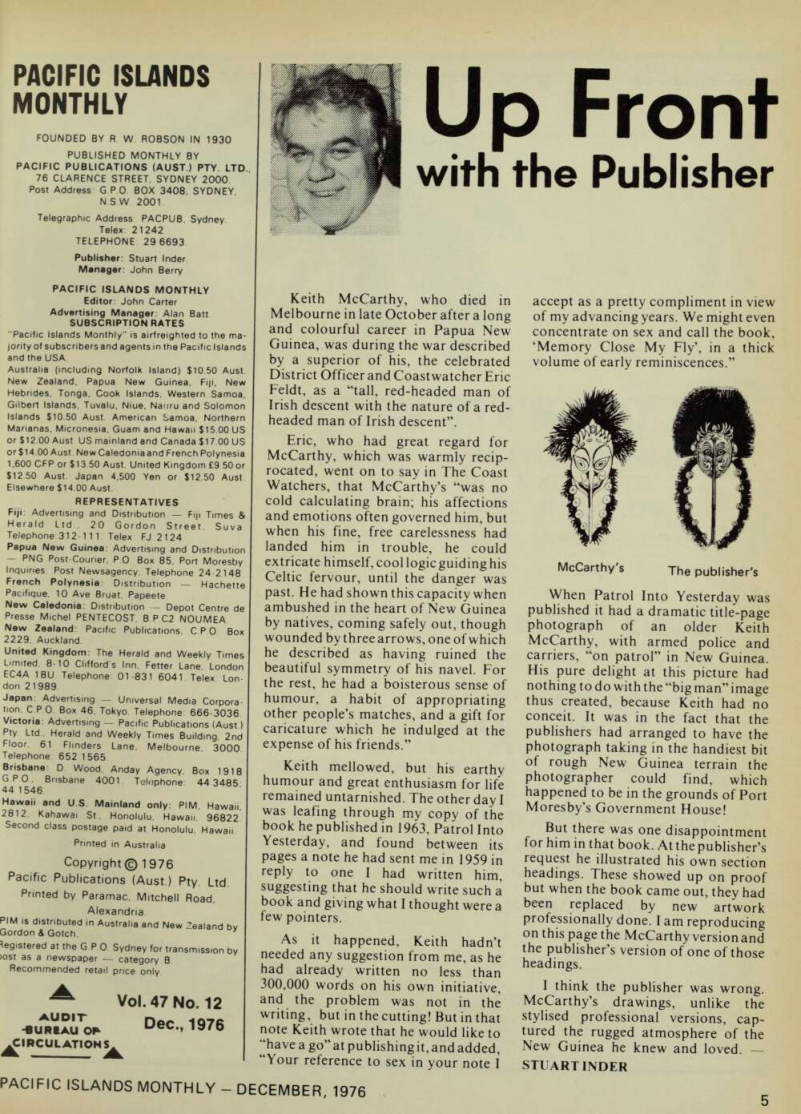
But there was one disappointment for him in that book. At the publisher’s request he illustrated his own section headings. These showed up on proof but when the book came out, they had been replaced by new artwork professionally done. I am reproducing on this page the McCarthy version and the publisher’s version of one of those headings.
I think the publisher was wrong.
McCarthy’s drawings, unlike the stylised professional versions, cap tured the rugged atmosphere of the New Guinea he knew and loved.
Stuart Inder
McCarthy's
The publisher's