a cultural resurrection?
p. 48 · Read in the full issue
The Gogodala woodcarvers: a cultural resurrection?
It comes to mind that the cultural damage that has been done by religious missions (do they all deserve the appella tion “Christian” even if they profess to be?) has been done in ratio corresponding to their own cultural inheritance. That is to say, they force their own poverty of riches of thought upon those whom they have decided to assist or to destroy. But the destruction must not be entirely blamed on missions: much destruction of the Papua New Guinea’s cultural inheritance has been done by the average, apparently innocent citizen by mere disregard, and much has been done by the people themselves feeling that they have grown out of these things.
It is no less reprehensible to thrust a revival and resurrection on to a people than it is to rob them of their traditions. I have known a number of anthropologists as anxious to retain groups that they have taken possession of as museum curiosities as the certain types of missions were to turn the same people into spineless sponges. Others besides missionaries were fierce in their determination to mould the souls of those they decided to possess. That battle in Papua New Guinea was unceas ing, and still goes on.
I remember someone who worked as a missionary telling me once, that the peo ple of Gogodala were hopeless and beyond redemption. A. L. Crawford, who has written about the wood carving of these people has proved that she was wrong, but not in the way she meant.
When I first went to Papua, some 30 years ago, I developed a great regard for the Western men, although I saw little of them except away from their homes. I saw some of the collection made by P. Wirz before it reached Basle and of course saw the whole collection after this was housed
in Basle, and the collection housed in the British Museum, and, viewing it, con firmed my opinion that, artistically, the western Papuans were not to be overlook ed. It is just as well that Wirz and the Cambridge expedition saved those Gogodala treasures as they did. for without them there would be nothing left.
Crawford stales that there is only one “an tique" left in (iogodala. The rest, which would have been destroyed lor one reason or another are mercifully preserved in Basle and London where millions have ad mired their great beauty. And they are ol
great beauty. The illustrations in Sakema by A.I Crawford indicate thiv There is a rhythm and lively How of line in the Gogodala carvings which make main of the Sepik carvings static and contrived In
comparison.
A. 1 . Crawford has done a wonderful work in reviving the Gogodala culture, if, in fact, a culture can be revivified. The fact that they are carving drums and masks and other objects in ancient design and pattern may or may not be a revival of culture, but may be no more than an attempt to please.
A. L. Crawford in the same way that they destroyed them to please that particular missionary.
Can one revive a culture? Or is all that happens w'hat has happened to the Japanese tea ceremony: an attraction for tourists who think they are penetrating Japanese living? It is now as divorced Irom the spirit which animated it as are the patterns on Dili Beier's shirts (Dili Beier writes a foreword to Sakema) or as the religion of some missions may have been
from Christianity.
I am sure that AT.. C rawford is aware of this and is watching to see that the pre sent revival is not 100 far removed from those foundations which gave Gogodala tradition its birth. I don't know how much good all this revival is; there seems to be little point in giving a hip-flask to a teetotaller.
Peter Livingston
(Sakema: Gogodala Woodcarvers. By A. L.
Crawford. Published by The National Cultural Council, Papua New Guinea, no price given.)
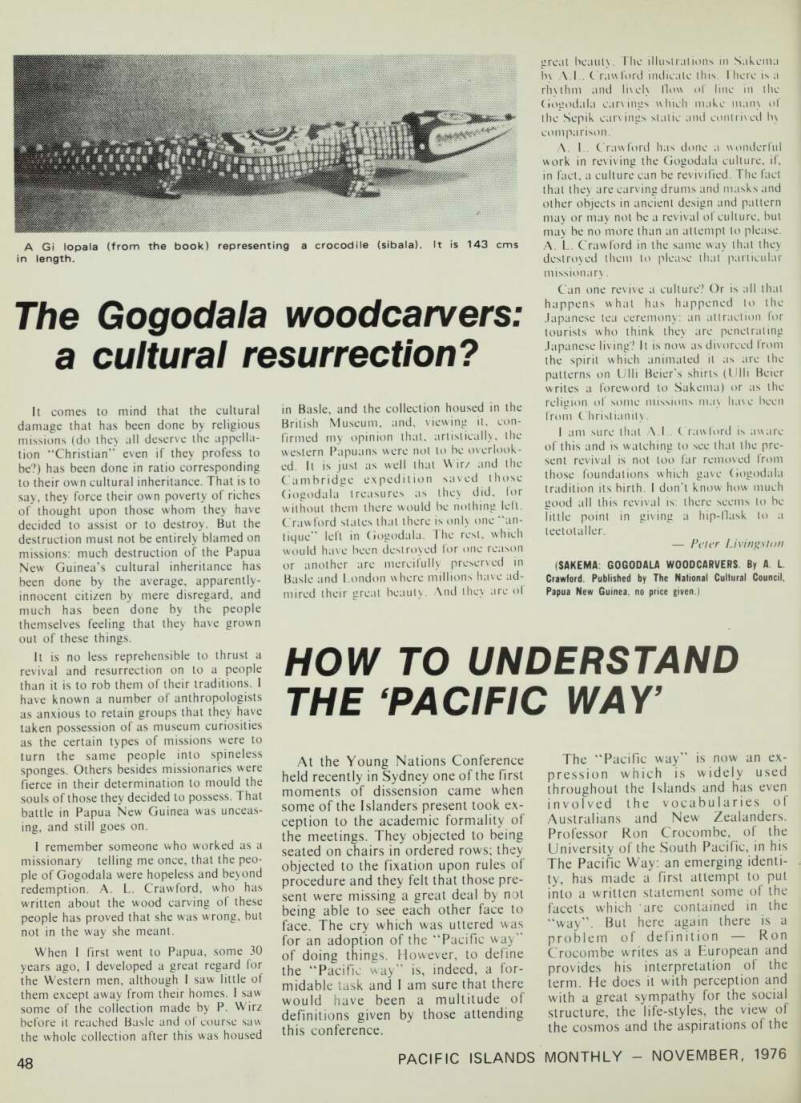
A Gi lopala (from the book) representing a crocodile (sibala). It is 143 cms in length.