Magazine
pp. 38-41 · Read in the full issue
When Tahiti Was A Land Of
Perpetual Intoxication
To be just twenty-one, unshackled and in Tahiti was a perpetual intoxication.
Under the floodlight of a tropic sun you came alive in all the senses. Wherever you looked even down the shabbier side streets of Papeete were flowering shrubs and trees, frangipani exploding in pink, yellow or chaste white blossom, or the crimson brilliance of hibiscus or flame trees shed ding scarlet flowers on a patch of wasteland. From wharfside storage sheds came the warm, musky odour of copra or the sharper sweetish tang of vanilla. Was there ever such a flower as the fragrant, white tiare Tahiti? Its small, shiny-leaved bushes grew in every garden and nowhere else but in these islands.
Tahiti was a land of flowers. Its language was flowers. To wear one of those small, star-petalled cousins of the gardenia over the ear, or a couronne of fern leaves and frangipani, or a lei of freshly picked hibiscus was the com monplace expression of an inner joy long departed from western living, perhaps since ancient Greece. Here was the last tru ly pagan society on earth, based on the pleasure principle, not supernatural fears or a cult of death.
These latter-day Greeks wore scarlet and gold pareus about their loins. Their hair was wreathed in ferns. They swam in these aquamarine lagoons and pursued the classical sport of venery.
Papeete, old hands declared, was a dull little port town, provincial. I did not find it so. Along the waterfront, down the green tunnel of the Rue du Commerce with its foliage of flame trees arching overhead, around the crowded market square you strolled past flimsy, unpainted timber frame buildings whose tall verandah posts, faded sunblinds and fretwork of upper balconies gave it an air of theatre. A large cast of Tahitians was always on stage as if awaiting the overture to some tropical Carmen. They lounged and sat on stone benches in Gauguinesque attitudes, squatted by the stone quay to yarn with the crews of tuna boats and moored schooners, grouped around the doorless entrances of
This fascinating account of life in Tahiti in the days before its discovery by the tourist is taken from George Far well’s latest book Re joice in Freedom, an autobiography published by Thomas Nelson {Australia) Limited, of Jeffcott Street, West Melbourne, at the recommended price of $15.95. George Farwell died suddenly about four months ago. The photographs appearing with the article are from PI M’s own library and do not appear in the book.
Chinese stores, sang out ribald greetings to one another, gossiped and expostulated in that rapid, polysyllabic, slurred tongue that, whatever the French might decree, was still the spontaneous currency of island life. There were stout, heavy bosomed women in flowered mother hub bards, with enormous calves and upper
arms; seamy-faced, lean grandmothers
robed in black; jaunty youths whose black, crinkly hair was cut en brosse or who wore narrow-brimmed pandanus hats banded with cowrie shells and, as always, those full-hipped girls with the waist-long black hair, glancing as provocatively as only males did at desirable women in other lands. In the main street traffic was so scarce even in business hours that pedestrians walked the middle of the road, leaving the sidewalks under sun awnings to the shopkeepers. A few bicycles went slow ly by, the occasional Chinese cart drawn by a bony little horse, perhaps a dozen old fashioned cars all day. Each side, behind those tree boles and verandah posts, were small, open-fronted stores and Chinese
tailors, a poolroom where Tahitian youths idled and smoked, bicycle repair shops, Madame Quinn’s quiet ice cream parlour and a couple of cool, cavernous bars with batwing doors.
After dark the tempo quickened for this was the time to promenade. Dim lights slanted from shop doorways, while tiny oil lamps sputtered under the canvas tops of red, two-wheeled Chinese barrows whose glass fronts displayed watermelons in huge slices, fresh drinking nuts and sweets like manioca, made from arrowroot. Almost nightly Michael and I strolled in from the hotel to join the leisurely parade.
The Blue Lagoon, a kilometre out of town, was the only place to stay. Beside a lagoon in Arue, recently built, its half dozen thatched bungalows were each screened by thickets of bamboo, hibiscus, and slender tall papaya trees, which squabbling mynah birds plundered daily to the shrill fury of the Chinese houseboys. In town the old Tiare Hotel had fallen into decay since the death of Lovaina, the famous Tahitian-American whom Frederick O’Brien had described as having limbs the girth of breadfruit trees, and a bosom broad as Juno of Rome. Rupert Brooke had stayed there, Robert Keable, George Calderon and Maugham but the light-hearted vahines they wrote about had moved on, though on its lattice-screened verandah, schooner captains and their trader friends still took long lunches and consumed their carafes of French wine. As for the other more modest places on or around the waterfront, they were air-less little hot boxes suited only for those stay ing overnight from the districts or brief assignations of lovers.
Thus we awaited the rest of our party, due from Australia in fifteen days.
Curtler, being earnest and Central Euro pean, was the only one to confuse in dolence with sin so we allowed him the lux ury of keeping busy. He called at the governor’s palace, arranged the schooner charter with a Chinese trading firm, had our plans approved by the authorities.
These, in the manner of Frenchmen, so ex-
tended themselves in long lunches, vin or dinaire and siestas as to bother us little. ‘Do what you will, mes amis,' their chief announced, for the hot months had begun.
What we did not know about was the cyclone season, which made it unwise to sail for a further month. Who cared? It was not exactly hardship at the Blue Lagoon.
Bill Wainwright was an enterprising man. His office and dining quarters were on the lagoon side of the road, the walls'a series of storm shutters which, when propped open each morning, revealed a wide arc of viridian water, tides washing gently below. Far out the reef smoked eter nally against a cobalt ocean. For breakfast a grave young Chinese, his white jacket crisply ironed, brought us papayas fresh from the garden, firm-fleshed avocados, hot croissants and aromatic Tahitian coffee, served with coconut cream.
Afterwards, all morning if we felt like it, we swam and dived in the warm lagoon.
Out there on a wooden jetty I felt no great struggle with a drowsing conscience. Did any able-bodied young man have the right to so pagan an existence, while dole queues lengthened around the globe? I dived into the lagoon again.
Polynesia lived to a different time scale.
The hours passed, days passed. I was hard ly aware of them. The sun rose on a distant profile of Moorea’s umber mountains, glittered across this iridescent lagoon, casting into the frieze of bronze the graceful coconut palms around the foreshores. At sundown when towering
white cumulus above the other island turn ed molten, Wainwright began his devotions at the bar. His specialty was Tahitian punch in tall, frosted glasses, with fresh limes, sliced native oranges and Mar tinique rum. Over dinner poisson cru, raw fish marinaded in the juice of limes, or a baked parrot fish or tiny chevrettes speared in some mountain stream and in expensive French hock we watched the kerosene flares of fishing canoes as they drifted along the reef.
All night, sleeping or awake, the remote, drum-like resonance of the reef became as much a part of my consciousness as the pulse of blood. For years after in other
lands I was to feel as if something essential had gone from life without that assuaging undertone of surf.
To have booked into the Blue Lagoon was like entering the needle’s eye.
Wainwright liked to know exactly who you were. His rimless spectacles glinted as you signed his register.
Captain Wainwright, do you mind. Ex- British army. Active service during the Sinn Fein troubles. But never ask about the Black and Tans. Atrocities? Just Irish propaganda. Besides, you don’t discuss a man’s past in the islands. Lean, fortyish, close-clipped fair moustache, Bill Wainwright was always in white shorts, long socks and officer-style white shirts with shoulder tabs. The thin smile recalled rumours of cold business dealings and con versational malice. ‘Hope you’re not another scribbler,’ he had said. He seemed to have an obsession about them. ‘Chaps come off every mailboat with bloody typewriters. All go ing to write the great book. On Tahiti?
Next thing you know they’re boozing in town, trying to hock their rusting machines to some poor benighted Chinaman.’
He need not have worried about his pre sent guests. Robert Gibbings, for one. He was not about to sell his typewriter, if he had one. The shaggy, spade-bearded ar tist spent most of his days with diver’s goggles or glass-paned headpiece under the lagoon, for he was researching a successor to his Blue Angels and Whales. Before he left for Moorea he showed me his curious set of slate pencils, designed for sketching the brilliantly-hued fish and coral for mations under water. His bungalow was taken over by J.K. Stimson. This elderly, horn-rimmed American ethnologist reveal ed other talents for recording native life.
Back from the Tuamotu Archipelago hav ing collected many historic tales and chants, he spent his evenings reciting the bawdier ones to mixed audiences, no doubt hoping to shock the ladies. In the end he
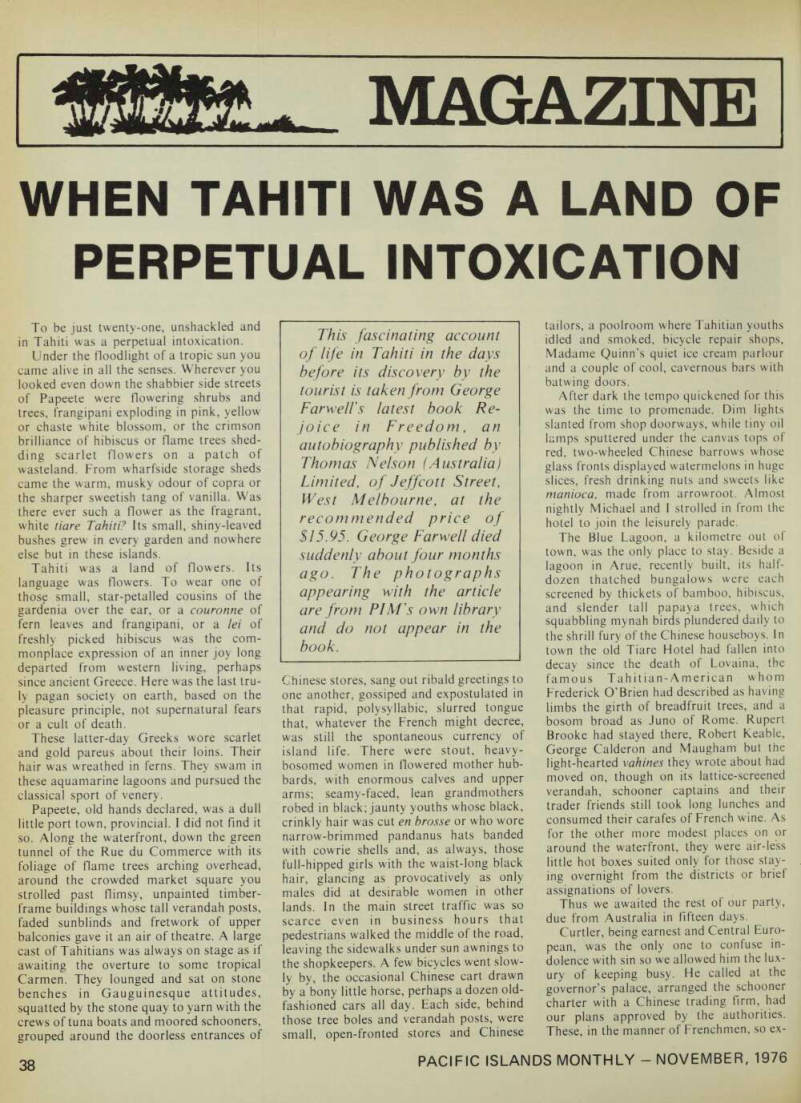
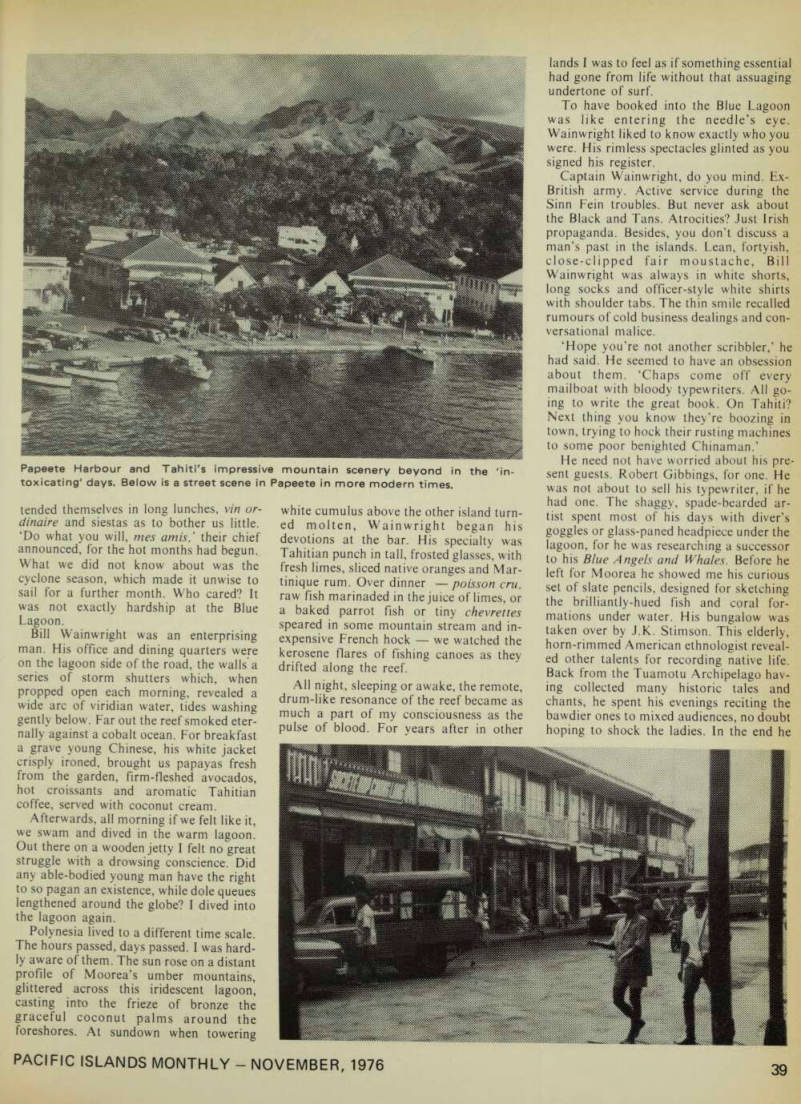
Papeete Harbour and Tahiti's impressive mountain scenery beyond in the 'in toxicating' days. Below is a street scene in Papeete in more modern times.
shocked only the directors of Honolulu’s Bishop Museum. Being Methodists to a man they refused to publish his rich source material which has been locked away ever since.
At a neighbouring table craggily good looking Pat O’Brien always dined alone.
Perhaps the coming of talkies had taken him by surprise for he rarely spoke and was said to be resting between Western films. Even his one pre-dinner Scotch was sipped in solitude. It was as if he derived some secret pleasure from denying his fame. When he departed his place was taken by Fredric March, whose ascetic profile and slight stoop gave his full, athletic frame the air of a misplaced scholar. At thirty-five he had still the quick enthusiasm of a college boy. It was hard to see him either as Dr Jekyll or Mr Hyde. ‘Right now,’ he remarked on one of his fast-striding walks into Papeete. ‘Hollywood’s some kind of a bad dream.
Let’s not talk about it here.' His springy walk, the unruly lock of black hair, the eager delight in the native life around us reflected his impatience with the indoor glitter of Sam Goldwyn’s spangled and sequinned world. Soon afterwards he vanished into the outlying districts for he had a one-man film to make. He travelled with a hand-held camera and wanted to reflect only what was natural to island ex istence. ‘We just have to find our way back to nature,' he told me. ‘lf we don’t, I guess there’s no way we’ll survive.’
No tourists came to Tahiti. The term had still to be invented. A few travellers, yes, but these were a different breed, as were the more adventurous owners of ocean-going yachts. The Union Steam ship Company had only two mail steamers on the long, slow trans-Pacific route so that anyone voyaging between San Francisco and Sydney, if he chose to drop off here, had to stay at least a month. We were remote from the rest of the planet.
Hence the excitement of steamer day.
It was a bigger event even than Tony Bambridge’s weekly picture show. For the pictures almost everyone in town assembl ed outside the gaunt, dilapidated hangar of timber and iron, arriving with watermelons, corn on the cob, ukuleles, so that latecomers found only standing room.
Talkies had not yet reached Papeete. But Tom Mix had. He and his noble white horse never failed to have the audience cheering. Amid a hub-bub of Polynesian voices, laughter and catcalls, the populace gazed at the wondrous doings of Douglas Fairbanks, Mary Pickford and the sultry Joan Crawford, the lack of a sound track being made good by a burly Tahitian inter preter, who shouted his hilarious version of the proceedings from the scaffolding.
Close-ups of embraces brought riotous mirth that could be heard blocks away.
Aue tatua e! It was a cry of disbelief.
Those pale faces kissing, the remorse and tears. Kissing just wasn’t an island prac tice. They thought it obscene. Tahitians went in for more earthy exchanges and no one thought mere kisses worth all that celluloid drama. The quaint ethics of the popaa (white man) were reasons enough to draw a crowd to the steamer wharf each time Makura or Maunganui came to port.
It brought almost every European in from the outlying districts, too.
Once the ship had berthed, they strolled on beneath the waterfront flame trees to the post office steps, waiting for the mail to be leisurely sorted. It was the day for meeting old acquaintances, gossip and
light-hearted slander.
‘Eaha to parau api?’
What’s the news? Most of these ex patriates in their brown pith helmets, khaki drill or high-collared white jackets had learnt, generally from the women they lived with, at least the rudiments of the language. The usual practice was to stay on in town, making a night of it. They moved on to Bohler’s companionable bar on the Rue du Commerce, buying each other the beachcomber’s drink of neat rum with water chasers which enabled a man to be drunk as an island trader for ten cents; or Alex Stergeios’s more refined but dead ly rainbow cocktails at the Yacht Club, where nobody owned a yacht, or bourbon and Hinano beer upstairs at the Cercle Bougainville, the all-nations club favoured by old hands. Next morning the survivors
reassembled on the wharf, watching the ship depart in a haze of coloured streamers, island songs and alcoholic remorse.
For some of these exiles the siren for departure brought its moment of truth.
They told one another they had stayed too long. Time to give away the islands, old son; face up to real life again. Maybe the next steamer, or the one after. Maybe.
Over Monsieur Bohler’s zinc tables, order ing another neat rum, you met characters who had been saying this for years. Some even booked their passages, carried their baggage aboard, only as the gap widen ed between ship’s hull and wharf to hurl themselves overboard, dog-paddling for the shore, where some tolerant gendarme would help them out, putting them on le true for the district again. Like some tropical infection, Tahiti worked its way into the bloodstream, dooming a man forever.
Many others had no intention of ever quitting. They belonged. The world began and ended at that beautiful, encircling out er reef. What happened beyond was no longer their concern unless it came under discussion at the Bougainville. To join this leisurely, unpretentious club on the quai, you needed only five francs and a jacket.
When its dapper, Greek-born manager, Alex Stergeios, left to open the more snob bish Yacht Club around the corner even jackets were forgotten.
Amid the brighter, Americanised decor of Le Club Yacht, adorned with swordfish and giant turtle shells, you met the bourgeois elite, the five first families, demis such as the Salmonds, Herves, Mar tins, Bambridges, whose grandfathers had been white traders or seamen jumping ship, far-sighted enough to marry some chieftain’s daughter and acquire his land; or newcomers like the game-fishing Guilds, who entertained only visiting VIPs in their lagoonside villa out at Paea or those fonctionnaires who did not prefer the company of other French provincials over Dubonnet and le whisky at the Cercle Coloniale uptown. I found my spiritual niche at the more homely, democratic
Bougainville.
You reached it by a steep, outside stair-
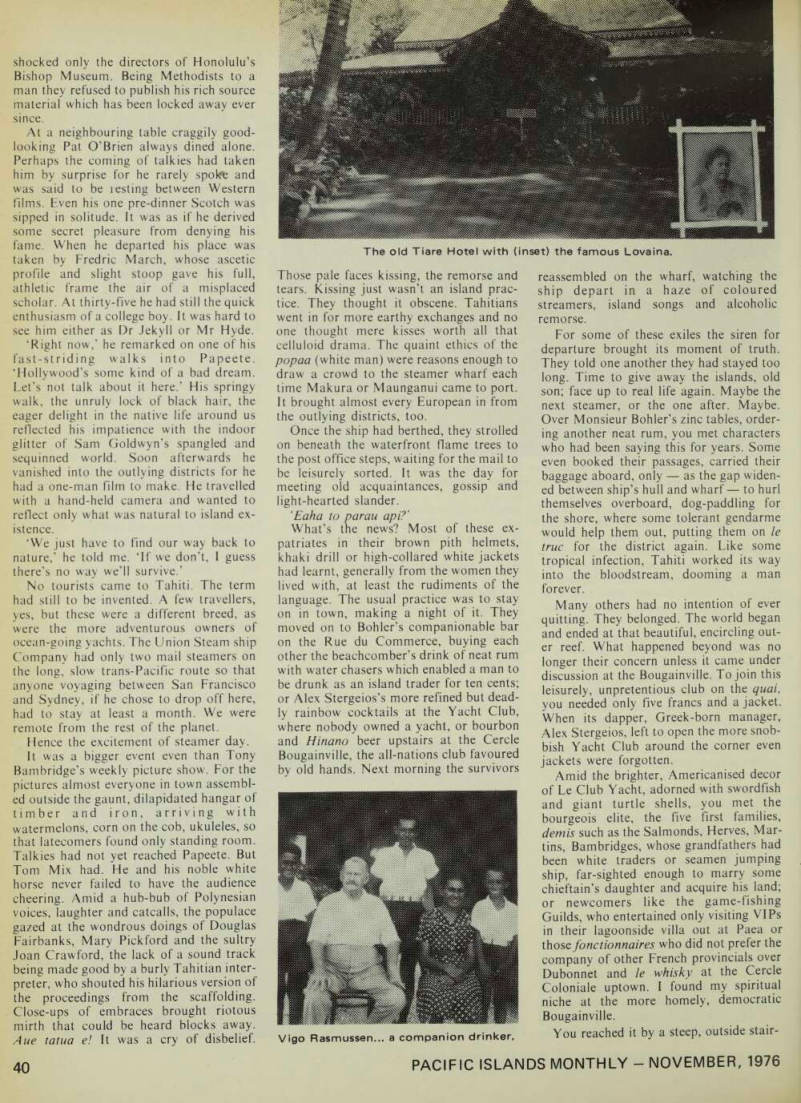
Vigo Rasmussen... a companion drinker.
The old Tiare Hotel with (inset) the famous Lovaina.
case which led to a long verandah shaded by rattan sun-blinds with many deal tables, upright chairs and a view over the balustrade to moored schooners at the quay below. Inside was a larger, dim-lit room with a service bar, two billiard tables and wall rack for foreign newspapers, long out of date. To decide who paid for the next drink, since the custom was not to buy in turn, you rolled poker dice from a leather cup.
The characters you met here were of a kind the South Seas will never again know.
Their talk was of copra prices, pearlshell, the arrival and departure of island schooners, not to mention the latest popaa scandal or graft by French officialdom.
Here, when he was in port you drank with Vigo Rasmussen, the huge, fair-headed master of A.B. Donald’s beautiful little schooner, Tiare Taporo, his Norwegian accent still strong after forty years, or the American Andy Thompson, who married a Cook Island girl and knew as much about the reefs, tides and sailing hazards of the outer islands as anyone in sail. Among the many old hands to be found here almost any time of day or evening were the sly, wizened old Polish pearl dealer, Voronich, whose front teeth had been capped with fourteen carat gold; the Russian-born vanilla exporter, Count Polonski, quizzing newcomers through a rimless monocle that earned him the nickname of Matatitiahoe, the one windowed man; Dr Williams, British con sul, the island’s only dentist whose famous missionary grandfather had appealed to Queen Victoria to prevent Tahiti’s annexa tion by the French; the immaculate, dark skinned copra planter, Norman Brander
whose English father married the daughter of a local chief, and sent their son to Ox ford and Heidelberg; Lloyd Osborne, Robert Lous Stevenson’s nephew- to whom “Treasure Island" had been dedicated, his legs so swollen with elephantiasis he could hardly climb the stairs; the Czech restaurateur Rivnac, claiming his gross stomach as proof that he served the best food in town; Armand Herve, the scholarly
part-Tahitian storekeeper, whose library
was filled with books and documents on island history; the quiet, white-haired terrier of a Scotsman, Alister MacDonald, painter of exquisite water-colours and Georges Ahne, the Paris educated lawyer whose polite exterior concealed a passion for Tahitian independence which was hard ly popular among the French.
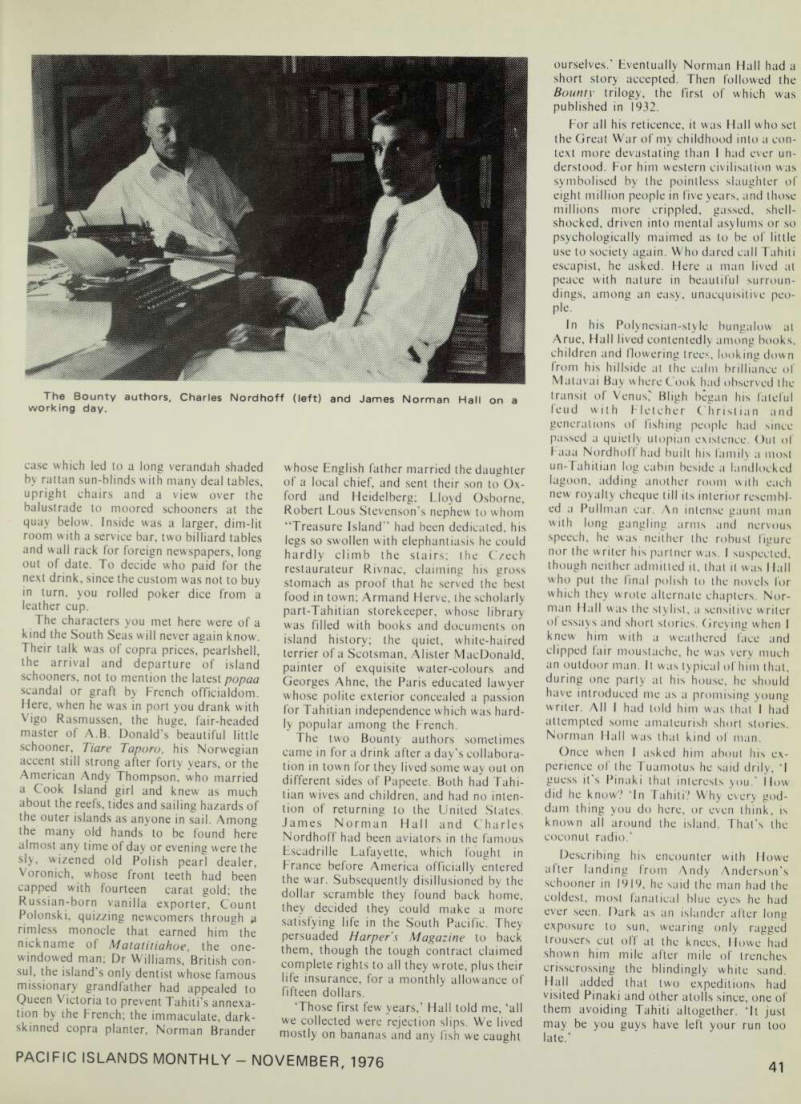
The two Bounty authors sometimes came in for a drink after a day’s collabora tion in town for they lived some way out on different sides of Papeete. Both had Tahi tian wives and children, and had no inten tion of returning to the United Stales.
James Norman Hall and Charles Nordhoff had been aviators in the famous Escadrille Lafayette, which fought in France before America officially entered the war. Subsequently disillusioned by the dollar scramble they found back home, they decided they could make a more satisfying life in the South Pacific. They persuaded Harper’s Magazine to back them, though the tough contract claimed complete rights to all they wrote, plus their life insurance, for a monthly allowance of fifteen dollars. ‘Those first few years,’ Hall told me, ‘all we collected were rejection slips. We lived mostly on bananas and any fish we caught
ourselves.' Eventually Norman Hall had a short story accepted. Then followed the Bounty trilogy, the first of which was published in 1932.
For all his reticence, it was Hall who set the Great War of my childhood into a con text more devastating than I had ever un derstood. For him western civilisation was symbolised by the pointless slaughter of eight million people in five years, and those millions more crippled, gassed, shell shocked, driven into mental asylums or so psychologically maimed as to be of little use to society again. Who dared call Tahiti escapist, he asked. Here a man lived at peace with nature in beautiful surroun dings, among an easy, unacquisitivc peo ple.
In his Polynesian-slyle bungalow at Arue, Hall lived contentedly among books, children and flowering trees, looking down from his hillside at the calm brilliance of Malavai Bay where Cook had observed the transit of Venus? Bligh began his fateful feud with Fletcher Christian and generations of fishing people had since passed a quietly utopian existence. Out of Fa a a Nordhoff had built his family a most un-Tahitian log cabin beside a landlocked lagoon, adding another room with each new royalty cheque till its interior resembl ed a Pullman car. An intense gaunt man with long gangling arms and nervous speech, he was neither the robust figure nor the writer his partner was. I suspected, though neither admitted it, that it was Hall who pul the final polish to the novels for which they wrote alternate chapters. Nor man Hall was the stylist, a sensitive writer of essays and short stories. Greying when I knew him with a weathered face and clipped fair moustache, he was very much an outdoor man. It was typical of him that, during one parly at his house, he should have introduced me as a promising young writer. All I had told him was that I had attempted some amateurish short stories.
Norman Hall was that kind of man.
Once when I asked him about his ex perience ol the Tuamolus he said drily, ‘I guess it's Pinaki that interests you.' How did he know? 'ln Tahiti? Why every god dam thing you do here, or even think, is known all around the island. Thai’s the coconut radio.’
Describing his encounter with Howe after landing from Andy Anderson’s schooner in 1919, he said the man had the coldest, most fanatical blue eyes he had ever seen. Dark as an islander after long exposure to sun, wearing only ragged trousers cut off at the knees, Howe had shown him mile after mile of trenches crisscrossing the blindingly white sand.
Flail added that two expeditions had visited Pinaki and other atolls since, one of them avoiding Tahiti altogether. ‘lt just may be you guys have left your run 100 late.’
The Bounty authors, Charles Nordhoff (left) and James Norman Hall on a working day.