No Crystal-Gazing Needed For
pp. 29-31 · Read in the full issue
Fiji's Coming Elections!
From ROBERT KEITH-REID in Suva
Election fever is slowly but surely beginning to grip Fiji politicians in general and the 52 members of its House of Representatives in par ticular.
After four years of relative leisure in which they have been drawing backbench or ministerial pay, MPs on both sides of the House are beginning to wonder what they will be doing this time next year.
The country’s second general elec tion since independence from Britain in 1970 will be held next May when the five-year life of the present parlia
ment expires.
There s no mystery about who will win it. For the last 10 years Fiji has been run by the Alliance, a political co-operative of Fijian, European, part-European, Chinese and some In dian sectional interests.
Thanks to constitutional arrangements that allocate parliamentary seats to various racial groups in proportions that are in the Alliance’s favour, it will still be firmly in the government saddle when the new parliament assembles for the first time next year.
But, in spite of the inevitability of the overall result, the election cam paign and the final test at the polling booth should settle several questions that have been bothering people.
For instance, is the Fijian National
Party of any real substance, and is the Social Democratic Party anything more than a figment of someone’s im agination?
The National Party didn’t exist when the 1972 general election was held, since its founder, Sakiasi Butadroka, was then a solid Alliance man and got a Fijian communal seat and an assistant minister’s job on a party ticket.
But Butadroka later began voicing anti-Indian sentiments that were a grave embarrassment for the multi racial Alliance, and the party’s leaders heaved a sigh of relief when he quit in a rage to occupy an indepen dent seat and set about founding the
Fnp.
Butadroka claims to represent a big Fiji-for-the-Fijians faction and he has demonstrated some political show manship which indicates that he has a following of sorts. Critics scoff that he is more of a loud noise than anything else, but if he does manage to keep his seat it will come as a shock for op ponents who say the strong racist elements in his views may make big newspaper headlines but reflect only an insignificant section of Fijian feel ing.
Mystery still surrounds the organisation and backing of the Social Democratic Party, so much so that there are grounds for suspecting that it is nothing more than a name.
It was founded last year by dis gruntled members of the National Federation Party, which forms the Fiji Opposition and gets nearly all its support from the Indians who con stitute just over 51 per cent of the country’s 560,000 population.
SDP men said, initially, they were fed up with lawyer Siddiq Koya’s leadership of the NFP. Later they said they were setting up a nation wide organisation. But nothing much has been heard from it of late and there are rumours that NFP leaders have been successfully herding dissi dent elements back into the fold.
A third interesting question the election should settle is whether the Alliance is managing to win more
support from the Indian community.
There is some evidence that it has been slowly doing so, although last March it was still not confident enough to make a bid for an Indian communal seat in a by-election.
The Alliance now holds 33 of the 52 House of Representatives seats and if next May it manages to increase its majority by taking just one or two of nine Indian communal seats it has none of them now it would be a devastating blow for the NFP.
Both parties began squaring up for the election in August, the Alliance publicly and the NFP secretly.
At its annual convention in August and opened to the press and anyone else who cared to drop in as observers, the Alliance for the first time fixed firm procedures for the selection of its election candidates.
These will be nominated and secret ly balloted for in a democratic manner which, judging by the code approved by the convention, should eliminate most of the internal jockey ing that can strain solidarity dangerously on the way along the path to the polls.
The convention heard with jubila tion that an election fund-raising committee’s $lOO,OOO target had been achieved nearly 10 months ahead of polling day.
Ratu Sir Kamisese Mara was
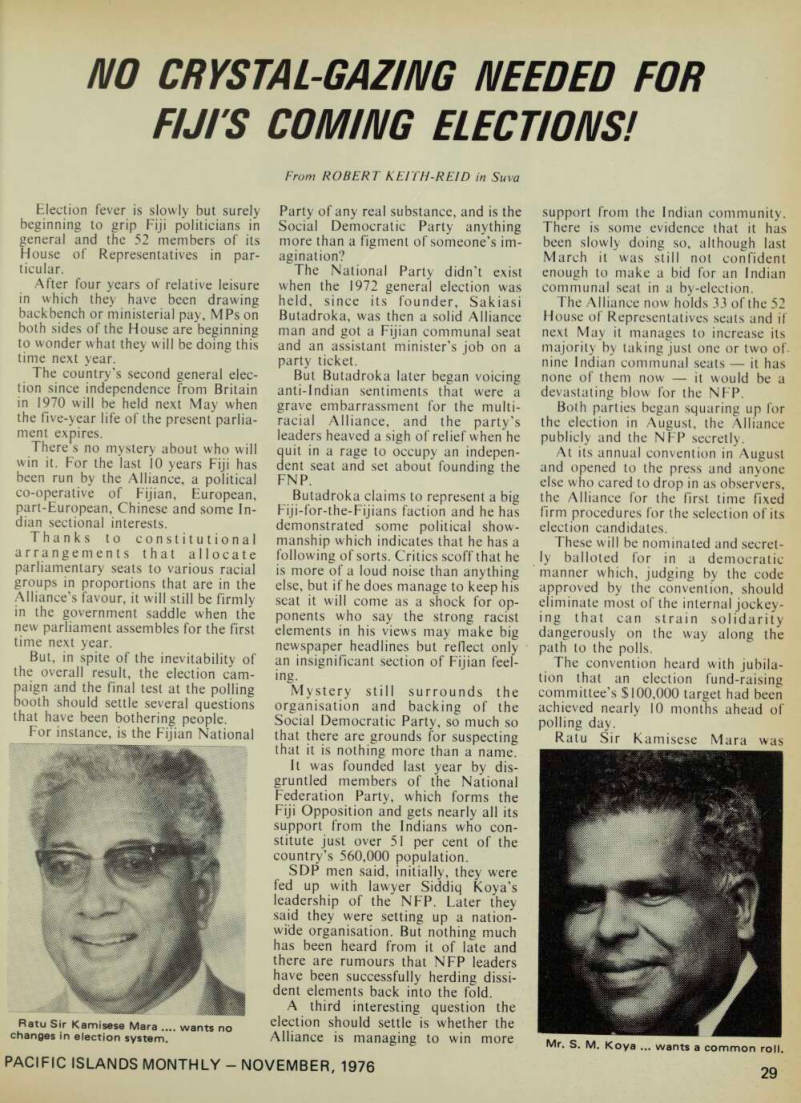
Ratu Sir Kamisese Mara ... wants no changes in election system.
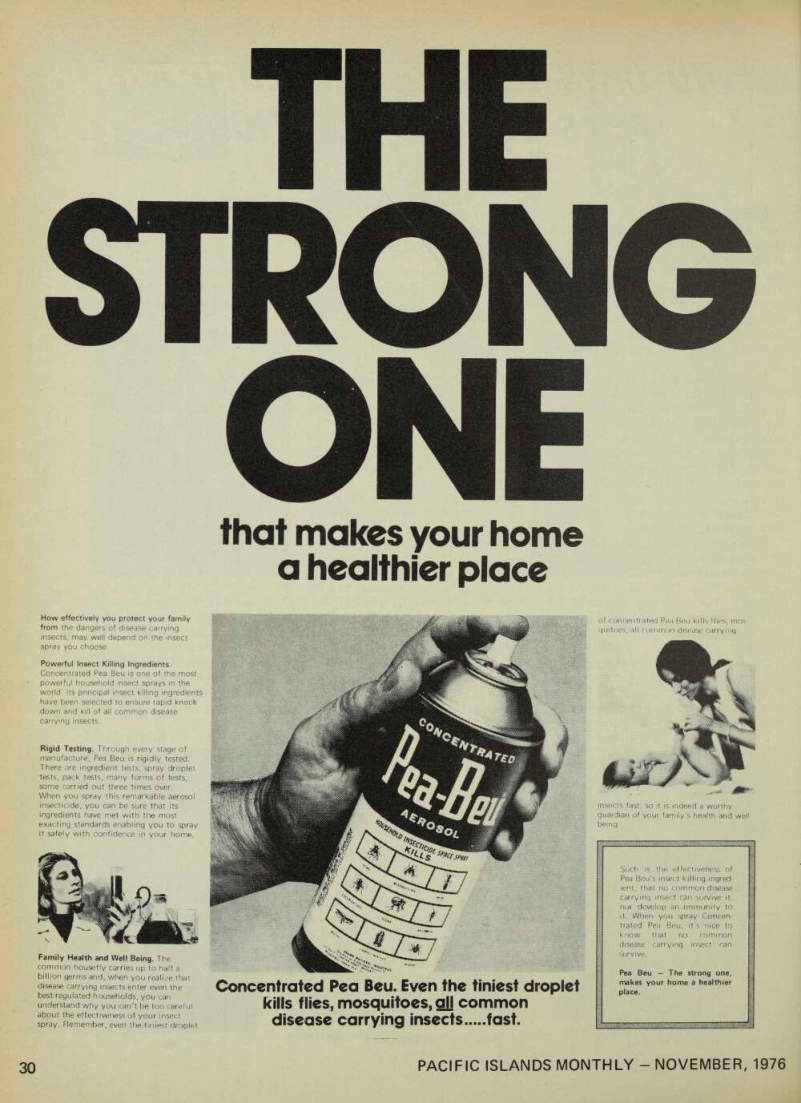
Mr. S. M. Koya ... wants a common roll.
returned unchallenged as the Alliance’s leader and proclaimed his party’s election platform. This, he said, was detailed in the $370 million 1976-1980 development plan publish ed last January.
The plan, he said, spelt continuing peace, progress and steady growth of prosperity for all if the Alliance got the five more years of power it needed to implement it.
In Parliament a few days later, Ratu Mara told a questioner that the Alliance completely rejected the idea of changes in Fiji’s communal election system as recommended by a Royal Commission of three British lawyers in a report also published last January.
His party did not think the report’s arguments justified “any change in the method of election which is suitable to our multi-racial society”.
The Alliance’s stand in resisting constitutional change is hardly sur prising since the present system of 22 guaranteed seats for Fijians, 22 guaranteed for Indians and eight for people of other races more or less guarantees perpetual power for it.
The Royal Commission urged a drastic reshaping of the electoral set up by the scrapping of 25 communal seats and their replacement by 25 “national” seats voted for on non communal lines a common roll.
In rejecting constitutional change, Ratu Sir Kamisese and his party would seem to have provided meat for the NFP to maul at during the elec tion campaign.
Mr Koya’s NFP has long bitterly opposed communal voting, knowing it has virtually no chance of attaining power while it is continued. But in moving to renew its battle with the Alliance over this issue, the NFP is, as yet, showing nothing like the con fidence the Alliance is displaying.
Rocked by internal splits and ap parently beset by money problems the NFP’s image is in complete contrast with the $lOO,OOO gilt-edged solidarity the Alliance boasts.
In recent months, Mr Koya has lost his place as NFP president to a woman, Mrs Irene Narayan, although he is still, officially, overall leader and Leader of the Opposition in parlia ment.
There was a “sustained attack” on Mr Koya to “discredit his authority and leadership and thus weaken the
party structure and cause confusion and loss of direction in the rank and file of the party,” it said.
Mr Koya and Mrs Narayan are rumoured to have patched up their differences, although some people wonder if the patch they have used will stand up to the wear and tear of a general election campaign.
One feature of previous Fiji elec tioneering will, the Alliance Party hopes, be totally absent from the cam paign now warming up. This is the type of speech that works up public anger, suspicion or alarm about any particular race or community.
In August, the House of Represen
tatives passed amendments to the Public Order Act making it illegal to do, say or publish anything that in cites race hatred.
A New Party
A 76-year-old former member of Fiji’s Legislative Council, Mr Brahma Das Lakshman, has announced the formation of a new political party, the Progressive Girmit Party.
He claimed that the party was “for the descendants of Indian indentured labourers”. It was hoped that it would stand candidates in the coming general election.