The Islands, The Spc And
pp. 25-27 · Read in the full issue


A ‘Certain Kind Of Unity’
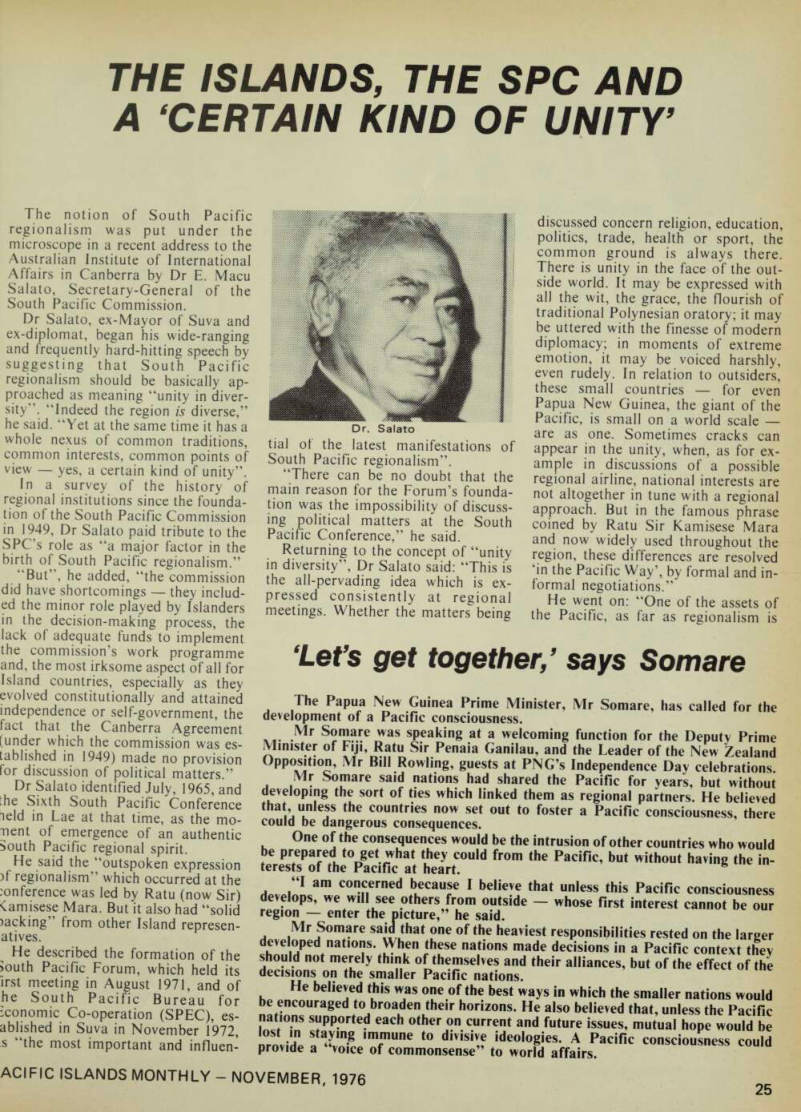
The notion of South Pacific regionalism was put under the microscope in a recent address to the Australian Institute of International Affairs in Canberra by Dr E. Macu Salato, Secretary-General of the South Pacific Commission.
Dr Salato, ex-Mayor of Suva and ex-diplomat, began his wide-ranging and frequently hard-hitting speech by suggesting that South Pacific regionalism should be basically ap proached as meaning “unity in diver sity”. “Indeed the region is diverse,” he said. “Yet at the same time it has a whole nexus of common traditions, common interests, common points of view yes, a certain kind of unity”.
In a survey of the history of regional institutions since the founda tion of the South Pacific Commission in 1949, Dr Salato paid tribute to the SPC’s role as “a major factor in the birth of South Pacific regionalism.”
“But”, he added, “the commission did have shortcomings they includ ed the minor role played by Islanders in the decision-making process, the lack of adequate funds to implement the commission’s work programme and, the most irksome aspect of all for Island countries, especially as they
evolved constitutionally and attained
independence or self-government, the fact that the Canberra Agreement [under which the commission was es tablished in 1949) made no provision for discussion of political matters.”
Dr Salato identified July, 1965, and the Sixth South Pacific Conference leld in Lae at that time, as the mo ment of emergence of an authentic South Pacific regional spirit.
He said the “outspoken expression )f regionalism” which occurred at the conference was led by Ratu (now Sir) Camisese Mara. But it also had “solid jacking” from other Island represen atives.
He described the formation of the >outh Pacific Forum, which held its irst meeting in August 1971, and of he South Pacific Bureau for economic Co-operation (SPEC), es ablished in Suva in November 1972, s “the most important and influen-
tial of the latest manifestations of South Pacific regionalism”.
“There can be no doubt that the main reason for the Forum’s founda tion was the impossibility of discuss ing political matters at the South Pacific Conference,” he said.
Returning to the concept of “unity in diversity”, Dr Salato said: “This is the all-pervading idea which is ex pressed consistently at regional meetings. Whether the matters being
discussed concern religion, education, politics, trade, health or sport, the common ground is always there.
There is unity in the face of the out side world. It may be expressed with all the wit, the grace, the flourish of traditional Polynesian oratory; it may be uttered with the finesse of modern diplomacy; in moments of extreme emotion, it may be voiced harshly, even rudely. In relation to outsiders, these small countries for even Papua New Guinea, the giant of the Pacific, is small on a world scale are as one. Sometimes cracks can appear in the unity, when, as for ex ample in discussions of a possible regional airline, national interests are not altogether in tune with a regional approach. But in the famous phrase coined by Ratu Sir Kamisese Mara and now widely used throughout the region, these differences are resolved ‘in the Pacific Way’, by formal and in formal negotiations.”
He went on; “One of the assets of the Pacific, as far as regionalism is
Dr. Salato
concerned, is its small size. While this may be a disadvantage in economic terms, it has the very real advantages of enabling representatives of different countries to meet and know each other well as people.
“Many of the Pacific leaders of today first met, for example, as students at the Fiji School of Medicine. The younger generation, the rising leaders, get to know each other at the University of the South Pacific. There are personal contacts not only between top national leaders, but also between those who represent the churches, the various specialised departments of national governments and administrations, the youth movements.
“I am proud to say that this personal contact is one area in which the South Pacific Commission has made a long-lasting and meaningful contribution to the Pacific sense of regional identity, not just through the South Pacific Conference, but also through its many specialised meetings and training courses, and its aid for study visits between territories and student travel within the region.”
Of the future, Dr Salato said; “I am no prophet, and I do not dare to make concrete predictions which
history might prove to be wildly off the mark. However, I think a general trend is discernible. South Pacific regionalism, in the sense of a united concern for the welfare of all the members of the Pacific family, is still very young. If we take its first appearance in the world as being the Sixth South Pacific Conference, South Pacific regionalism has just celebrated its 11th birthday. It has yet to develop, to reach maturity. And while the ‘top people’ of the Pacific Islands are very conscious of the things they have in common, the ‘man in the street’ is still too busy struggl ing with his problems social, medical, economic to be very much aware of his neighbours in the nextdoor island.
“It will be many years before those problems are adequately remedied, The time-worn picture of the happy Islander in his ‘paradise on earth’ was probably never accurate; certainly it is not so today. Like any man, the Pacific Islander needs food and shelter for his family, an outlet for his primary produce, a relevant education system for his children, an opportunity to lead a full, contented, useful life.
“This, as I see it, is the ultimate
goal towards which the regional and sub-regional organisations of today, and those which will come into being in the future, are striving. This is what regionalism is all about. As the dis tances between the Islands have shortened with the advent of air travel and satellite communications, so the extended family has expanded to in elude the whole region. There is a place for all, and no one must be left out.”
Sp Con Fer Ence
The 16th South Pacific Confer* ence, this time confined to a week for the first time since its inception, opened in Noumea on October 20 with an official reception staged by the French Administration in the new ORSTOM Auditorium. Mr. Dick Ukeiwe, President of the New Caledonia Territorial Assembly was conference chairman. A new name for the South Pacific Corn mission and proposed functional changes were on the agenda. A report of the conference will ap pear in the December PIM.