Seat Of Its Pants In Png
pp. 85-88 · Read in the full issue
When Qantas Flew By The
By John Behr
Qantas in the years from 1946 to 1960 played a major part in establishing an air etwork throughout s apua New Guinea and surrounding islands an area then known simply as the “Teiitory".
Today the independent nation of Papua New Guinea embraces what was formerly the Territory. It has its own airline now, Air Niugini, heir to the developmental work of Qantas and later TAA and Ansett.
But back to 1945, when the tide of World War II had rolled away from the Territory and all that remained was the debris of war scattered from Port Moresby to Lae and Rabaul and from there to Bougainville.
Coastal towns had taken a batter ing, some had virtually ceased to ex ist, harbours were strewn with the wrecks of ships, wharves had been damaged or destroyed, housing was at a premium, exploration and develop ment had stopped for the duration of the war. There were still many unex plored areas that were virtually in accessible. Maps were inadequate and left many blank spaces.
The Territory was gradually retur ning to civilian control the ad ministrator, Colonel J. K. Murray, faced the daunting task of restoring law and order, a task made more difficult because of the lack of proper and regular air transport in a country that was then and still is today so dependent on effective airline systems.
To facilitate transport between Australia and the Territory, Qantas had started services out of Sydney to Port Moresby and Lae, in 1945 a service that later became known as the “Bird of Paradise” route. But within the Territory there still was the urgent need for air transport to carry freight and passengers.
Colonel Murray at the time said: There is only one way to rehabilitate this country and that is through the agency of air transport. We must act quickly.”
After contacting the Department of Aviation in Melbourne, Colonel Murray asked that a Qantas manage
ment team should come to Port Moresby for a conference to see what could and should be done to establish an adequate air network.
Early in 1946, the late Sir Hudson Fysh, then chairman and managing director of Qantas, the airline’s general manager, H. H. Harman, and Captain D. O. (Orme) Denny, an old New Guinea hand and pioneer, flew to Port Moresby to meet Col. Murray and administration officials.
Sir Hudson, with his wife and Qantas staffmen, visited Port Moresby and Lae again later that year for “another look round”. At the time he said; “I will always remember the sunken Burns Philp ship, Macdhui, lying on its side in Port Moresby Harhour and how at the Lae airstrip our pilot had to dodge the rearing prow of a sunken Japanese vessel in the harbour “Conditions were primitive at Lae.
There was a How C s torm water ripnl ing through the iamaged Guinea Airways hangar, wi* re a crashed DC 3 leaned drunkenly longside.”
Captain A. Bird gave up *9 , ir Hudson and s w if e hj s little sisalcraft-lmed packi, case home * he best V 1 ? 1 c 99 ld be nade available or tbe ni gj>t. This watypj ca j 0 f the accommodation prou ms Q an tas ? . * aceb then, airline in itiated a major buildin programme at ae otber P orts - On November 20, 19a a Q an tas DH-84 Dragon, flown by > a p ta j n l McNeill, left Brisbai f or L ae which was to become head quarters in the Territory, Captain McNeill was be* shown around by an old New Gui a hand and pioneer airman, Capta* r q.
Mant.
The Dragon was supposeq 0 be available for the Administral anc j
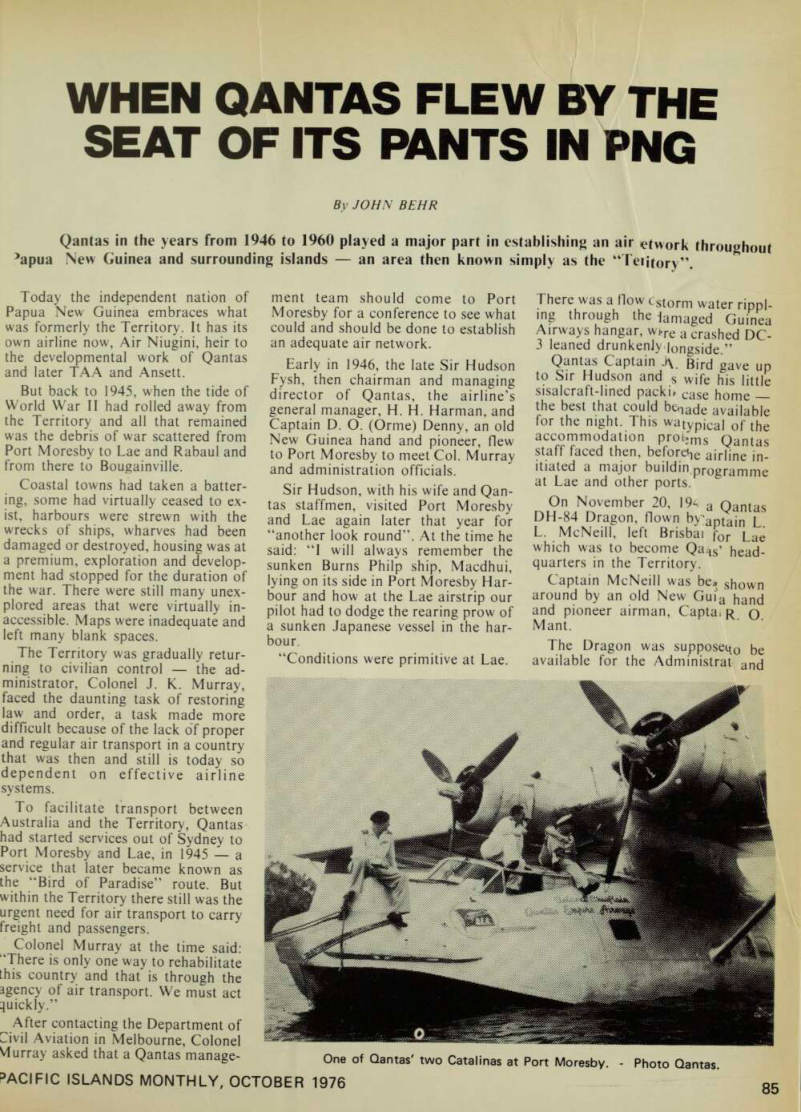
One of Qantas' two Catalinas at Port Moresby. Photo Qantas.
administration officials. It was at that time, probably the most luxuriously fitted aircraft seen in the Territory then still a primitive frontier-land. It had a fancy lining in the cabin, plush seats and carpets, curtains, even a wash-basin and other refinements.
Captain Mant was impressed with all the elegance, but less impressed with the performance of the Dragon, which had to be pushed hard to gain enough altitude to negotiate the “gaps” in the mountain ranges.
In 1946, at Lae, Qantas ground staff consisted ef the manager, Harold Hindwood, one traffic officer, two ground engineers and a cook. The airport terminal consisted chiefly of an area around a lamp-post at the edge of the airfield. The paol of light cast by the lamp allowed engineers to work on aircraft at night.
Captain McNeill was soon Joined by Captain F. S. Furniss with a se cond Dragon. There was a despeiate need for air transport to fly anythiig anywhere.
So out came all the fancy trim mings in the first Dragon Captain McNeill had flown to Lae. The air craft was stripped for action, ready for charter work.
The two captains flew charters for missions, planters, miners, surveying geologists, the Bulolo gold fields which had resumed production, and the Administration. They made supp ly drops to administration patrols, miners and explorers in areas where no airfields existed or were just being built.
Stripping the Dragon of all its trim mings must have been a bit of a blow to Murray and his staff. There was at certain levels at Port Moresby an at mosphere that would have fitted into a Somerset Maugham novel.
Former Minister for Territories, Paul Hasluck, (later Sir Paul) in his
latest book, A Time For Building, had this to say about his first visit to Port Moresby, after taking over as minister, in 1951 “The Administrator (at that time Colonel Murray) acted like a colonial Governor and was accorded the deference due to vice-regal rank which, in fact, he did not have.
“At his own residence, which to my surprise was called Government House, an aide-de-camp in uniform stood to attention when he moved from his chair.
“At public assemblies he was greeted with God Save the King. He flew the Union Jack on the flagstaff at his residence and on his car and when I asked why he did so, he said that was always the custom at Government Houses and the Australian Hag would not be appropriate.”
Q antas Captain A.J. Jacobson reported that runways in the Territory were short and narrow J- six or seven hundred yards long and about 40 yards wide. Some were at sea level 0116 W3S at 9000 ft more than half were at 5000 ft New G uine? pilots requ ired social training no matter how exten their expedience had been in other park of the world. They had to con tend vith unpredictable weather, lack of communications and navigational aids artf o/ten hostile terrain The Highlands had some' of the strang/t and trickiest airfields in the world) At some, pilots landed steepl uphill, parked at right angles
“43 £',o" X 3 h"„a
downlll for take-off. F Ratd as one of t}le most difficult stnpsfvas Tapini, in the mountains 65 nles north of Port MoreZ hacki I out of an unfriendly mountain slope y ~luunidm Pil ;s had to fly low down a valley
then make a left-hand turn for a one way approach. Once committed to land, there was no way back and no margin for error.
The eastern end of the runway was 150 ft lower than the one facing west.
Flying in the Territory then was visual that meant visual contact with the ground. Cloud banks had to be avoided. There was no night flying.
Qantas gradually built up its fleet as the demand for air transport grew.
By 1949, it had a fleet of six Dragons and five DC-3s and established a fly ing boat network operated with two Catalinas to provide coastal services and provide air links for the many islands, all part of the Territory.
Cargo carried by Qantas included food supplies, equipment, machinery, building materials, livestock and even explosives.
There was the odd unofficial piece of freight requested a Qantas Catalina pilot in his report for maintenance staff “please remove crocodile from forward bilge”.
There was a constant need for aerial supply drops in remote areas.
Qantas crews had become quite adept in dropping supplies with a 98% success rate. In fact they were so successful that Administration staff at Tari, north-western Papua, tried to “dream up something” the Qantas boys could not drop.
Finally, they asked Qantas crews to drop live poultry, hens and a rooster.
The method used was ingenious the hens and the rooster were placed into airline sickbags one at the top and one at the bottom. Around these were wrapped, loosely, rolls of toilet paper.
The Catalina flew low over the dropping site the wrappings were meant to protect the chooks from the slipstream. As the birds dropped, the bags and toilet paper were torn off.
But, by that time, they were low enough to flutter to the ground.
The hens arrived in good order with all feathers intact. The rooster’s “parachute” failed, but he made the dining table.
That was certainly not the only oc casion pilots had to improvise. Flying in New Guinea they had to be ver satile and entirely reliant on their own good judgment. Pilots in those days made out their own waybills and loadsheets, wrote out passenger tickets and took the money.
By 1952, Captain Orme Denny was back in New Guinea as area manager.
His task was to make the airline’s in ternal services more self-reliant and
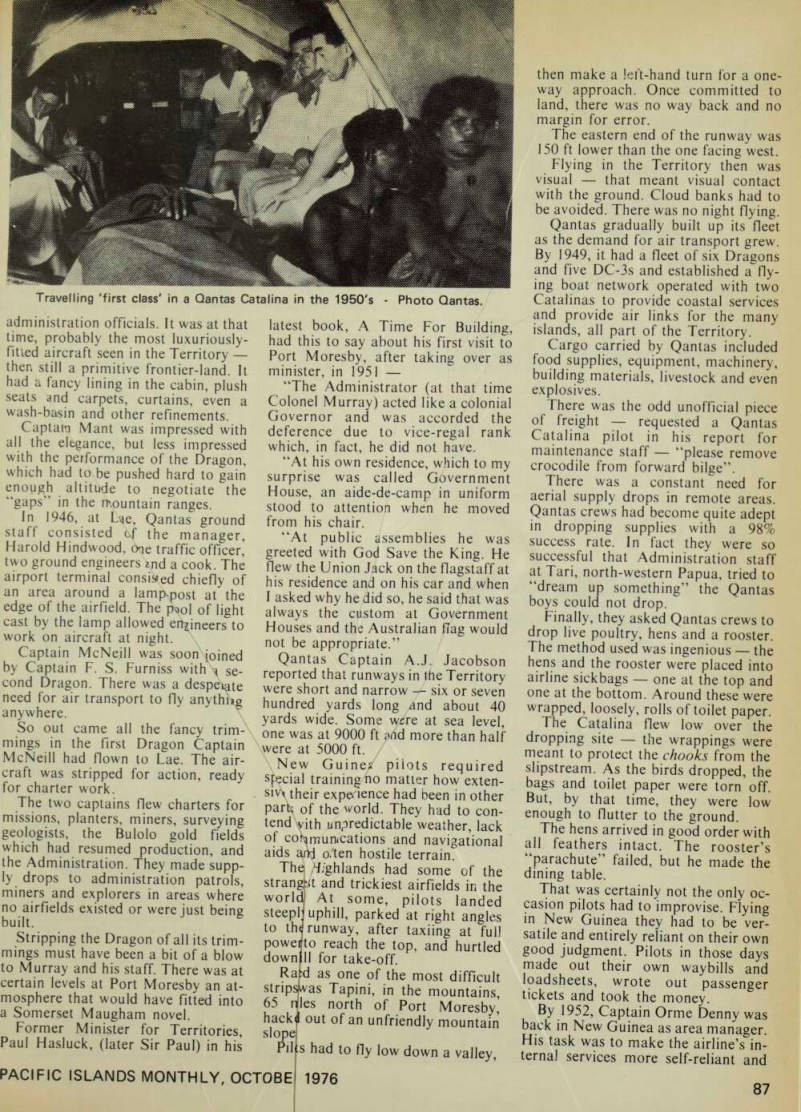
Travelling 'first class' in a Qantas Catalina in the 1950's Photo Qantas.
self-contained. His chief pilot was the legendary Captain W. (Forgie) rorgan-Smith.
The airline had a staff of 174 Europeans and a fleet of 14 aircraft, flying to more than 103 ports Qantas in that year carried 35,029 passengers.
The Administration had opened up more areas in a country that was in parts still very primitive, where customs and life style of the indigenes had no, changed for centuries, where tribal wars were still commonplace.
There was still pockets where canmbalism was practised.
But development moved much more rapidly. Qantas was able to provide more scheduled services, apart from charter flights, extending throughout the Territory (with extensive penetration in the Highlands).
Services were extended to the British Solomons and to what was then Dutch New Guinea.
Qantas did not expect to make much out of New Guinea in the way of profits its job was largely developmental. At the same time, its directors were concerned about the company’s insecurity of tenure in the Territory.
Later events showed that their concern was justified.
As sj r Hudson Fysh put it, in the latter 19505, when Senator Paltridge was Minister for Civil Aviation and the late D. G. Anderson (later Sir Donald) Director-General for Civil Aviation, increasing pressure was exerted by Ansett to enter the Territory.
Sir Hudson said. "That company t Ansett) had great hopes of extending overseas from Port Moresby to Hong Kong as they had inherited ANA shareholdings in Cathay Pacific Airways, based ,n Hong Kong.
“New Guinea had been a magnificent training ground for our young pilots before they entered on our main international routes and we fought hard against losing the New Guinea services.
“It seemed, as in other instances, that the government was determined to do something for Ansett-ANA, a company full of vigour and bent on expansion.
“However, there was the government’s two-airline policy to be reckoned with. Ansett-ANA could not go to New Guinea unless TAA did the same thing.
“It all ended with us losing the bat-
tie and the government deciding to relieve us of our services to and within New Guinea.”
Qantas was obliged to sell its territorial network, aircraft, equip ment, buildings and all other assets to TAA for £700,000 (about $1,400,000).
Ansett joined TAA in the Territory later through the take-over of Man dated Airlines.
In July 1960, both TAA and Ansett took over from Qantas the Australia to New Guinea Bird of Paradise ser vice. And at 6.30 am on September 1, of that year, Nanandai, a Papuan in Qantas service for many years, lowered the Qantas flag at Lae air port.
A few minutes later, the TAA flag was raised in its place as the airline’s first territorial service from Lae to Madang, Wewak, Manus, Kavieng and Rabaul was ready to take off.
The ceremony at Lae underlined the end of the last chapter of a unique period in Qantas’ long history. Uni que, because in Australia, Qantas had left behind its pioneering days in the 19205, while in the Territory after the war it had to start all over again, creating a frontier airline.