Tonga Tourist Group
pp. 71-73 · Read in the full issue
In Financial Trouble
The ailing Tonga Tourist and Development Company Ltd was plac ed in liquidation by order of the Supreme Court of Tonga in July. The company, which owns and operates the Port of Refuge International Hotel at Vava’u, the Tonga internal air service and a ground tour opera tion had been in financial difficulties for some time following the failure of its parent operation in Australia, Pacific Resorts Pty Ltd.
Following the hearing of a petition on behalf of another NSW company Fred Lee Pty Ltd, itself in liquidation,’ the court appointed Mr William J.
Hamilton, a chartered accountant of Sydney as provisional liquidator.
Mr Hamilton is preparing a scheme of arrangement for the ap proval of the Tonga Court whereby he will endeavour to dispose of the com pany’s assets as a going concern and be able to pay out its creditors in full.
He has taken charge of the company and is continuing to run both the Port of Refuge Hotel and the air service and has been instrumental in granting both a new lease of life.
The company was formed by two Australian businessmen, solicitor Mr R W. Moin and building contractor, Mr D. G. Sundin, together with two Tongan partners, Herbert and Ralph Sanft in 1970. Mr Sundin subsequent ly sold out his shareholding to the Mom family in 1974 and they, at the time of liquidation, held the majority t)f issued shares.
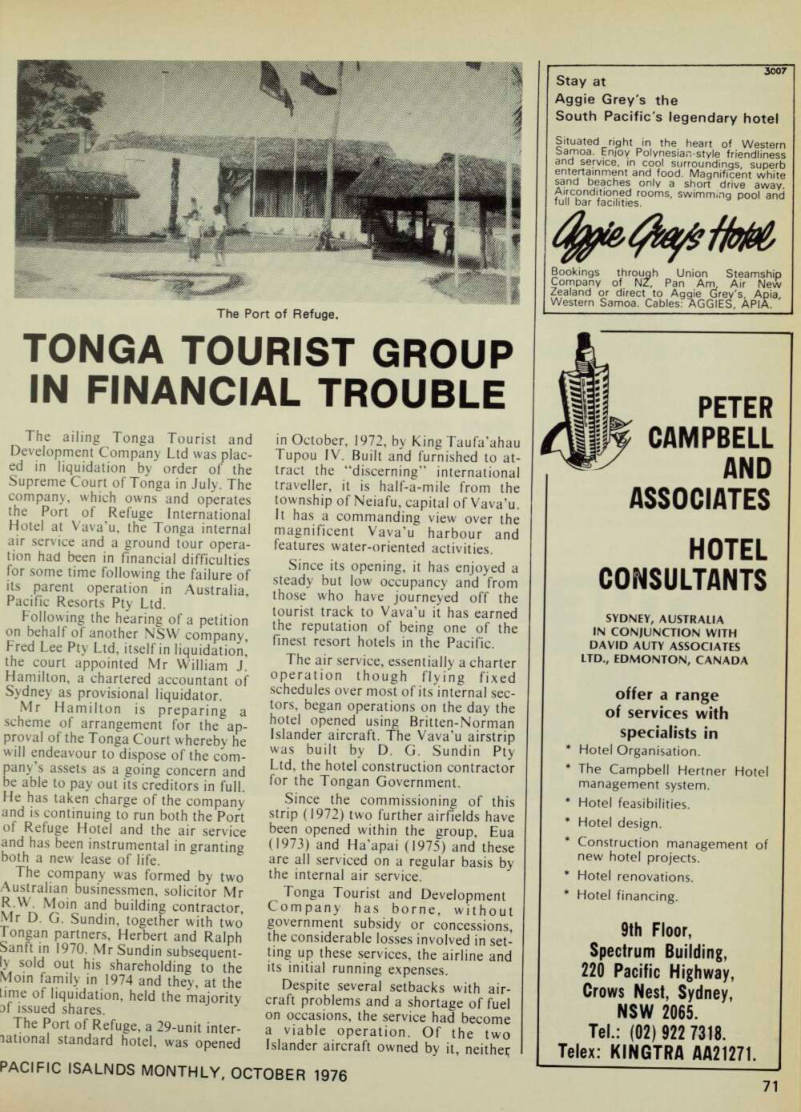
The Port of Refuge, a 29-unit inter lational standard hotel, was opened
in October, 1972, by King Taufa’ahau Tupou IV. Built and furnished to at tract the “discerning” international traveller, it is half-a-mile from the township of Neiafu, capital of Vava’u.
It has a commanding view over the magnificent Vava’u harbour and features water-oriented activities.
Since its opening, it has enjoyed a steady but low occupancy and from those who have journeyed off the tourist track to Vava’u it has earned the reputation of being one of the finest resort hotels in the Pacific.
The air service, essentially a charter operation though flying fixed schedules over most of its internal sec tors, began operations on the day the hotel opened using Britten-Norman Islander aircraft. The Vava’u airstrip was built by D. G. Sundin Pty Ltd, the hotel construction contractor for the Tongan Government.
Since the commissioning of this strip (1972) two further airfields have been opened within the group, Eua (1973) and Ha’apai (1975) and these are all serviced on a regular basis by the internal air service.
Tonga Tourist and Development Company has borne, without government subsidy or concessions, the considerable losses involved in set ting up these services, the airline and its initial running expenses.
Despite several setbacks with air craft problems and a shortage of fuel on occasions, the service had become a viable operation. Of the two Islander aircraft owned by it, neither
The Port of Refuge.
is flying at present and the service is being maintained by a leased Piper Aztec. One Islander developed fuel problems while on a test flight and was force-landed on a somewhat remote beach on Tongatapu where h remained for the several months it took to construct an access road to the site to enable it to be recovered overland.
This aircraft, though still in flying condition, is grounded at Fua’amotu airport awaiting inspection and recer tification.
The second Islander was totally destroyed in December, 1975, after being stolen and crashed by two Tongans who, under the influence of alcohol, forced access to it and, after managing to start the engines, attempted to fly it.
The provisional liquidator is con tinuing to run the air-service normally and has entered into negotiations with two major companies involved with airline operations. However, any arrangement made by him would be subject to the agreement of the Tonga Government, which has been procrastinating for years over the sub ject of airlines, services and air rights involving Tonga.
Tonga Tourist and Development
Company also had the rights to build a further hotel on the main island of Tongatapu. A site at Ha’atafu, a beach area some 13 miles from the capital, Nuku’alofa, had been leased and plans approved for a 160-room development.
Site work initiated in late 1974 was suspended before prime construction could commence. As there was a per formance covenant as a condition of the lease on this site it will now probably revert to the Tonga Tourist Authority, under whose control the lease was placed.
Whatever the outcome of the air service negotiations and entering the Port of Refuge for sale, it is hoped that the provisional liquidator can keep both these valuable assets to the kingdom and tourism operating for the benefit of all concerned.
Meat merger
to cut PNG imports
New Guinea Industries Pty Ltd, the big Morobe cattle producer, and the province’s biggest manufacturer of meat products, Sylvan Smallgoods (NG) Pty Ltd have merged.
Aim of the merger, according to
NGLs managing director, Mr William McLellan, is to replace im ported meat products on the Papua New Guinea market as soon as possi ble.
The new company has its eyes par ticularly on Bougainville, PNG’s ma jor smallgoods market, and on the huge potential market in the Highlands.
The merger gives the PNG Invest ment Corporation an equity in Sylvan for the first time through the equity it already holds in NGI.
PNG’s Development
Bank forges ahead
Steady progress in localisation was the dominant theme of an August press release on the past year’s ac tivities of the Papua New Guinea Development Bank.
Among points noted in the release by the managing director, Mr Alan Redman, and PNG’s Minister for Finance, Mr Julius Chan, are the following: • A higher proportion of the bank’s loan money went to Papua New Guineans than ever before K 7.2 million, compared with K 5.8
million the previous year. Two years ago, the amount lent by the bank to Papua New Guineans was only 40% of its total lending; this year it had been 66% of a greater total amount; • The average size of loans to Papua New Guineans rose from K2,- 677 the year before to K 4,115, in dicating a trend to the ownership by nationals of larger enterprises. These were mainly in rural commercial ac tivities, such as hotels, wholesale and retail trade, transport, boats and some manufacturing enterprises; • Localisation of staff rose from 79% to 83%, and, • Loans for agricultural develop ment totalled K 2 million, the highest for any year except 1971-72 when the total was boosted by loans for oil palm.
Summing up, Mr Chan said; “The Development Bank has now become self-sufficient, and will continue to assist the people without the necessity of further capital grants from the government in the immediate future.
This will increase the funds available to the government for other develop ment purposes.
“The Development Bank has now loaned K6O million for the develop ment of PNG. I congratulate its staff on this year’s performance.’’
Bad news for
Fiji tourism
Australian tourist traffic to Fiji -ould be hard hit by new cut-price air fares to the United States announced by Qantas.
From December, Australians will be able to buy a 16-day package holi day in America for $B9O. Current iconomy return fare is $1,370.
The Australian airline said it hoped he new fares would boost its present )assenger loadings to the States by as nuch as 55%.
It has also said it plans later in the 'ear to make similar cuts in fares to iouth-East Asia and Europe.
At talks in January, the Fiji Government rejected Qantas )roposals for a revision of package toliday fares as being against the in erests of Fiji’s tourism at that time.
Qantas officials visited Suva in July to eopen talks with the government on he subject. • A bright spot! Towards the end of lugust, Qantas flew 1162 people to Fiji, the lost the airline has ever flown to a single estination in one day.
Nauru has
its own bank
Nauru’s national bank, the Bank of Nauru, is expected to open its doors on October 1. This was announced in the Nauru Parliament in August by President Hammer Deßoburt. He said the new bank, whose establish ment follows lengthy discussions with senior representatives of the Bank of New South Wales and the Australian Government, will be a commercial rather than a reserve or central bank.
The President said agreement had been reached with the Australian representatives for the continued use of Australian currency in the republic after the bank begins operations.
PNG-Indonesian
trade link
Now that Papua New Guinea and In donesia had established firm diplomatic relations, it was logical to negotiate a bilateral trade agreement as soon as possi ble in the view of Mr R. B. Thureehl, presi dent of the Port Moresby Chamber of Commerce. Mr Thureehl, returning after a week in Jakarta, said he was surprised to
note the number of companies there producing goods, which PNG imported from Japan, Hong Kong, the UK and the Continent. He was also surprised to 11 nd that Indonesia imported coconut seedlings, coffee, cocoa and lea, which were the main products of PNG, from elsewhere.
Mr Thurechl said it was obvious the two countries could help each other. To make trade easier, however, Indonesia would need to ease import restrictions.
The PNG Ambassador to Indonesia, Mr R. V. Kumaina, said PNG might be in terested in importing Indonesian textiles as Indonesian products were relatively cheaper than those of other countries.
Ok Tedi may
rival Bougainville
The Ok Tedi in the remote Star Moun tains ol Papua New Guinea, may be belter than Bougainville Copper s mine at Panguna. The directors of the Government-owned Ok Tedi Development Co reported recently the Ok Tedi ore averages 0.75 per cent sulphide copper (0.85 per cent total copper), 0.012 per cent molybdenum and 0.653 grams of gold a tonne. In comparison, the Bougainville Copper mine contained about 840 million tonnes of ore averaging 0.46 per cent