Under Lonely Valley'
pp. 67-69 · Read in the full issue
Business
A Nation’S Heart Beats
On the small field in the centre of the township a handful of young men play
touch rugby.
A few Tolais from the Gazelle, a sprinkling of Papuans from Marshall Lagoon area, one or two Highlanders, a couple of Morobes.
Their tee-shirts carry the emblem,
“Lonely Valley Sports Club”.
The place is Yonki Township, support centre for the Upper Ramu Hydro-electric Scheme, in the Ramu River valley of the Eastern Highlands. The time is early 1976, the valley is again lonely, the future of Yonki township is uncertain, and by 7 o clock at night the only sounds come from the nearby Highlands Highway.
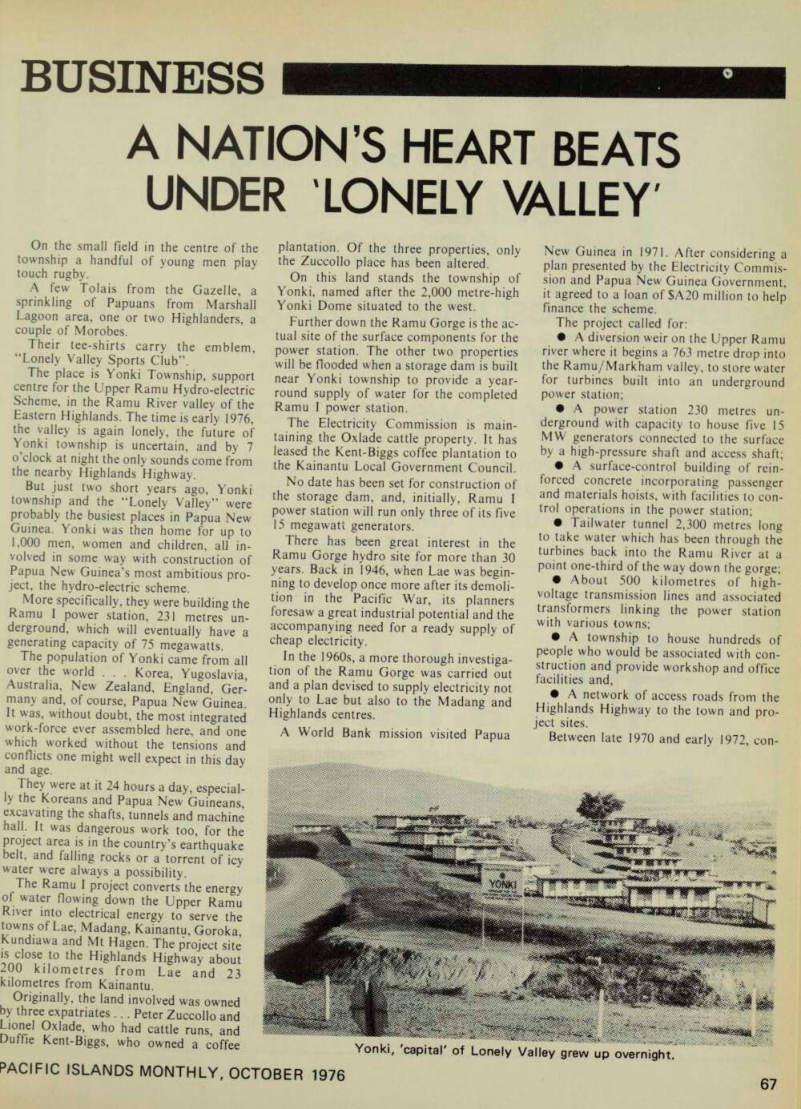
But just two short years ago, Yonki township and the “Lonely Valley” were probably the busiest places in Papua New Guinea. Yonki was then home for up to 1,000 men, women and children, all in volved in some way with construction of Papua New Guinea’s most ambitious pro ject, the hydro-electric scheme.
More specifically, they were building the
Ramu I power station, 231 metres un derground, which will eventually have a generating capacity of 75 megawatts.
The population of Yonki came from all over the world . . . Korea, Yugoslavia Australia, New Zealand, England, Ger many and, of course, Papua New Guinea.
It was, without doubt, the most integrated work-force ever assembled here, and one which worked without the tensions and conflicts one might well expect in this day and age.
They were at it 24 hours a day, especial ly the Koreans and Papua New Guineans excavating the shafts, tunnels and machine hall. It was dangerous work too, for the project area is in the country’s earthquake belt, and falling rocks or a torrent of icy water were always a possibility.
The Ramu I project converts the energy of water flowing down the Upper Ramu River into electrical energy to serve the towns of Lae, Madang, Kainantu, Goroka Kundiawa and Mt Hagen. The project site is close to the Highlands Highway about 200 kilometres from Lae and 23 kilometres from Kainantu.
Originally, the land involved was owned by three expatriates .. . Peter Zuccollo and uonel Oxlade, who had cattle runs, and Duffie Kent-Biggs, who owned a coffee
plantation. Of the three properties, only the Zuccollo place has been altered.
On this land stands the township of Yonki, named after the 2,000 metre-high Yonki Dome situated to the west.
Further down the Ramu Gorge is the ac tual site of the surface components for the power station. The other two properties will be flooded when a storage dam is built near Yonki township to provide a year round supply of water for the completed Ramu I power station.
The Electricity Commission is main taining the Oxlade cattle property. It has leased the Kent-Biggs coffee plantation to the Kainantu Local Government Council.
No date has been set for construction of the storage dam, and, initially, Ramu I power station will run only three of its five 15 megawatt generators.
There has been great interest in the Ramu Gorge hydro site for more than 30 years. Back in 1946, when Lae was begin ning to develop once more after its demoli tion in the Pacific War, its planners foresaw a great industrial potential and the accompanying need for a ready supply of
cheap electricity.
In the 19605, a more thorough investiga tion of the Ramu Gorge was carried out and a plan devised to supply electricity not only to Lae but also to the Madang and
Highlands centres.
A World Bank mission visited Papua
New Guinea in 1971. After considering a plan presented by the Electricity Commis sion and Papua New Guinea Government, it agreed to a loan of SA2O million to help finance the scheme.
The project called for: • A diversion weir on the Upper Ramu river where it begins a 763 metre drop into the Ramu/Markham valley, to store water for turbines built into an underground power station; • A power station 230 metres un derground with capacity to house five 15 MW generators connected to the surface by a high-pressure shaft and access shaft; • A surface-control building of rein forced concrete incorporating passenger and materials hoists, with facilities to con trol operations in the power station; • Tailwater tunnel 2,300 metres long to take water which has been through the turbines back into the Ramu River at a point one-third of the way down the gorge; • About 500 kilometres of high voltage transmission lines and associated transformers linking the power station with various towns; • A township to house hundreds of people who would be associated with con struction and provide workshop and office facilities and, • A network of access roads from the Highlands Highway to the town and pro ject sites.
Between late 1970 and early 1972, con-
Yonki, capital' of Lonely Valley grew up overnight.
tracts for these individual projects were awarded. First on the job was Lucas and Ducrow, a Lae-based company, who had the K 170,000 contract for access and town roads. They were soon joined by another locally-based enterprise, Morobe Constructions, with a contract to build of fices, a mess hall and canteen, single of ficers quartersT a school and general domestic housing at a cost of K 1.3 million.
By the time the main contract for civil works including the diversion weir, pressure and access shafts, underground power station, tailwater tunnel and surface control building had been awarded to the South Korean company, Hyundai Constructions, the “Lonely Valley” had
changed.
The Koreans had K 13.1 million to spend and lost no time in making the valley echo to the din of their heavy equipment. They came with years of experience from similar projects in remote and mountainous parts of South-east Asia and took to the precipitous gorge country like fish to water.
Their fearless tunnelling and digging in the shafts and tailwater tunnel also raised many an experienced eyebrow. Many times during the 12 months it took to com plete the tailwater tunnel, drilling teams were literally washed from their platforms as tonnes of water broke through from sink holes in the mountains above them.
It is remarkable that there was only one life lost during the whole six-year duration of the initial phase of the project.
After the Koreans came two groups of Australians who had won contracts for the construction of the Ramu switchyard and zone substations and for erection of towers and transmission lines to connect the pro ject with Lae, Madang, Kainantu, Goroka, Kundiawa and Mt Hagen.
Between them, the two contractors, T.A. Mellen Pty Ltd and Electric Power Transmission Pty Ltd, both of Sydney, handled contracts worth K 7.4 million and provided what could become one of the most vital links in Papua New Guinea.
Finally, when the Koreans had almost finished their part of the project, the
Yugoslavian firm, Progress International,
arrived with their intricate turbines, generators and alternators which had been specially manufactured in Europe to fit into the overall design of the underground power station.
Their contract was worth K 2.75 million and will not be completed until all.three 15 MW generators in the initial phase of the project are installed, tested and working to perfection.
The Yugoslavs are hard at work on the last of three generators and should have it ready for commissioning by the end of this year.
Only three Koreans are there now, a
rearguard to tie up any loose ends affecting their contract.
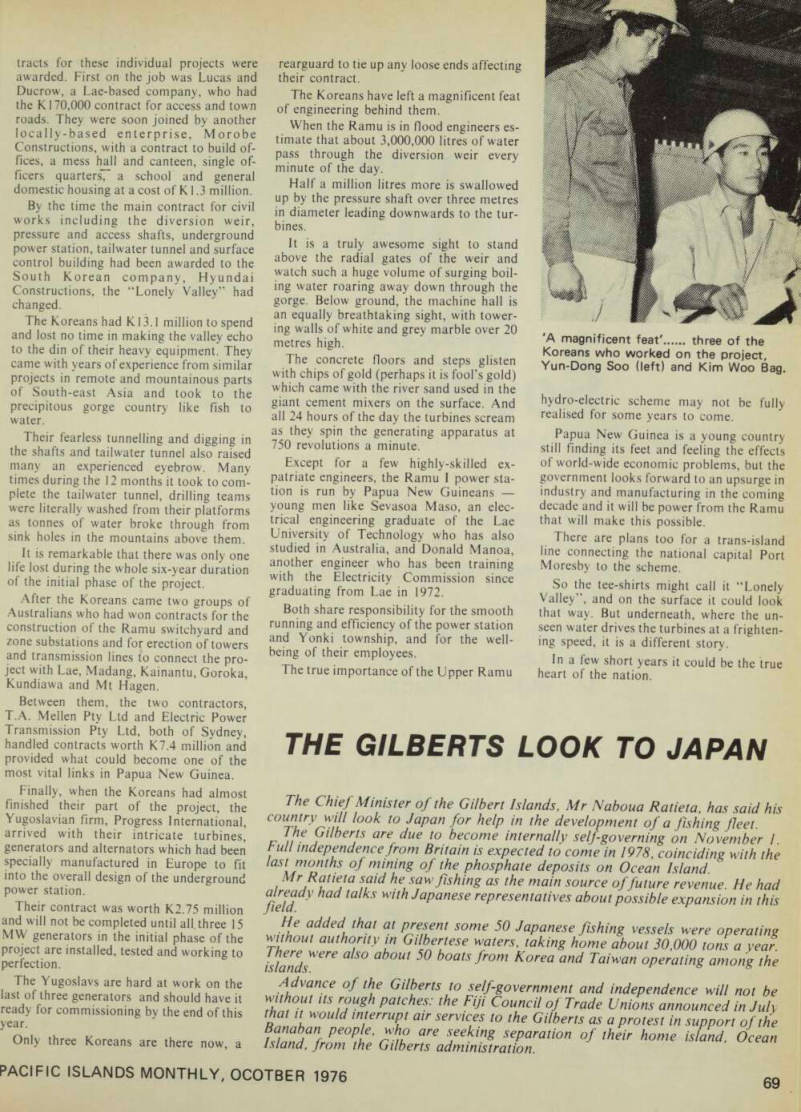
The Koreans have left a magnificent feat of engineering behind them.
When the Ramu is in flood engineers es timate that about 3,000,000 litres of water pass through the diversion weir every minute of the day.
Half a million litres more is swallowed up by the pressure shaft over three metres in diameter leading downwards to the tur bines.
It is a truly awesome sight to stand above the radial gates of the weir and watch such a huge volume of surging boil ing water roaring away down through the gorge. Below ground, the machine hall is an equally breathtaking sight, with tower ing walls of white and grey marble over 20 metres high.
The concrete floors and steps glisten with chips of gold (perhaps it is fool’s gold) which came with the river sand used in the giant cement mixers on the surface. And all 24 hours of the day the turbines scream as they spin the generating apparatus at 750 revolutions a minute.
Except for a few highly-skilled ex patriate engineers, the Ramu I power sta tion is run by Papua New Guineans young men like Sevasoa Maso, an elec trical engineering graduate of the Lae University of Technology who has also studied in Australia, and Donald Manoa, another engineer who has been training with the Electricity Commission since graduating from Lae in 1972.
Both share responsibility for the smooth running and efficiency of the power station and Yonki township, and for the well
being of their employees.
The true importance of the Upper Ramu
hydro-electric scheme may not be fully realised for some years to come.
Papua New Guinea is a young country still finding its feet and feeling the effects of world-wide economic problems, but the government looks forward to an upsurge in
industry and manufacturing in the coming
decade and it will be power from the Ramu that will make this possible.
There are plans too for a trans-island line connecting the national capital Port Moresby to the scheme.
So the tee-shirts might call it “Lonely Valley”, and on the surface it could look that way. But underneath, where the un seen water drives the turbines at a frighten ing speed, it is a different story.
In a few short years it could be the true heart of the nation.
'A magnificent feat'... three of the Koreans who worked on the project, Yun-Dong Soo (left) and Kim Woo Bag.