Another PNG birthday
pp. 39-40 · Read in the full issue
Scouting’s 50 years old
By TONY REED, Deputy Chief Scout Commissioner for Papua New Guinea.
Fifty years were swept away in August when an ageing but, nevertheless, agile missionary got together with four or five of his “old boys” at the Skaut Hegogo in Port Moresby.
Percy Chatterton, long-time resi dent of Papua New Guinea, along with over a thousand scouts camped at more than half a dozen centres, was celebrating the 50th Anniversary of Scouting in that country.
This large, extended family had been joined by 29 brother scouts from Australia who had travelled to Papua New Guinea to take part in the week long 50th Anniversary celebrations.
Percy was noticeably touched by the big BRAVO given him by the Moresby scouts as the founder of Scouting in Papua New Guinea and the leader of the first troop in Hanuabada in 1926.
A few days earlier in an interview on the NBC, he had recalled to Joe Kivori, a present-day Scout Head quarters Commissioner, the problems that confronted that first troop back in 1926.
Camping in those days was to “get on a truck with all the gear and drive there” affair as it is today, but a solid walk with all the rations and other paraphernalia from Port Moresby to the Laloki River and back again when it was all over.
“Mums”, it appears, were just as worried in those days for the welfare of their children as they are today and did not allow the youngsters to ac company their older brothers on this new-fangled thing called a scout camp.
Winking lights across Port Moresby harbour at night were not the flashing eyes of some departed spirit but young scouts practising their morse signalling, an exercise that later proved invaluable as an en
tree to the Australian signals units during World War 11.
Back to the present day. On the first Sunday of the camp, after the Chief Scout, Sir John Guise, had officially opened the Skaut Hegogo over the national radio network, the scouts themselves were able to speak to other scouts all over Papua New Guinea.
Amateur radio “hams” who in most cases had set up their equipment at the camp sites, made Teh transceivers available to the boys so they could swap names, troops, activities and stories with their counterparts in other centres.
Scouts in Madang told scouts in Lae and Port Moresby how they had to rush off and tie down their tents as they were in imminent danger of being blown away by strong winds that were blowing through the camp.
Scouts in Kerema and Rabaul chatted with wantoks in each other’s camps bringing the whole Skaut Hegogo together as a truly national event -
The term Skaut Hegogo was coined as a local equivalent of the world famous “jamboree”, Skaut being the Pidgin word for Scout and Hegogo. a Motu word meaning gathering or meeting. Thus Skaut Hegogo, scout meeting or jamboree, p , iniiy r u l>
New fl!!! .? be,r l? Papua
terrain the corn municdtlons network and straight-out
Wettow N^V’ 1 T°T
„L\° e Joint™ in Li b ? rCC ° T the ountry m one centre.
National Headquarters hit on the idea of holding a number of separate camps simultaneously and trying to co-ordinate at least some of the ac tivities so that at certain times all the scouts were taking part in the same thing.
Thus, on the opening day, after the official opening by the Chief Scout, the radio link-up provided the first in tegratmg activity. Later in the week all camps held Hegogo games so that scouts at Kimbe should have been
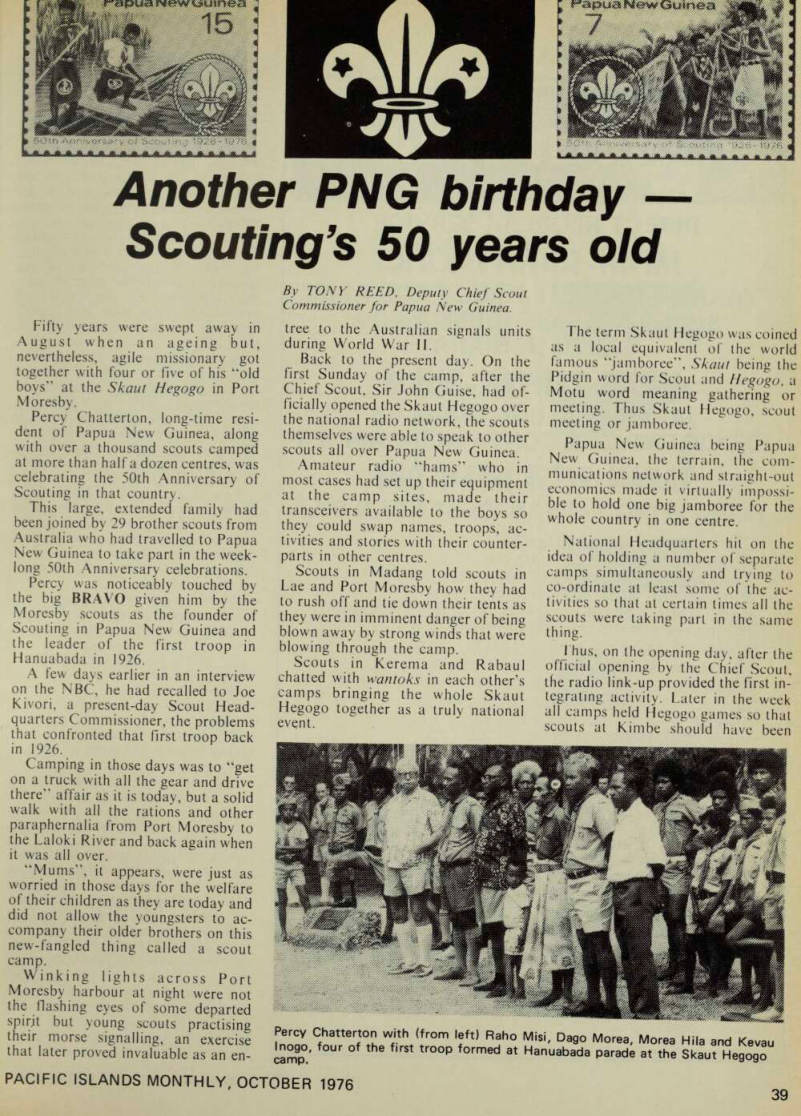
P ercy Chatterton with(fromleft) Raho Misi,Dage Morea Hila and Kevau Inogo, four fo the first troop formed at Hanuabada parade at the Skaut Hegogo camp
competing in the same events as those at Goroka or Rabaul.
A national campfire, an off-site day and an open-day when parents, friends and anybody who was in terested were invited to come along, were all part of the activities. They looked at the camps and watched special demonstrations, and it all helped to make the week a great success.
At many camps the culminating event was the burial of a time capsule.
In Port Moresby, apart from documents, papers and other present day artefacts, all the names of present-day scouts were also buried, hopefully, to be resurrected in the year 2000!
Apart from the Skaut Hegogo, a number of other activities are planned during the coming 12 months to emphasise this 50th year of Scouting.
A national church parade will be held later in the year and it’s a fair bet that, possibly, the largest congregation will be seen at the church in Hanuabada where it all started.
The Posts and Telecom munications Department have issued special 50th anniversary com memorative stamps in 7 and 15 toea denominations. These are bound to become collectors’ items amongst scout philatelists.
A special anniversary badge has been issued and all scouts in PNG will be allowed to wear it for this 50th year.
So much for the first 50 years.
What of the future?
Papua New Guinea is a young country. Young in as much as it recently attained independence. But more important it has a young pop ulation over 50% under 20 years of age.
Many people are looking to organisations like the Scout and Guide associations to provide a meaningful contribution to the train ing and direction of youth.
Not the least of these is the Gover nor-General, Sir John Guise, who has accepted the warrant of Chief Scout.
Already he has instigated action to set up youth-training projects and is publicly encouraging both govern ment and the private sector to put their money and their resources where their mouth is and stop talking about how someone else must do something for the youth of the country and get down and do it.
With this kind of support the next 50 years of Scouting is assured.