Wigs’-Or Should Judges
pp. 20-21 · Read in the full issue
Be Hair-Conditioned...
The Chief Justice is reported to have said that the wearing of such robes and headgear was of "long-standing custom" and as such would not be changed during his term of office; when a national Chief Justice is ap pointed it will be up to him to decide whether the custom will be continued or not. A good judgment, if I may say so, and I am sure that my friend Sir Sidney will not mind if I put him right on one point, for the wearing of legal wigs is by no means a long-standing custom in Papua New Guinea.
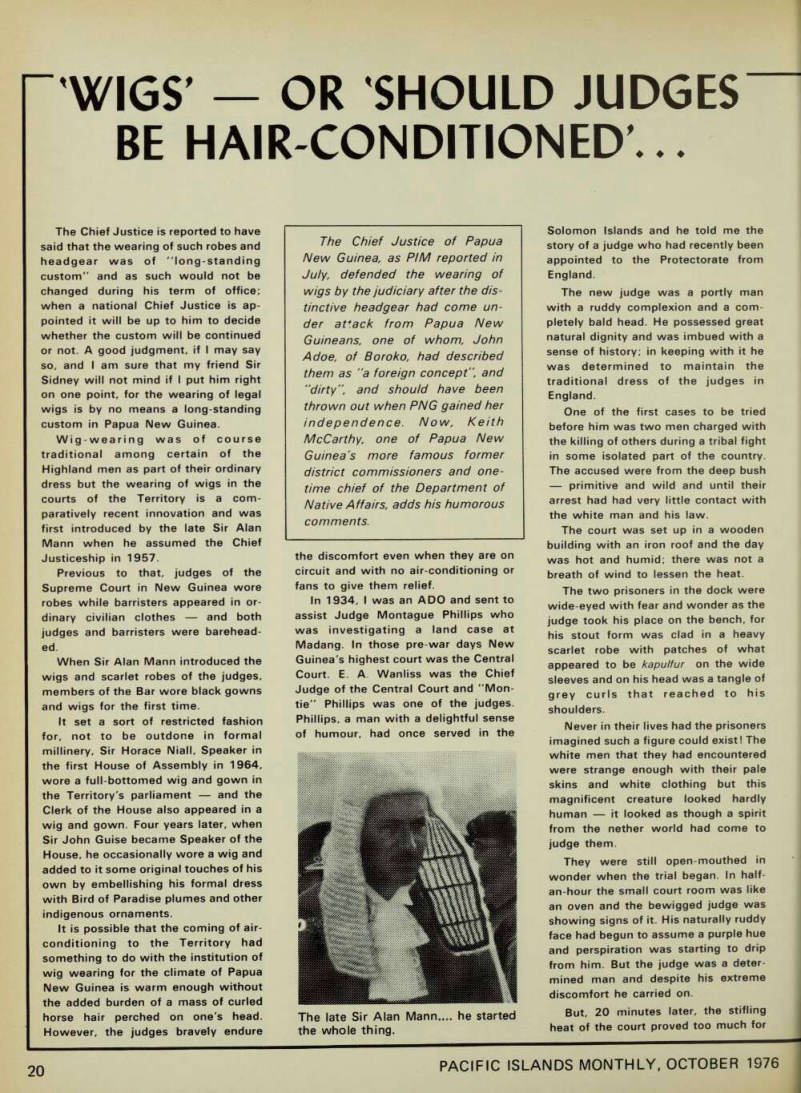
Wig-wearing was of course traditional among certain of the Highland men as part of their ordinary dress but the wearing of wigs in the courts of the Territory is a com paratively recent innovation and was first introduced by the late Sir Alan Mann when he assumed the Chief Justiceship in 1957.
Previous to that, judges of the Supreme Court in New Guinea wore robes while barristers appeared in or dinary civilian clothes and both judges and barristers were barehead ed.
When Sir Alan Mann introduced the wigs and scarlet robes of the judges, members of the Bar wore black gowns and wigs for the first time.
It set a sort of restricted fashion for, not to be outdone in formal millinery. Sir Horace Niall, Speaker in the first House of Assembly in 1964, wore a full-bottomed wig and gown in the Territory's parliament and the Clerk of the House also appeared in a wig and gown. Four years later, when Sir John Guise became Speaker of the House, he occasionally wore a wig and added to it some original touches of his own by embellishing his formal dress with Bird of Paradise plumes and other indigenous ornaments.
It is possible that the coming of air conditioning to the Territory had something to do with the institution of wig wearing for the climate of Papua New Guinea is warm enough without the added burden of a mass of curled horse hair perched on one's head.
However, the judges bravely endure
The Chief Justice of Papua New Guinea, as PIM reported in July, defended the wearing of wigs by the judiciary after the dis tinctive headgear had come un der attack from Papua New Guineans, one of whom, John Adoe, of Boroko, had described them as "a foreign concept", and "dirty", and should have been thrown out when PNG gained her independence. Now, Keith McCarthy, one of Papua New Guinea's more famous former district commissioners and one time chief of the Department of Native Affairs, adds his humorous comments.
the discomfort even when they are on circuit and with no air-conditioning or fans to give them relief.
In 1934, I was an ADO and sent to assist Judge Montague Phillips who was investigating a land case at Madang. In those pre-war days New Guinea's highest court was the Central Court. E. A Wanliss was the Chief Judge of the Central Court and "Mon tie” Phillips was one of the judges.
Phillips, a man with a delightful sense of humour, had once served in the
Solomon Islands and he told me the story of a judge who had recently been appointed to the Protectorate from England.
The new judge was a portly man with a ruddy complexion and a com pletely bald head. He possessed great natural dignity and was imbued with a sense of history; in keeping with it he was determined to maintain the traditional dress of the judges in England.
One of the first cases to be tried before him was two men charged with the killing of others during a tribal fight in some isolated part of the country.
The accused were from the deep bush primitive and wild and until their arrest had had very little contact with the white man and his law.
The court was set up in a wooden building with an iron roof and the day was hot and humid; there was not a breath of wind to lessen the heat.
The two prisoners in the dock were wide-eyed with fear and wonder as the judge took his place on the bench, for his stout form was clad in a heavy scarlet robe with patches of what appeared to be kapulfur on the wide sleeves and on his head was a tangle of grey curls that reached to his shoulders.
Never in their lives had the prisoners imagined such a figure could exist! The white men that they had encountered were strange enough with their pale skins and white clothing but this magnificent creature looked hardly human it looked as though a spirit from the nether world had come to judge them.
They were still open-mouthed in wonder when the trial began. In half an-hour the small court room was like an oven and the bewigged judge was showing signs of it. His naturally ruddy face had begun to assume a purple hue and perspiration was starting to drip from him. But the judge was a deter mined man and despite his extreme discomfort he carried on.
But, 20 minutes later, the stifling heat of the court proved too much for
The late Sir Alan Mann... he started the whole thing.
his iron will. A witness was in the mid dle of his evidence when his Honour's complexion was seen to take on the colour of a ripe plum and he suddenly collapsed face forward on the bench.
As he fell forward he made one last desperate gesture and with a sweep of his arm brushed the full-bottomed wig from his head. There, the unfortunate judge lay revealing a bald head that glistened with sweat.
They brought water to revive him and then had to bring more to revive the two prisoners they were used to sudden death but this was the first time they had seen a man scalp himself.
I don't know whether this BSI inci dent had anything to do with it but after the Japanese War, when Sir Montague Phillips became Chief Justice of Papua New Guinea, he never wore a wig.
Personally, I'm rather in favour of
wigs and gowns, for like most of the people of the Territory I think a bit of bi/as relieves the drabness of modern life. But I have no doubt that the or dinary village man who finds himself in the dock must wonder what is going on when he is suddenly confronted by a man dressed in the fashion of several centuries before. To some it must be
terrifying.
As I have said, wigs and gowns in PNG started less than 20 years ago but so far as I know such things as buckled shoes and knee-breeches have not yet been worn by judges. And I've never noticed any nosegays being placed on the bench to purify the air although the closeness of the atmosphere in some of the Territory's courts must at times equal that of the Old Bailey.
As Sir Sidney Frost remarked, it will be up to the national Chief Justice to decide such things when he is ap pointed.
•♦ • No, says Fiji’s Speaker
The Speaker of Fiji’s House of
Representatives, Sir Vijay Singh,
appeared wigless in Parliament for the first time one day in August.
Sir Vijay had decided to doff his wig "hot, itchy and deafening," he called it and following a debate in the House the day before in which opposition member, Mrs Irene Jai Narayan, had attacked wig wearing on grounds of both comfort and cost.
She said lawyer friends had told her the wigs they were forced to wear in court were hot and humid in the Fiji climate. Other former British colonies that had kept the British parliament and judicial system had done away with wigs, so why didn't Fiji?
Mrs Narayan said she was amaz ed to learn what it cost to fit a judge with a wig SF76O for one of the full-bottomed variety, plus case, and SF29O for a bench wig.
She added that perhaps wigs might be kept for purely ceremonial occasions because they did, after all, "look very nice".
But government back-bencher Mr Kishore Govind, a lawyer, vowed he
would defend wig-wearing to the last. Wigs were not just decoration; they spelt dignity and did much to create the court's atmosphere of authority.
Do away with wigs, and lawyers would be turning up to court in bu/a shirts and flip-flops," he warned.
The Prime Minister, Ratu Sir Kamisese Mara, said he went along with Mrs Narayan. He was happy that MPs could now take off their coats in the House on a hot day, and looked forward to the time when they could take off their ties as well.
The Speaker's decision to act un ilaterally and leave his wig off has no doubt lent strength to Fiji's anti-wig lobby in the continuing argument.
But a due to the long-term out come of the battle was provided by opposition MP Mr Karam Ramrakha, who is also a lawyer. During the debate Mr Ramrakha pointed out that not only were wigs dearer now than ever before, they were also of poorer quality. This was because wig-making was "a dying craft".
Only one company in Britain was still
making them.