Problems Of Young Nations
pp. 17-18 · Read in the full issue
An Academic Look At Some
By W. G. Coppell
The Young Nations Conference, with its theme of Research and Development Planning in the South Pacific, was held at the University of New South Wales over five days late in August, and in its wake it left a trail of questions, the solution of which are of vital concern for the peoples of the Pacific Islands.
It also posed a series of queries, which must now tax the thinking of non-Pacific Islanders, who feel that they have something to contribute to the advancement of the Pacific nations and their peoples.
Now, let’s make no bones about it, this was in all its essentials an academic conference, and with it came all those aspects of academic conferences are the discussions to be concerned with conceptual matters? Are the spin-off products of secondary importance? Are the in terests of academia to take a prime position?
This conference was organised by the School of Sociology at the univer sity, with the financial support of a whole bank of funding organisations, the Australian Board of Missions, the Australian Council of Churches Australian Catholic Relief, Com munity Aid Abroad, Foundation for the Peoples of the South Pacific, Freedom from Hunger-Action Development, and the Wenner-Gren Foundation for Anthropological Research.
It was a well-presented conference, the papers were published and presented with panache and a con siderable amount of money must have been -spent on bringing to Sydney and accommodating something like 30 people from the various Pacific coun tries.
And now, the point must be made what was the rationale behind call ng the conference? The preceding 3ublicity seems to have been directed at a restricted audience. It would appear odd that the organisers did not eel that it was appropriate to bring to he attention of those interested in ;Uch an important topic, that the con erence was to be held. No advance
notice of the conference appeared in such well-circulated serials as the South Pacific Bulletin, or PIM. It also seems clear that a number of peo ple working in the Pacific, both in digenous and expatriate, were either reluctant participants, or declined to attend. It was almost at the opening of proceedings that Esiteri Kamikamica, of Fiji, challenged the organisers to explain the reasoning behind the bringing together of the people present.
She asked why the Islands people had been brought to Sydney, when most of them had previously had the pleasure of visiting Australia, and she wanted to know why the structure of the proceedings seemed to deny to the participants an atmosphere in which a face-to-face dialogue might take place in the “Pacific way”.
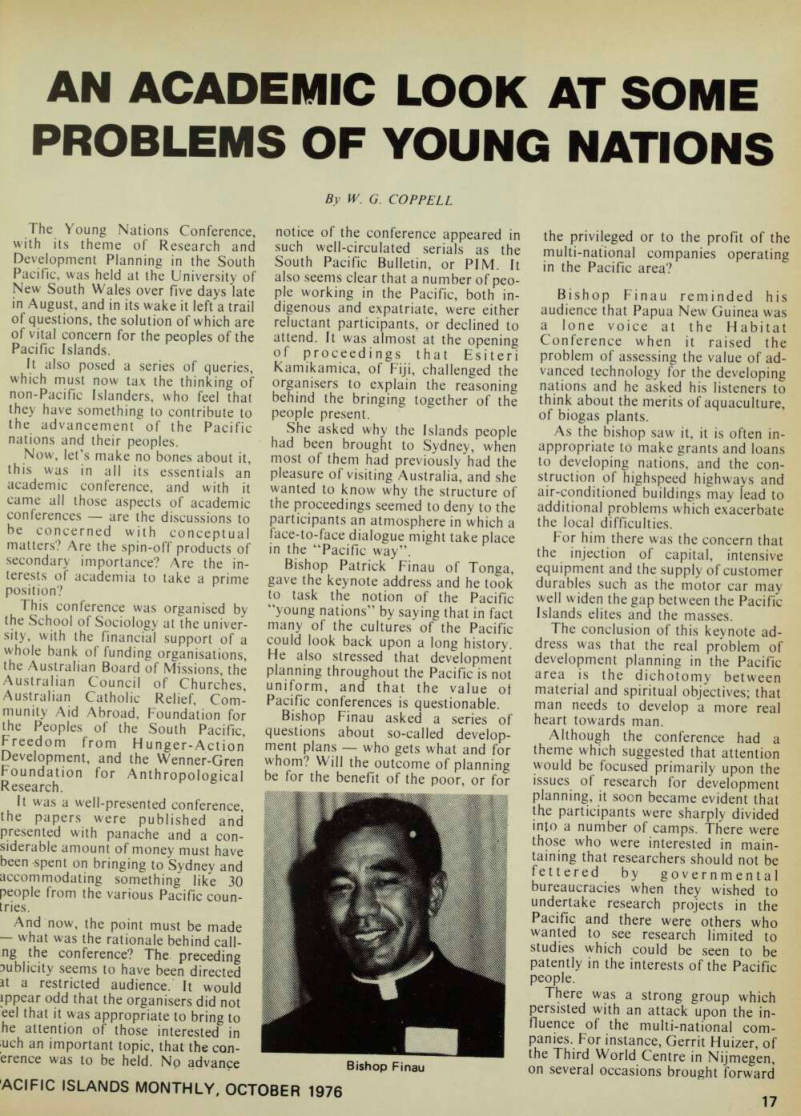
Bishop Patrick Finau of Tonga, gave the keynote address and he took to task the notion of the Pacific “young nations” by saying that in fact many of the cultures of the Pacific could look back upon a long history.
He also stressed that development planning throughout the Pacific is not uniform, and that the value ot Pacific conferences is questionable.
Bishop Finau asked a series of questions about so-called develop ment plans who gets what and for whom? Will the outcome of planning be for the benefit of the poor, or for
the privileged or to the profit of the multi-national companies operating in the Pacific area?
Bishop Finau reminded his audience that Papua New Guinea was a lone voice at the Habitat Conference when it raised the problem of assessing the value of ad vanced technology for the developing nations and he asked his listeners to think about the merits of aquaculture, of biogas plants.
As the bishop saw it, it is often in appropriate to make grants and loans to developing nations, and the con struction of highspeed highways and air-conditioned buildings may lead to additional problems which exacerbate the local difficulties.
For him there was the concern that the injection of capital, intensive equipment and the supply of customer durables such as the motor car may well widen the gap between the Pacific Islands elites and the masses.
The conclusion of this keynote ad dress was that the real problem of development planning in the Pacific area is the dichotomy between material and spiritual objectives; that man needs to develop a more real heart towards man.
Although the conference had a theme which suggested that attention would be focused primarily upon the issues of research for development planning, it soon became evident that the participants were sharply divided into a number of camps. There were those who were interested in main taining that researchers should not be fettered by governmental bureaucracies when they wished to undertake research projects in the Pacific and there were others who wanted to see research limited to studies which could be seen to be patently in the interests of the Pacific people.
There was a strong group which persisted with an attack upon the in fluence of the multi-national com panies. For instance, Gerrit Huizer, of the Third World Centre in Nijmegen, on several occasions brought forward
Bishop Finau
his perceptions of the influences ex erted by groups such as Unilever and Phillips and advocated an examina tion of the aspects of the scope of operations of multi-nationals in the Pacific.
Huizer also questioned the role of the breweries in Papua New Guinea, although several of the Papua New Guinea delegates were more in terested in the social effects of the growth of alcoholism, and some suggested that it might be useful to ex amine the replacement of the traditional pig-exchange system by a beer-exchange system.
It was more from the Islanders that a demand came to look into the value of much of the research which is carried out. Epeli Hau’ofa, of Tonga, said that, in his opinion, research for development was not only useless but in fact harmful. He considered there should be real research into exploita tion and corruption by the Pacific Islands’ elites and that the research should be carried out by Pacific Islanders, who would be able to make contacts with small, uncommitted groups outside the establishment.
He stated a position, which found support from many of the Islanders present, that, perhaps, the role of the local researcher would be to locate the centres of oppression and exploitation within the Island nations, with outside researchers being concerned with the identification of sources of exploita tion from outside influences. Stuart Kingan of the Cook Islands ad vocated the case for an extension of research into the physical sciences but there was a strong rebuttal of this by Cook Islander Marjorie Crocombe, who saw social issues as being of prime importance.
Stuart Kingan outlined a plan for the establishment of a television network throughout the Pacific.
While all the delegates praised the achievements in education of the use of radio transmissions through the Peacesat facilities, many were not prepared to support the early in troduction of mass television.
There was also an uneasiness about the role outside influences might be able to play through television programmes and a need for a very careful preparation of Islands people so that they would understand what the implications of the innovation were.
Lasarusa Vusoniwailala, of Fiji, pointed out that the introduction of
television would be an example of a concession to “comfort technology”, and he considered there was a real possibility of the introduction of television on a universal basis becom ing dysfunctional.
A most significant feature of the conference was the strong voice which came from the Pacific Islands women.
Boio Daro, of Papua New Guinea, was part of that voice when she main tained that television technology was beyond the resources of Papua New Guinea, because the mass of the peo ple lived outside town areas. She could see television as becoming a town-centres amenity. Boio also focused the attention of the par ticipants upon one of the basic dilem mas of the Pacific, that the more educated some Islanders become the less able they are to communicate with their own people.
One of the issues which eventually received a considerable airing was that of the feedback of research fin dings to the people most concerned.
Several delegates found fault with projects which had not reported back to the groups of people who had been the centres of research and a persis tent and vigorous plea was made for the establishment of information clearing-house facilities; a system of reporting back to people in straight forward terms, if necessary in the ver nacular languages.
Esiteri Kamikamica thought Island people should be able to establish research priorities in terms of needs of the people. In some instances, she said, governments may not in fact represent the real interests of the peo ple.
Esiteri felt that Pacific Islanders wanted to see worthwhile alternative solutions to problems made available.
She also considered that certain areas of research should be left for Pacific Islanders to deal with in “their own little way”, and she put a view,
supported by other Islanders, that perhaps there is often too much emphasis placed upon international, academic standards in the production of research documents. Again, as happened with other delegates, Esiteri returned to the question of com munication in the languages of the peoples under scrutiny. As she said “If I don’t know the language I am not good enough among my own people”.
In some ways this was a bewilder ing conference. Papers were presented at an almost breakneck speed. In some cases the authors read papers which had been previously dis tributed, some spoke to their papers, and there was even one instance where the speaker made virtually no reference to the matter within his paper.
One of the oddities about this con ference was that there seemed to be no real mechanism to bring to the notice of appropriate governmental or inter national organisations the findings and recommendations arrived at by the delegates.
The resolutions and recommen dations passed at the final plenary ses sion numbered 33 and although many of the items were sound and could be seen as having some effect upon decision-making processes, in other instances it was difficult to see what the practical outcome could be. Cer tainly, there is much to be worried about in relation to the situation of Islands communities in New Zealand, but it is not easy to see the practical outcome of a resolution, which was discussed “that Island migrants in New Zealand recognise their respon sibility to the metropolitan coun tries.” Or, how would a resolution “that the spread of Pacific elitism be halted and Pacific elites made more aware of the consequences of their policies and actions” be put into effect?
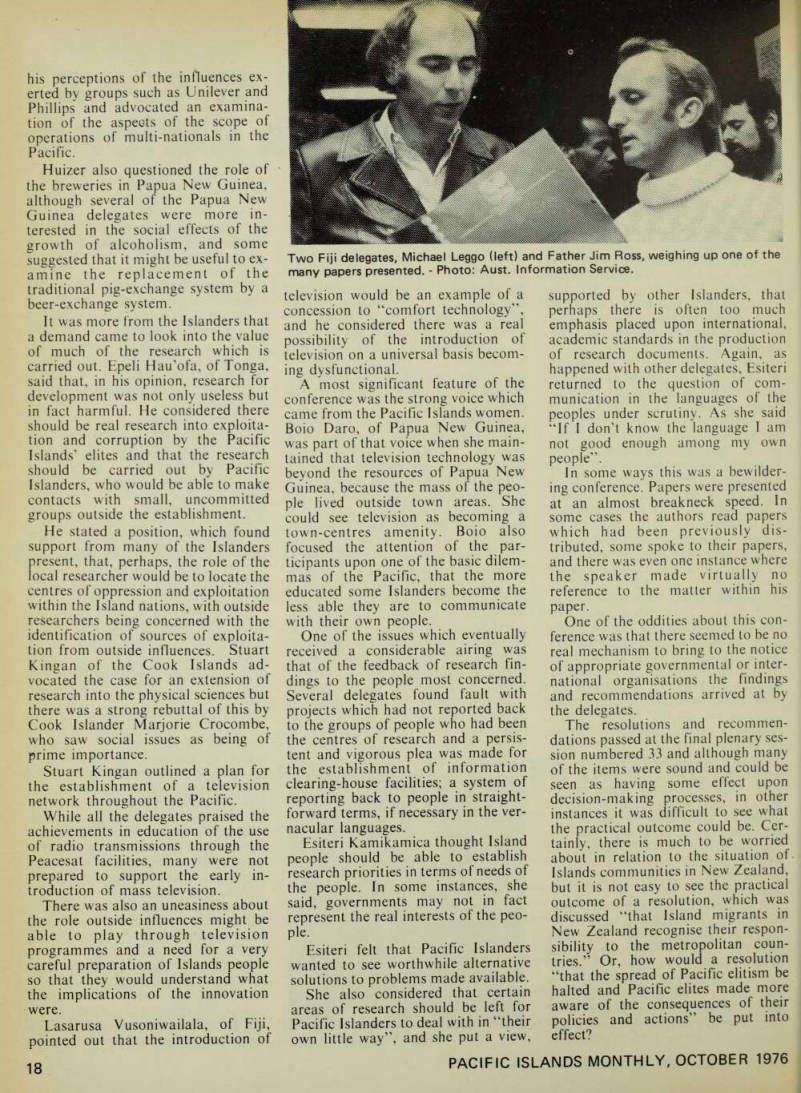
Two Fiji delegates, Michael Leggo (left) and Father Jim Ross, weighing up one of the many papers presented. Photo: Aust. Information Service.