the'i’in
pp. 14-15 · Read in the full issue
PNG dots the'i’in independence
From GUS SMA LES in Port Moresby Being yourself and making your own decisions are no doubt the things that matter when a country achieves independence after years of colonial status. But the activity which often gives the new nationalist his warmest glow is making sure that other people know all about his independence.
The urge to establish an identity and then project an image is one of the biggest side-issues involved in modern, new nation politics. It’s something which insists not only must you establish an identity, but the rest of the world must be made aware that such an identity exists.
The result is often an almost ar tificial adoption of ideas and attitudes and customs. Many of them, no doubt, existed incipiently, others are sought out and enthroned with painstaking care, and some are down right invented.
Relationships which a long established nation may often have stopped thinking about become major issues, and the whole new national community gets caught up in the game.
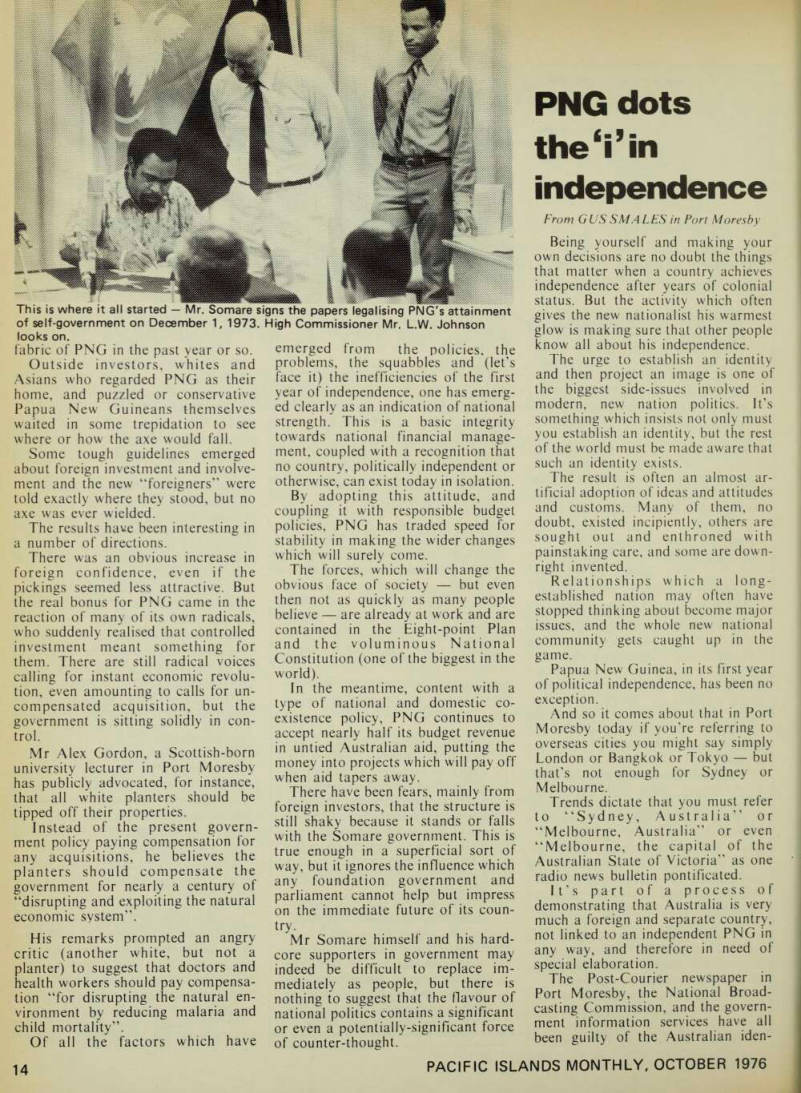
Papua New Guinea, in its first year of political independence, has been no exception.
And so it comes about that in Port Moresby today if you’re referring to overseas cities you might say simply London or Bangkok or Tokyo but that’s not enough for Sydney or Melbourne.
Trends dictate that you must refer to “Sydney, Australia’’ or “Melbourne, Australia’’ or even “Melbourne, the capital of the Australian State of Victoria” as one radio news bulletin pontificated.
It’s part of a process of demonstrating that Australia is very much a foreign and separate country, not linked to an independent PNG in any way, and therefore in need of special elaboration.
The Post-Courier newspaper in Port Moresby, the National Broad casting Commission, and the govern ment information services have all been guilty of the Australian iden
tification game to a greater or lesser degree.
Air Niugini, too, was, at one stage, advertising flights to “Brisbane, Australia” just across the border, and to “Manila” two countries away.
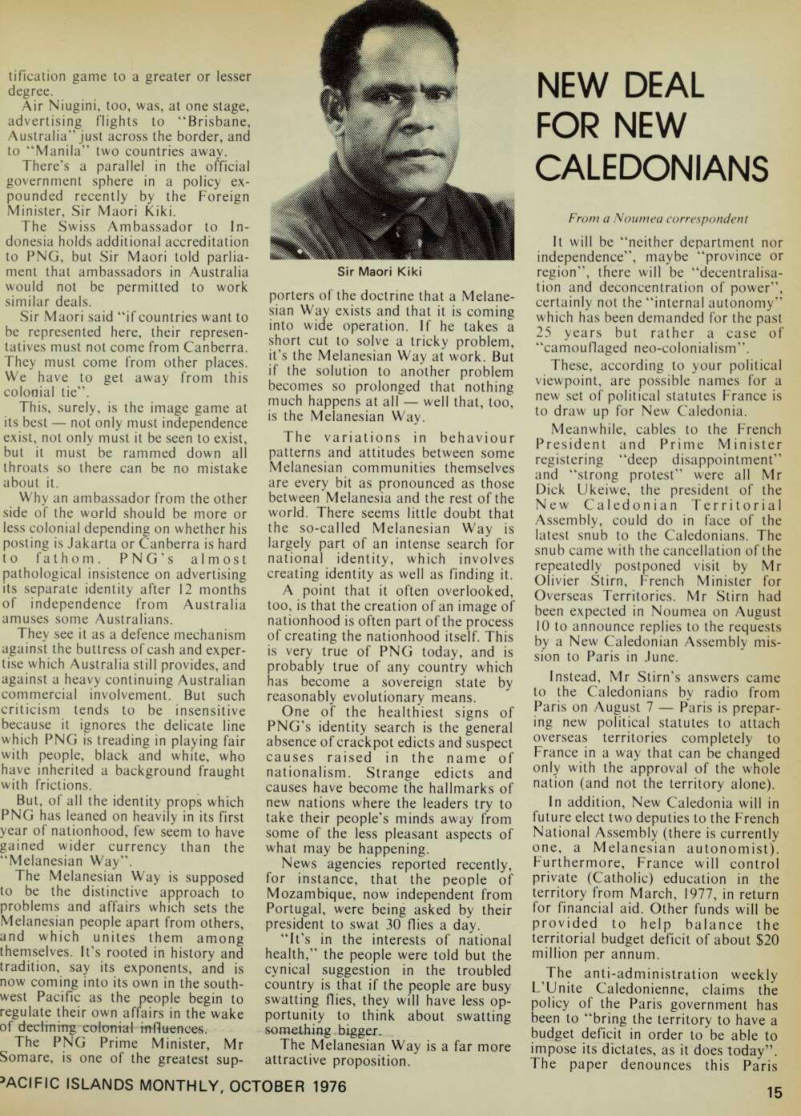
There’s a parallel in the official government sphere in a policy ex pounded recently by the Foreign Minister, Sir Maori Kiki.
The Swiss Ambassador to In donesia holds additional accreditation to PNG, but Sir Maori told parlia ment that ambassadors in Australia would not be permitted to work similar deals.
Sir Maori said “if countries want to be represented here, their represen tatives must not come from Canberra.
They must come from other places.
We have to get away from this colonial tie”.
This, surely, is the image game at its best not only must independence exist, not only must it be seen to exist, but it must be rammed down all throats so there can be no mistake about it.
Why an ambassador from the other side of the world should be more or less colonial depending on whether his posting is Jakarta or Canberra is hard to fathom. PNG’s almost pathological insistence on advertising its separate identity after 12 months of independence from Australia amuses some Australians.
They see it as a defence mechanism against the buttress of cash and exper tise which Australia still provides, and against a heavy continuing Australian commercial involvement. But such criticism tends to be insensitive because it ignores the delicate line which PNG is treading in playing fair with people, black and white, who have inherited a background fraught with frictions.
But, of all the identity props which PNG has leaned on heavily in its first year of nationhood, few seem to have gained wider currency than the “Melanesian Way”.
The Melanesian Way is supposed to be the distinctive approach to problems and affairs which sets the Melanesian people apart from others, and which unites them among themselves. It’s rooted in history and tradition, say its exponents, and is now coming into its own in the south west Pacific as the people begin to regulate their own affairs in the wake of declining colonial influences.
The PNG Prime Minister, Mr Somare, is one of the greatest sup-
porters of the doctrine that a Melane sian Way exists and that it is coming into wide operation. If he takes a short cut to solve a tricky problem, it’s the Melanesian Way at work. But if the solution to another problem becomes so prolonged that nothing much happens at all well that, too, is the Melanesian Way.
The variations in behaviour patterns and attitudes between some Melanesian communities themselves are every bit as pronounced as those between Melanesia and the rest of the world. There seems little doubt that the so-called Melanesian Way is largely part of an intense search for national identity, which involves creating identity as well as finding it.
A point that it often overlooked, too, is that the creation of an image of nationhood is often part of the process of creating the nationhood itself. This is very true of PNG today, and is probably true of any country which has become a sovereign state by reasonably evolutionary means.
One of the healthiest signs of PNG’s identity search is the general absence of crackpot edicts and suspect causes raised in the name of nationalism. Strange edicts and causes have become the hallmarks of new nations where the leaders try to take their people’s minds away from some of the less pleasant aspects of what may be happening.
News agencies reported recently, for instance, that the people of Mozambique, now independent from Portugal, were being asked by their president to swat 30 flies a day.
“It’s in the interests of national health,” the people were told but the cynical suggestion in the troubled country is that if the people are busy swatting flies, they will have less op portunity to think about swatting something bigger.
The Melanesian Way is a far more attractive proposition.
Sir Maori Kiki